
Takeaways
- Contrary to common belief, the canter is a four-beat gait, while the ordinary gallop is a five-beat gait (four hoofbeats followed by a period of suspension). Understanding these beats is critical for precision riding, as it helps determine the optimal moment to apply aids.
- The primary factor in generating a horse’s speed is the propulsive power of the hindquarters and back muscles, which extend the stifle and hock joints and flatten the spine.
- The primary determinant of speed in mammals is not the length of the limbs or height at the withers, but rather the flexibility of the spine (the ability to coil and uncoil the loins).
Click here for Part 1: 13 Rules of Equine Movement
Click here for Part 2: The Equine Walk: “Mother of All Gaits”
Click here for Part 3: How the Trot & Pseudo-Trot Affect the Equine Hoof
Click here for Part 4: The Spectrum of Ambling Horse Gaits
Click here for Part 5: Disarticulating the Horse’s Canter
Readers who have been following this series have learned that all the gaits in which horses move can be analyzed and understood through study of film and still photographs that capture the motions of the four legs and the oscillating spine.
Film analysis is especially useful in the multi-million-dollar racing industry because a sequence of still photos “freezes” the coordination between the legs and back, revealing which horses are clumsy, lame, or crooked, and which are much more likely to be winners.
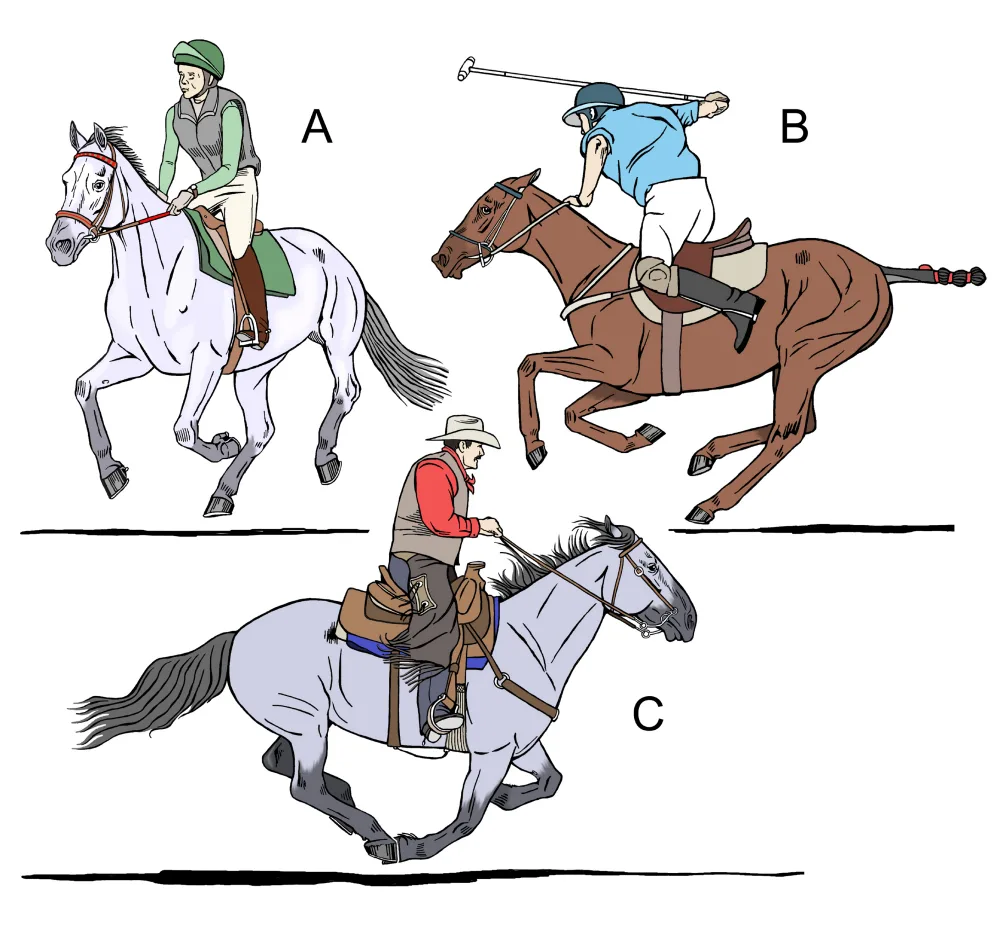
In our last installment, we disarticulated the canter and in this one, we build upon that to understand the gallop. The two gaits are similar in that both are asymmetrical and thus can be performed on either a right or left lead. However, the canter is slower and daintier, historically a ladies’ gait and today seen universally in both “rail shows” and dressage. The gallop, by contrast, is the gait of the war horse, polo horse, jumper and racehorse (Figure 1); utilizing its coordination, the horse can achieve its maximum potential speed.
Canter vs. Gallop
Let’s begin by considering the differences between canter and the two forms of gallop. We hear so often the incorrect information that the canter is a “three-beat gait.” It comes as a surprise to find that when the “music” of canter is written (Figure 2), it turns out to have four beats to the measure. The “three-beat” idea derives from the fact that people tend to ignore the period of suspension (silence) that follows three hoofbeats that sound in the canter. But ignoring the period of suspension is not helpful, for it is during or just before this beat that aids are best given. Precision riding is only possible when the rider knows the best moment to apply aids and realizes when that moment is going to come along.
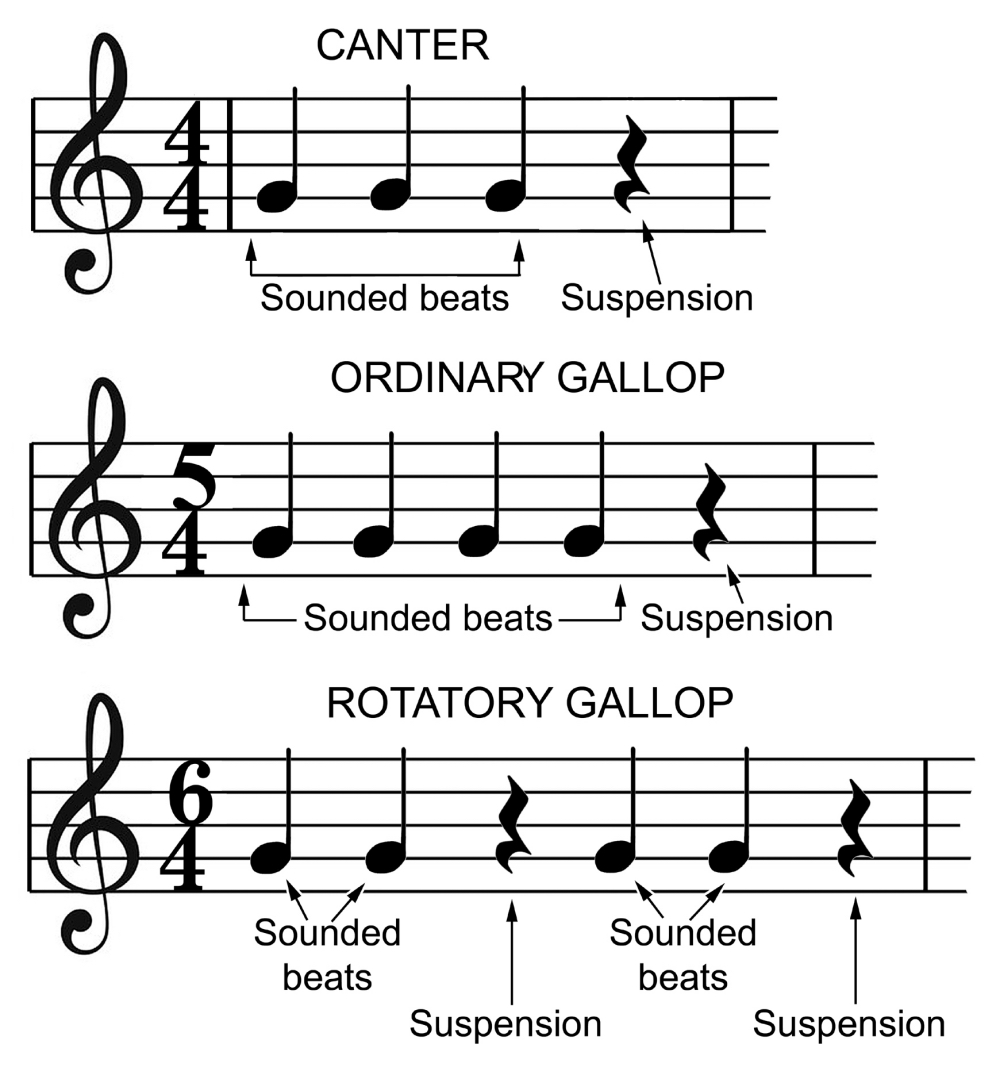
Figure 2: Musical notation comparing the canter, ordinary gallop and rotatory gallop. The latter is also sometimes called the “double suspension” gallop, as there are two periods of suspension instead of merely one. Note how the time signature changes to reflect the number of beats (sounded + unsounded) per measure. Suspension constitutes 25% of the canter, 20% of the ordinary gallop and 25% of the rotatory gallop. In real life, the period of suspension is usually shorter than any of the sounded beats, but horses that double it in the rotatory gallop are nonetheless at significant advantage. Image: Dr. Deb Bennett
Musical notation, as well as film analysis, prove that the canter is a four-beat gait. How does the gallop differ? The ordinary gallop, which we find 95% of horses using, is a five-beat gait — four sounded beats followed by a period of suspension (Figure 2). The footfall order in the ordinary gallop (for example on a right lead as shown in Figure 7) is left hind, right hind, left fore, right fore, suspension.
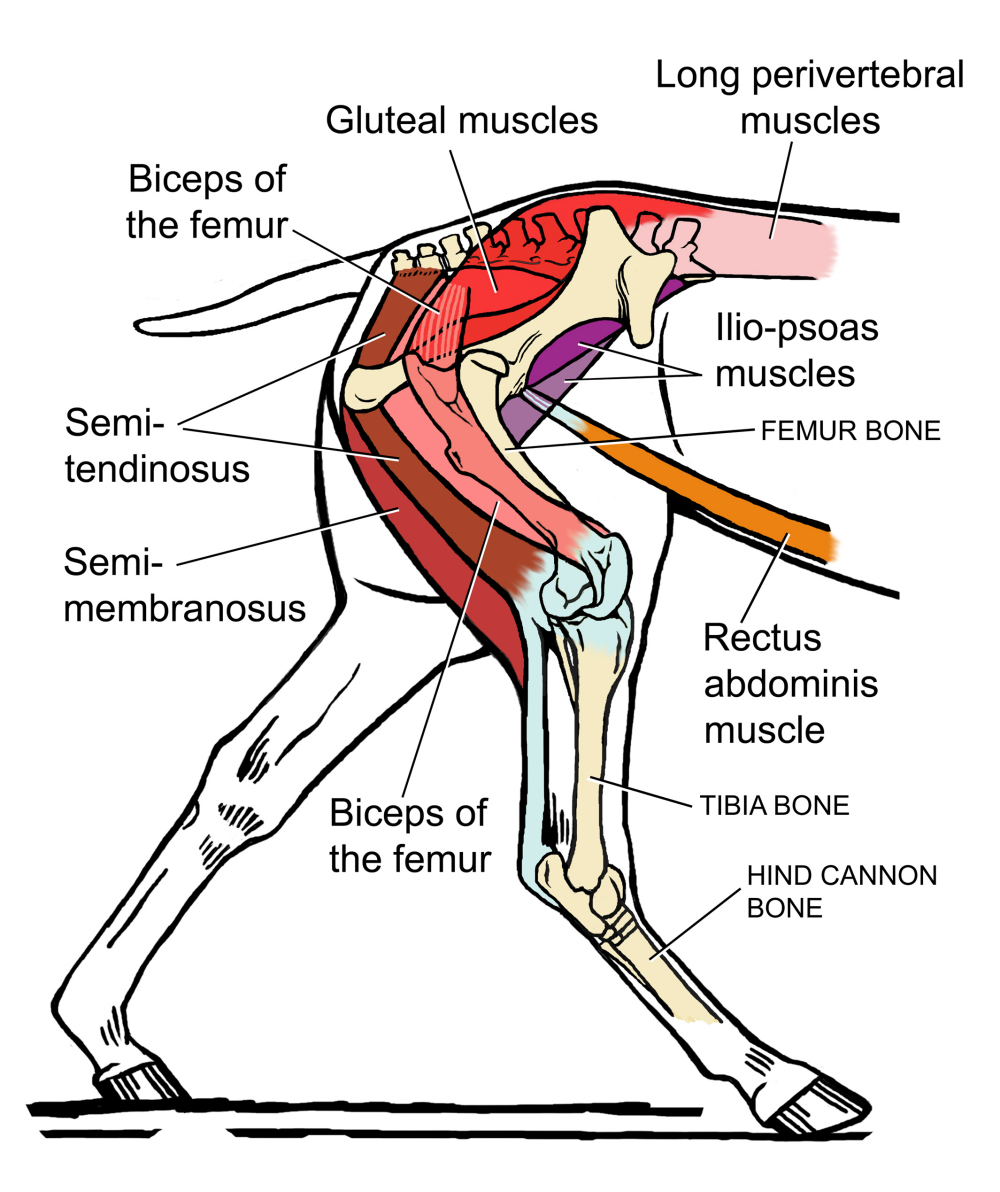
Figure 3: Muscles that coil and uncoil the loins and retract the hind limb. Contraction (shortening) of the iliopsoas and rectus abdominis muscles coils the loins. The rectus abdominis is palpable in the living horse, but the iliopsoas is difficult to access because it lies deep within the body cavity. Contraction of the long perivertebral muscles — mainly the longissimus dorsi muscle — acts to uncoil (extend) the back; this is the single most important part of the horse’s power stroke, reflected in the fact that the longissimus dorsi (the main perivertebral muscle) is the largest single muscle in the body.
The hind limb is swung backward (retracted) by contraction of the gluteal, biceps, semitendinosus and semimembranosus muscles. Note that the long perivertebrals and gluteals both anchor toward the horse’s head and they wrap around the top of the pelvis and femur. This drawing poses the horse at the moment of contact of the right hind hoof with the ground: contraction of the retractor muscles, no matter how powerful, can produce propulsion ONLY when the hoof is in contact with the ground. Image: Dr. Deb Bennett
The gallop is faster than the canter because when galloping, the horse exerts maximum effort with the propulsive muscles of the haunches and back (Figure 3). During propulsion, these muscles act to open or extend the stifle and hock joints, swing the femurs back, and extend and flatten the back (uncoil the loins). Effort of the hindquarters is the most important factor in generating speed, but an important way in which the gallop differs from the canter is that retraction of the forelimb adds significantly to the overall propulsive effort (Figure 4).
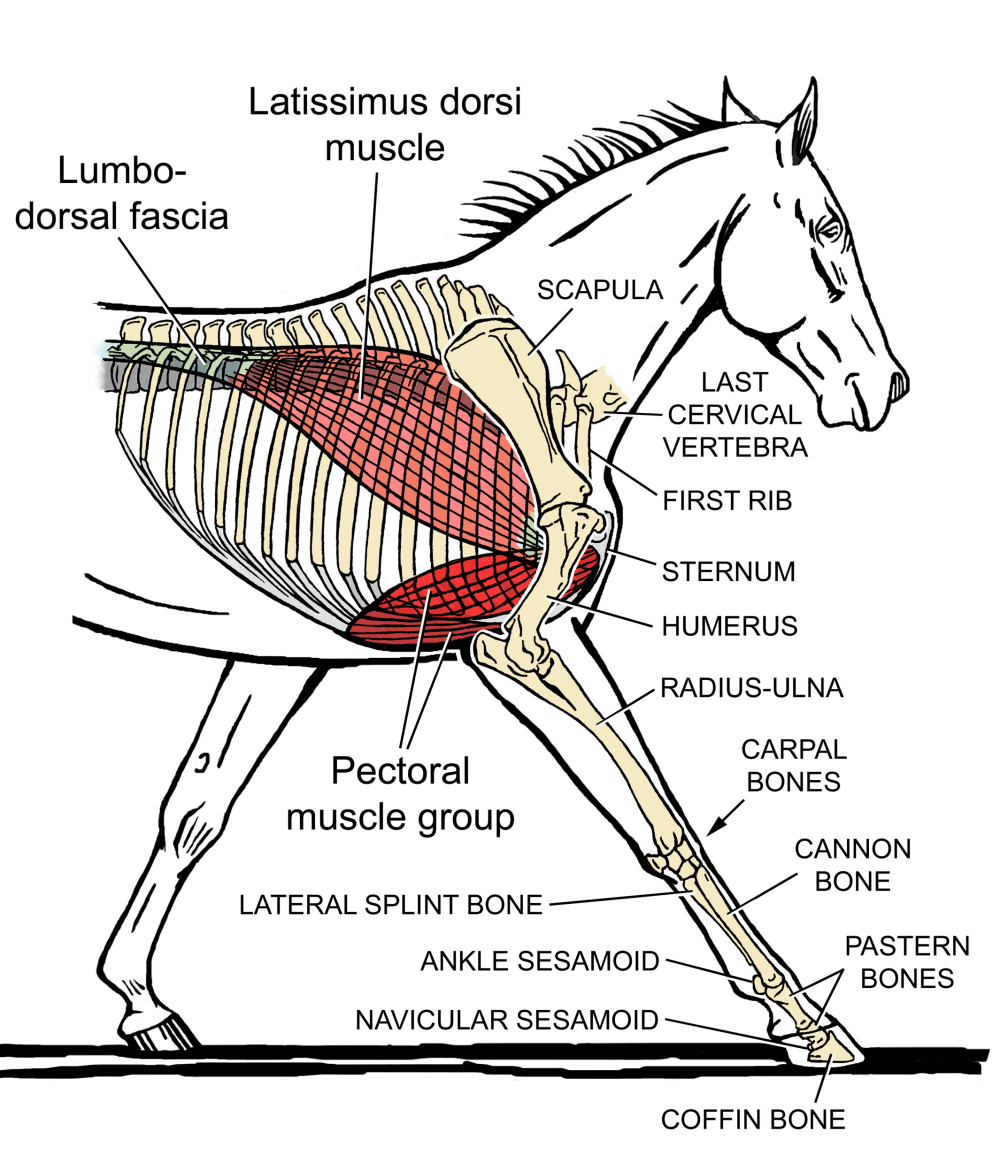
Figure 4: In the gallop, part of the propulsive power comes from retraction of the forelimbs. There are only two muscle groups important in producing this. The main one is the latissimus dorsi, which anchors behind on the lumbo-dorsal fascia (blue) and travels obliquely over the rib cage to attach by a strong tendon to the medial side of the humerus. The pectoral group, three muscles that originate on the sternum and insert on the humerus, is also important. Other muscles, including the cervical rhomboideus, cervical trapezius, and cervical serratus, are of minor importance and not shown. As in the hind limb, the muscles draw the limb back when they contract (get shorter from end to end). Contraction of the retractor muscles of the forelimb can only result in forward propulsion of the body when the fore hoof is in contact with the ground. Image: Dr. Deb Bennett
As we have mentioned throughout this series, per the laws of physics, propulsion only happens when hooves — either hind or fore — are in contact with the ground. A horse that forcefully swings its hind hooves back, yet does not have them in contact with the ground, is kicking — beating the air — but that will get it nowhere in a race.
Similarly, the forelimbs cannot add to propulsive effort if they do not make firm contact with the ground. The surest way to maximize forelimb contact, both in terms of duration and in terms of weight, is to build the horse “downhill” or (looked at the other way around), “high behind.” History’s most successful racehorses are all built this way.
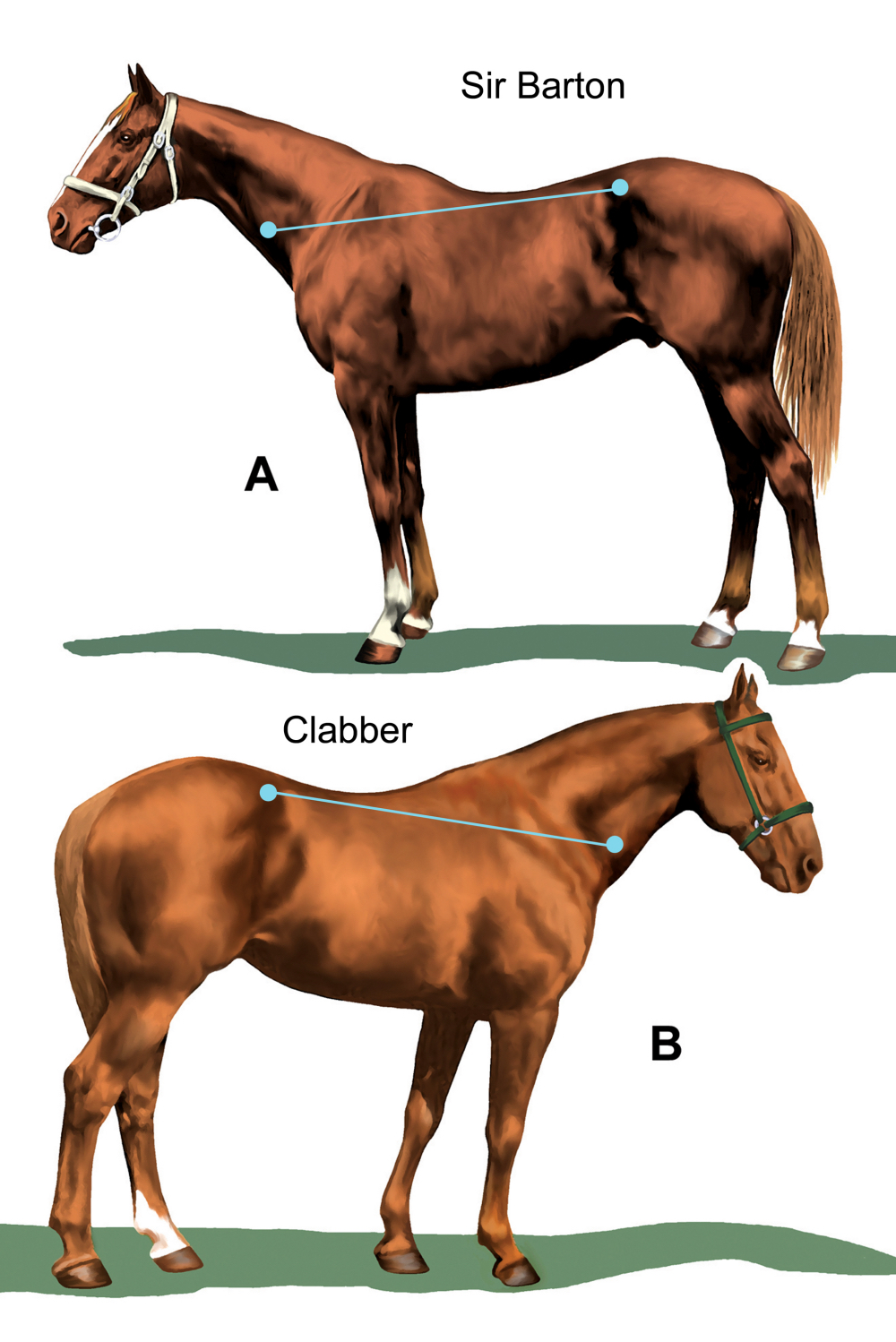
Figure 5: Conformation studies of two champion racehorses. A, Sir Barton, the first Triple Crown winner (1919). He ran the Kentucky Derby (1.25 miles) in 2:09.80 = 34.67mph; the Preakness ( 1 1/8th miles) in 1:53:00 = 35.84mph; and the Belmont Stakes (1 3/8ths mile) in 2:17.40 = 36.03mph. B, Clabber, Quarter Racing Association World Champion Running horse for the 1940-1941 season. Clabber became famous for winning performances in match races. In a 1941 contest against Parker’s Chicaro, he covered 350 yards (1.6 furlongs) in 18.4 seconds = 38.91 mph. The blue line in the images marks overall body balance. In Sir Barton (the “stayer” or “classic distance horse”), the line goes down 6.5 degrees from the core of the loins to the base of the neck, whereas in the sprinter Clabber, it goes down 9.0 degrees. The shorter the distance over which a racehorse is intended to compete, the more downhill he should be built. Image: Dr. Deb Bennett
There are two general types of flat-track racehorses, sprinter and classic-distance horses (Figure 5). Since sprint races are short, from 2-4 furlongs, the animal must be capable of an explosive start and must achieve top speed quickly — conditions that tend to cause the forehand to rise, lighten, or “fly up” (Figure 6). This gives rise to the general truism that the shorter the distance over which the horse is to race, the more downhill it must be built. This is borne out in general by the chest-heavy conformation of Quarter Horses, whose races are sprints of 2 furlongs vs. the more horizontal body balance typical of Thoroughbreds, which historically have been bred for half-mile to 4-mile coursing.
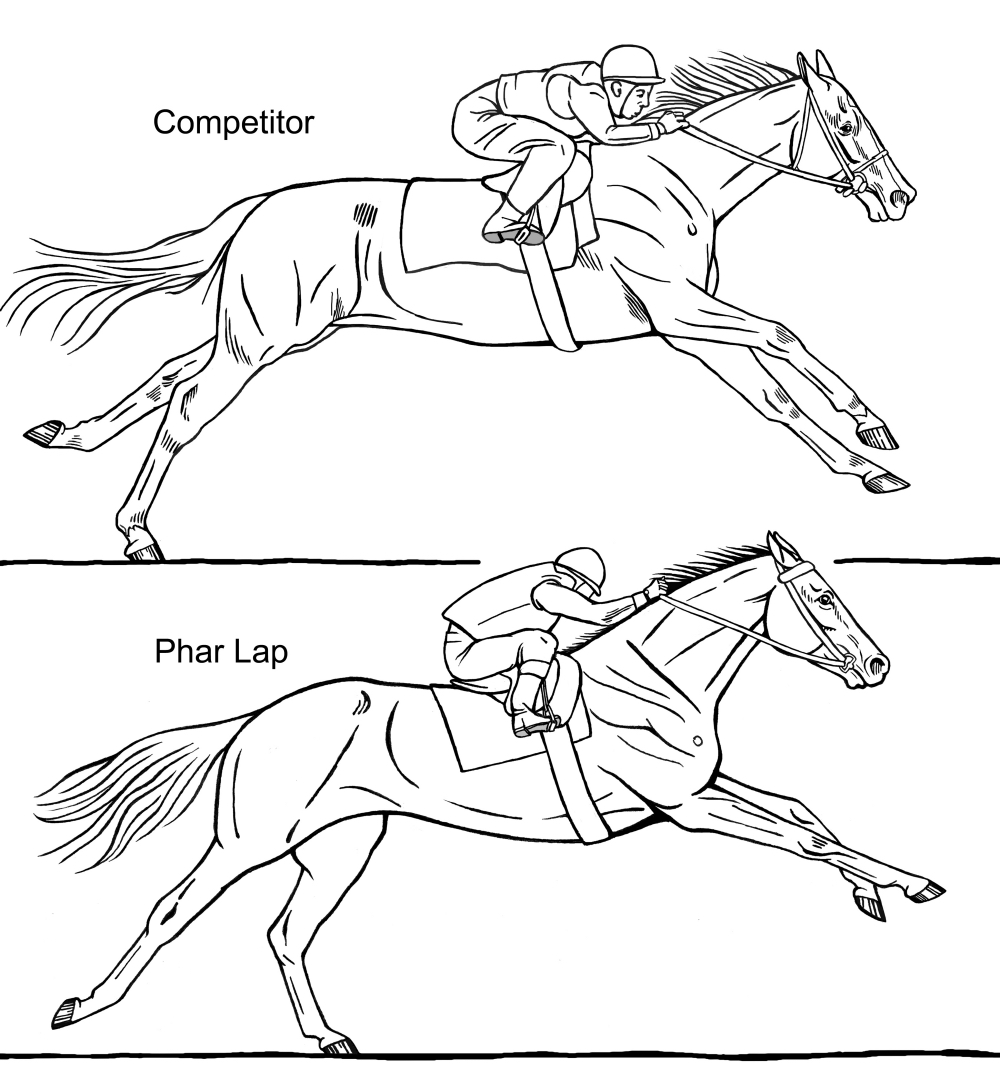
Figure 6. Two classic distance Thoroughbreds as they spring forward out of the starting gate. Below is the New Zealand-bred Phar Lap, a champion during the 1920’s; the other horse is an anonymous competitor. Notice that Phar Lap’s exceedingly powerful hind thrust has caused him to “fly up” in front; he was notorious for doing this, and it was partly because his conformation verged on that of a riding horse rather than a racehorse, with near-level overall body balance. “Flying up” is not particularly desirable in a racehorse unless he can make up for the air resistance that it creates in some other way. Whereas “flying up” is not desired at the track, the very same effect — lightening the forehand — is highly desirable when the context is dressage, mounted bullfighting, working cow horse, or anywhere else that agility is at a premium. We will go into this in an upcoming installment. Image: Dr. Deb Bennett
The World’s Fastest AnimalAs Figure 2 indicates, there are two forms of gallop, ordinary and rotatory. The ordinary gallop (Figure 7) is spontaneously performed by most equines, including asses, onagers and zebras. It’s utilized by all kinds of domestic horses — those working on range and polo horses, as well as jumpers, steeplechasers and eventers, enduro competitors and “general purpose” horses belonging to amateur owners. A tiny minority of elite-class racehorses, however, show the capability for rotatory gallop (Figure 8).
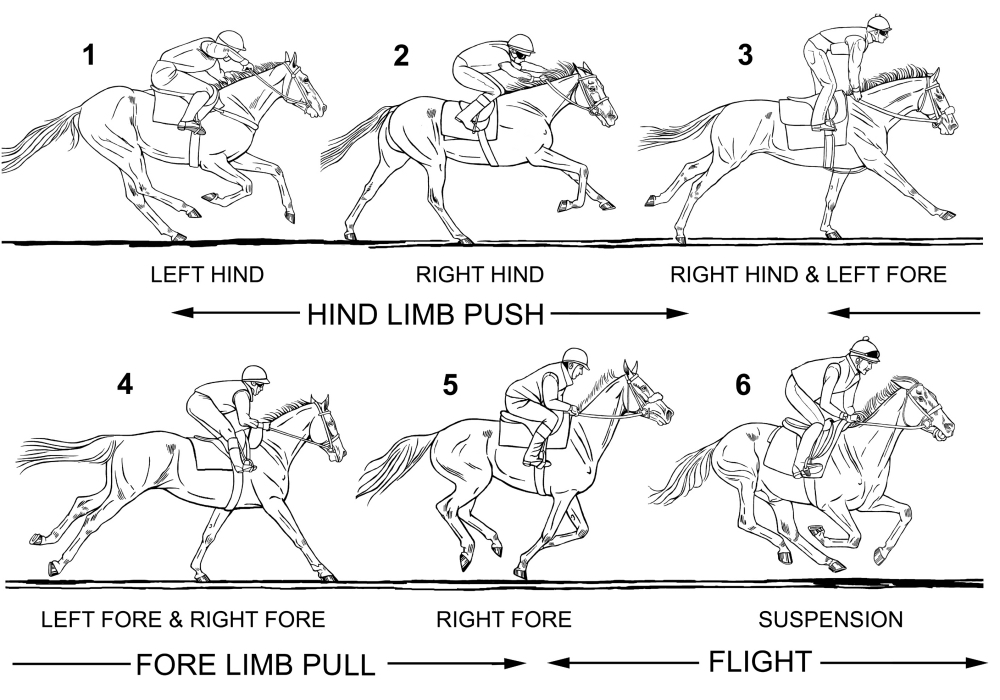
Figure 7. A composite sequence for the ordinary gallop, made up of images of six different horses caught by the camera in different phases of the gait. The phases exactly match those captured by Muybridge in 1876, who filmed a single horse through all phases. Note that hind limb push occupies frames 1 through 3, while forelimb pull goes on during frames 3 through 5. It is important that in an ordinary gallop, the period of suspension during which no feet are in contact with the ground always occurs after the period of forelimb pull. This fact has important implications for the way horses are typically trimmed and shod for racing, something we will investigate in detail in our next installment. Image: Dr. Deb Bennett
The power coming from the hindquarters in an ordinary gallop propels the horse’s body forward in an arc with such force that the diagonal pair, which would have been coupled in a canter, becomes de-coupled so the forehoof belonging to this pair lands late. So, the footfall order changes from that of a canter; instead of left hind, right hind plus left fore, right fore, suspension, the order becomes left hind, right hind, left fore, right fore, suspension. In other words, the ordinary gallop goes from hindlimbs to forelimbs as hind-hind, fore-fore, suspension. Note that in the ordinary gallop, the period of suspension always follows the propulsive effort of the forelimbs.
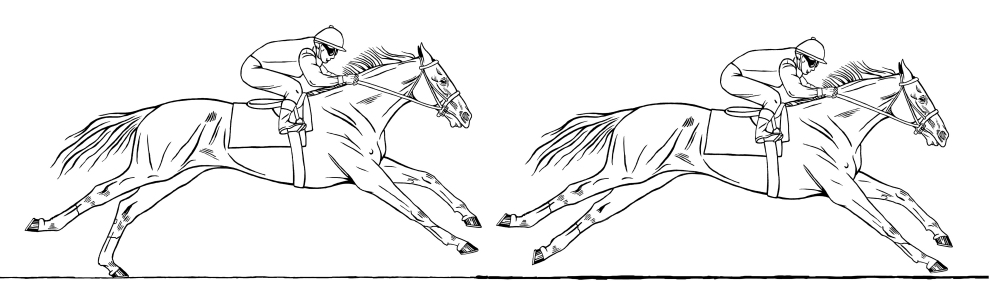
Figure 8: To change an ordinary gallop into a rotatory gallop, just insert these two images between frames 2 and 3 of the preceding sequence. The images in this figure are of Secretariat. Image: Dr. Deb Bennett
A horse that produces a rotatory gallop is generating extraordinary propulsive power, specifically with the muscles of the hindquarters and back. The animal is pushing so hard with the hind hooves that this effort alone is sufficient to create a brief period of suspension (Figure 8).
The footfall order in a rotatory gallop is thus: hind, hind, suspension, fore, fore, suspension – a gait consisting of six beats, including two periods of suspension per stride, as charted in Figure 1. This is why the rotatory gallop is sometimes called the “double suspension” gallop. The animal producing it can be seen in a characteristic posture, flying through the air with hindlimbs stretched far to the back and forelimbs reaching far forward (Figure 8). In old paintings, this was the “conventional” way to represent a galloping horse. While this posture is not common, it’s not false or inaccurate either, at least when representing the fastest horses.
My survey of racehorse galloping technique indicates that few horses, probably fewer than 5% of all that have competed on American racetracks, are capable of rotatory gallop. Even those horses may use it only at times of peak effort. The list of famous racehorses caught by the camera in a rotatory gallop includes the great Man o’ War (champion in the early years of the 20th century); Dr. Fager (1968 Sprinter of the Year and Turf Horse of the Year); Secretariat (Triple Crown winner 1973); American Pharoah (Triple Crown winner 2015) and Justify (Triple Crown winner 2018).
Forward speed in miles per hour is always greater over shorter distances, so Dr. Fager’s top speed was about 39 mph, and a mare called Winning Brew is on record as having run a two-furlong race in 2008 in 20.57 seconds, equivalent to 43.97 mph. This is the greatest forward speed recorded for any racehorse.
Nonetheless, “classic distance horses” come close. American Pharoah ran the 1½ -mile Belmont in 2:26.25, which is an average speed of just shy of 37 mph. In 1989, Hawkster set a longstanding record for this distance at Santa Anita Park in 2:22.80, just over 37 mph. The fastest classic-distance horse of all time is the great Secretariat, who holds the record for the fastest time in all three legs of the Triple Crown. In 1973, he ran the Kentucky Derby in 1:59.40 (37.6 mph), the Preakness in 1.53.00 (37.83 mph) and the Belmont Stakes in 2:24.00 (37.5 mph).
Impressive as these horses are, their speed is nothing compared to that of the world’s fastest hoofed mammal, the American pronghorn antelope. Pronghorns have been clocked doing 61 mph in short bursts and can maintain a speed of 40 mph for several miles, a feat of endurance that no horse can equal. We can also note that horses are not even the fastest of equines. The (now probably extinct) Somali wild ass was clocked at 49 mph, and like the pronghorn, could maintain 40 mph for several miles.
As to covering ground at speed, 4 miles is about the maximum that a herd of mustangs can manage before needing to stop for air. This matches historical maximum race-course distances. The original contests for Thoroughbreds, called “King’s Plate races” because King Charles II of England himself sponsored and wrote the rules for them, were run in heats — generally three heats of 4 miles each, all run in a single morning. There are no such races today; the greatest and almost the last American heat-racer was the redoubtable Lexington, who as a 5-year-old in 1855 set a record at Metairie Race Course in New Orleans of 7:19.75, averaging 32.75 mph.
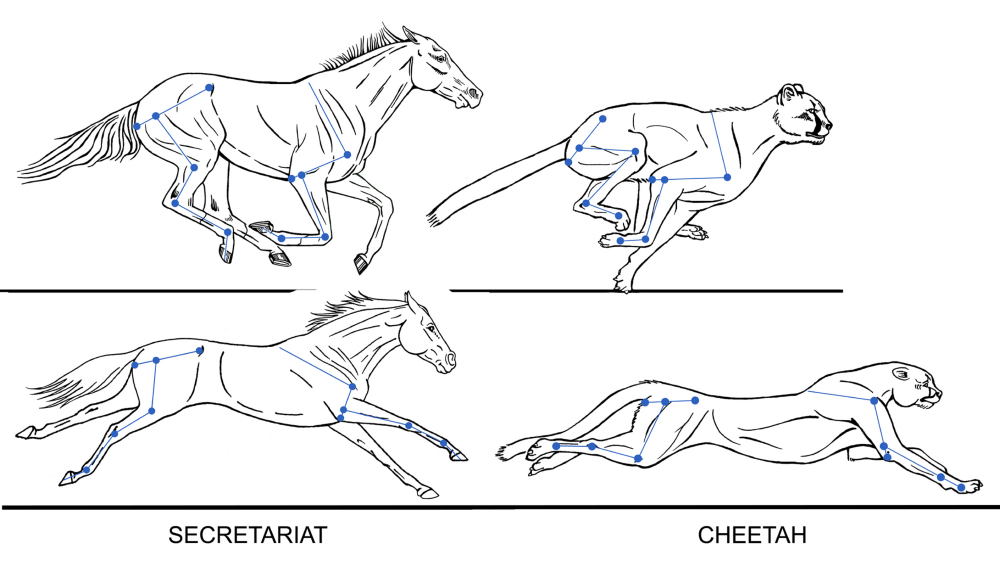
Figure 9: Secretariat compared with a cheetah: The cat can go twice as fast as even the greatest racehorse, not because he is taller but because cats have much more flexible backs than horses. The difference in Secretariat between maximal coiling of the loins (as measured by pelvic angle) is 17 degrees; in the cheetah it is 49 degrees. Image: Dr. Deb Bennett
The elegant pronghorn beats even the fastest equines, but itself is topped by the world’s fastest mammal, the cheetah (Figures 9-11). Standing no higher than 36 inches (9 hands) at the withers, cheetahs can achieve a top speed of 75 mph for short bursts and can go from zero to 75 in 3 seconds flat. In short, the cheetah, which stands a third shorter at the withers than the average 16-hand racehorse, can go almost twice as fast.
The biomechanical key to this is the structure of the lumbar vertebrae (Figures 10-11). In horses, the vertebral bodies are short from front to back and the wing-like transverse processes are wide enough that those pertaining to the last three or four lumbars meet edge to edge, forming intertransverse articulations. Further, in horses, the articular processes are broad and vertically oriented. These features strictly limit lumbar flexibility in horses to coiling and uncoiling, i.e., flexion and extension in the up-down plane. Not only is spiraling or rolling motion forbidden by the architecture of the horse’s lumbar vertebrae, but it’s also dangerous, as a sharp twist may fracture articular processes, resulting in paralysis and death.
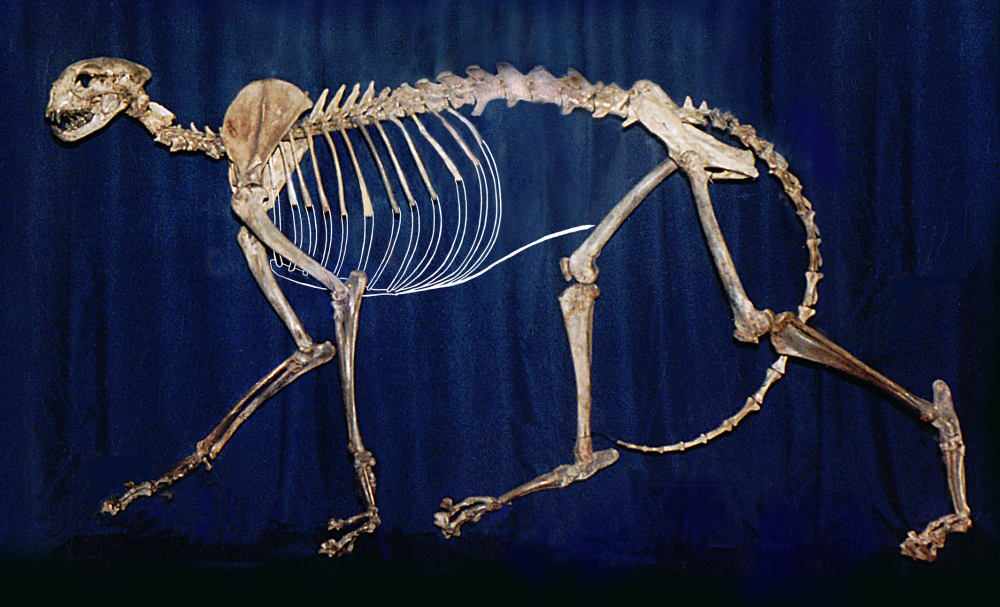
Figure 10: During the last Ice Age, lions, camels, rhinoceroses and also cheetahs lived in North America. This skeletal mount of Miracinonyx trumani, on display at the University of Kansas Museum of Natural History, shows that the American cheetah had much the same skeletal adaptations for speed as the living African Acinonyx jubatus. Note the long lumbar span but short ribcage, typical of both cats and dogs. For aerodynamic reasons, cheetahs have small heads. They also have proportionally long limbs, but overall stand only about 9 hands at the withers, less than two-thirds the height of the average racehorse — yet can run 75 mph. Image: Dr. Deb Bennett
Anatomical constraints are eased in the pronghorn. Its lumbar vertebrae are individually longer and its transverse processes narrower, so that no intertransverse articulations are formed. The “loosest” lumbar design of all is that found in the cheetah, where the lumbar bodies are long, the transverse processes are mere chevrons and the articular processes spread into wide “V” shapes. Not only that, there are seven lumbar vertebrae but only 13 pairs of ribs, so the lumbars as a group comprise over 50% of the length of the back (Figure 10). In horses, by contrast, the design incorporates 18 pairs of ribs and the lumbar span is comparatively compact, making up only about 30% of total spinal length from base of neck to sacrum.
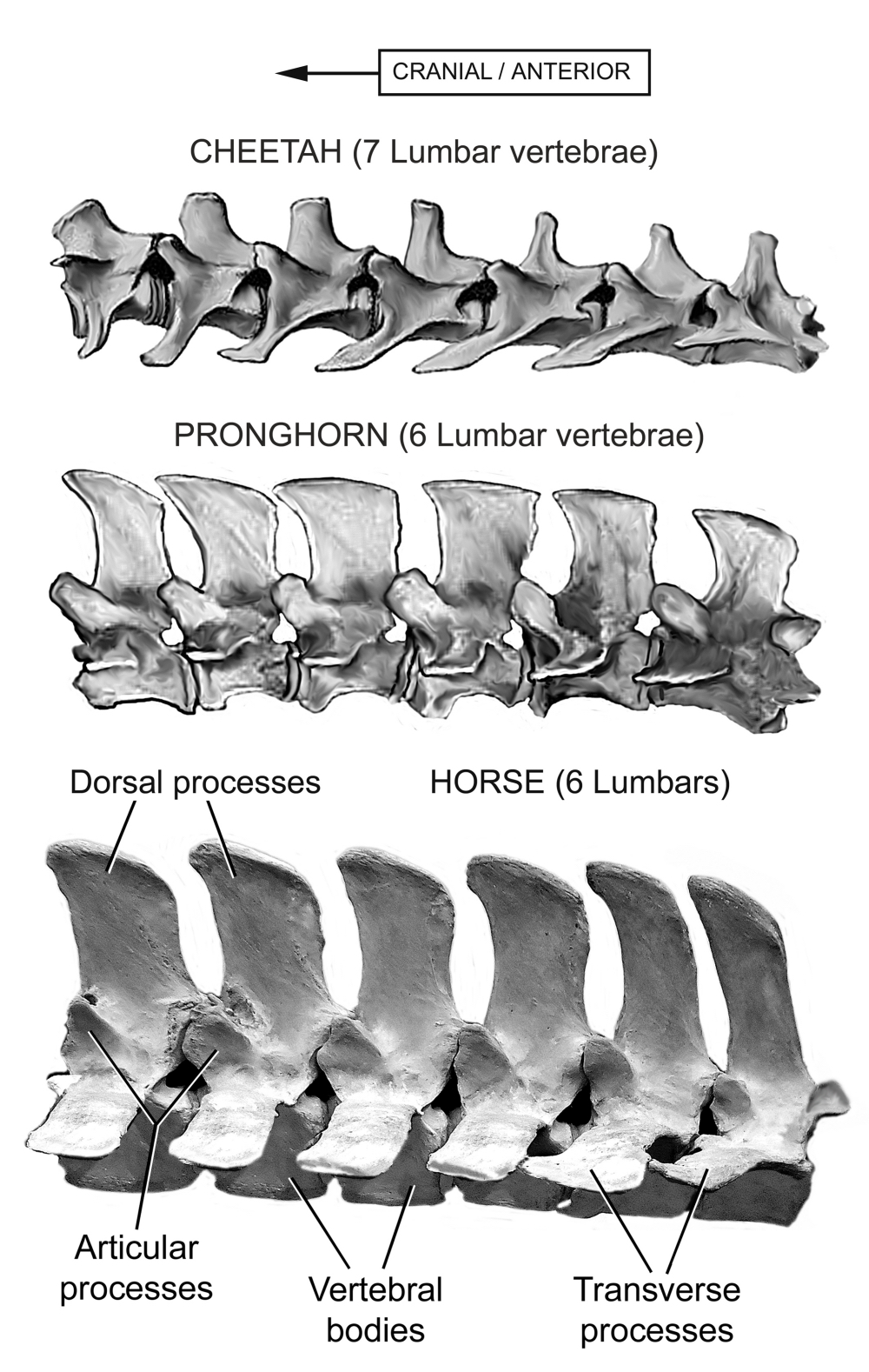
Figure 11. Lumbar vertebrae of cheetah, pronghorn and horse compared. See text for explanation. The cheetah has, by far, the most flexible lumbar joints and can thus coil its loins the most. Image: Dr. Deb Bennett
The ability to coil and uncoil the loins, so that the coiled position angles the pelvis downward while the extended position brings it to near level, is shown in Figure 9. While Secretariat achieves 17 degrees of difference between coiled and extended pelvic positions, the cheetah produces an astonishing 49 degrees of difference. So deeply can a cheetah coil its loins that the camera may catch moments when the animal’s hind paws are ahead of its nose. Some fast dogs can do this too, but no horse, not even the best and greatest, can come close. What we learn from comparison of the spinal structure in horses, pronghorns and cheetahs is that the primary determinant of speed is not limb length (or withers height); it is spinal flexibility.
Learn to Pick & Train Winners
Racehorse breeders and trainers who want to produce winners need to cotton on to this and stop the silly effort to breed horses that are merely taller. The thought is that a horse that’s 2 inches taller than any of its competitors will take fewer strides over a course of a mile. But the total gain is mere inches, while the disadvantages imposed by increasing the height of the horse are many.
Remember, a horse is a three-dimensional object, so that increase in height means more than a proportional increase in weight, because while height increases linearly, weight goes by the cube function. More than proportional increase in the diameter of cannon bones will also be required. A racehorse weighing 1,100 lbs. needs 7½ inches of “bone” per 1,000 lbs. of weight = 8.25 inches of “bone” as taped just below the knee. This is rare enough. Most racehorses do not come up even to this standard.
Consider then that if we increase the height of the horse to 17:1 hands, it will then weigh about 1,350 lbs. and would require 10.15 inches of “bone”. A few Warmbloods can present this much bone, but no racehorses that I know of. How much simpler and surer to train racehorses to use their backs instead of galloping stiffly, as we often see.
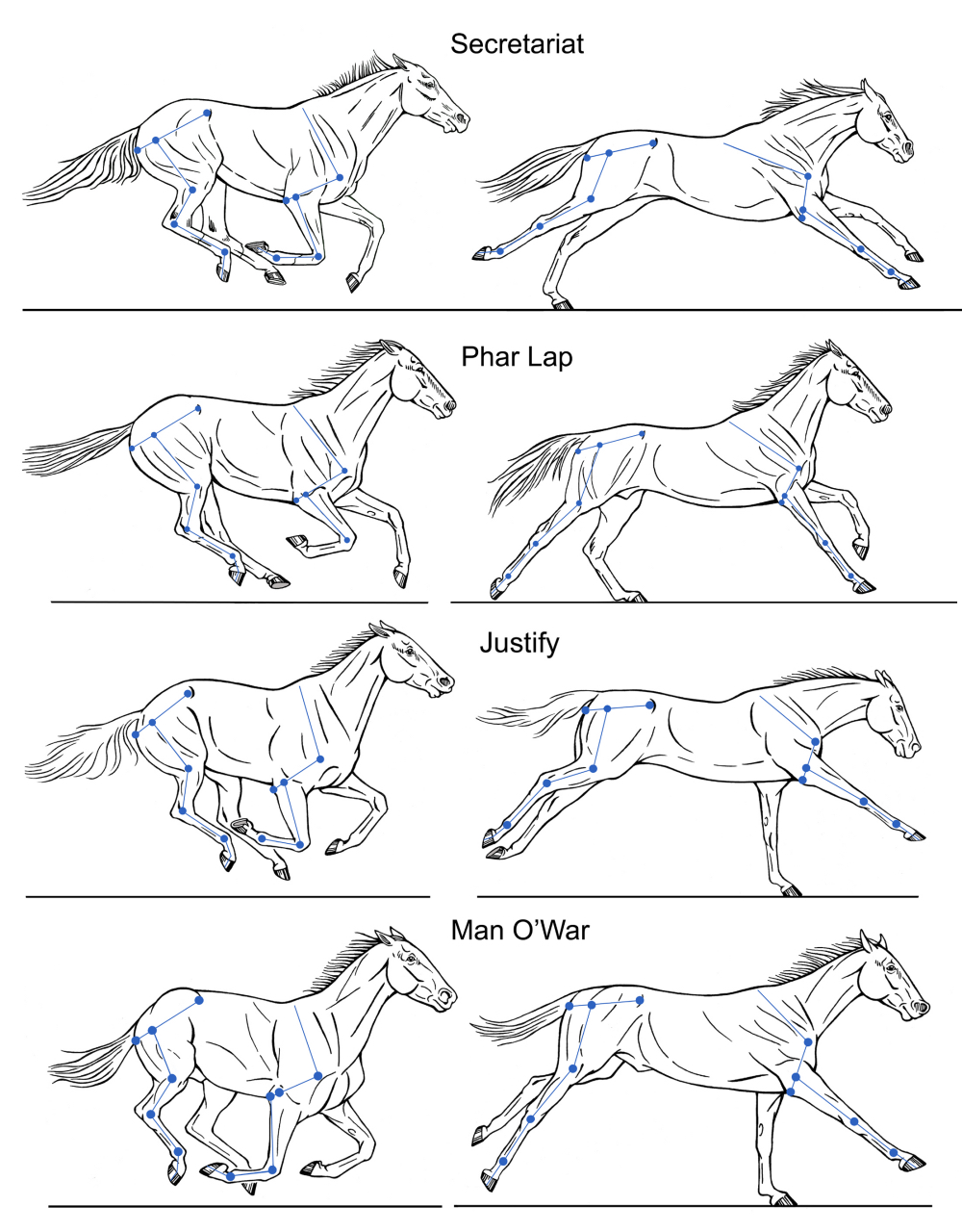
Figure 12: Four great Thoroughbred racehorses compared. Maximum coiled position on the left; extended position on the right. See text for explanation. Image: Dr. Deb Bennett
Film analysis of great racehorses bears this suggestion out completely. Famous champions Secretariat, Phar Lap, Justify and Man o’ War – all captured by the camera while producing rotatory gallop — are compared in Figure 12.
Secretariat and Phar Lap are shown in maximally coiled position on the left and in maximally extended position on the right; both demonstrate between 16 and 17 degrees of difference between coiled and extended spinal posture. Justify and Man o’ War are shown in maximally coiled position and, on the right, a little later in the extended phase, so that one forelimb is planted and both hind feet have come off the ground. This phase catches the maximum spinal extension of which horses are capable. Man o’ War achieves 27 degrees of difference between coiled and extended, while Justify produces an astonishing 32 degrees, essentially the maximum of which any equine is capable given the structure of their lumbar vertebrae.
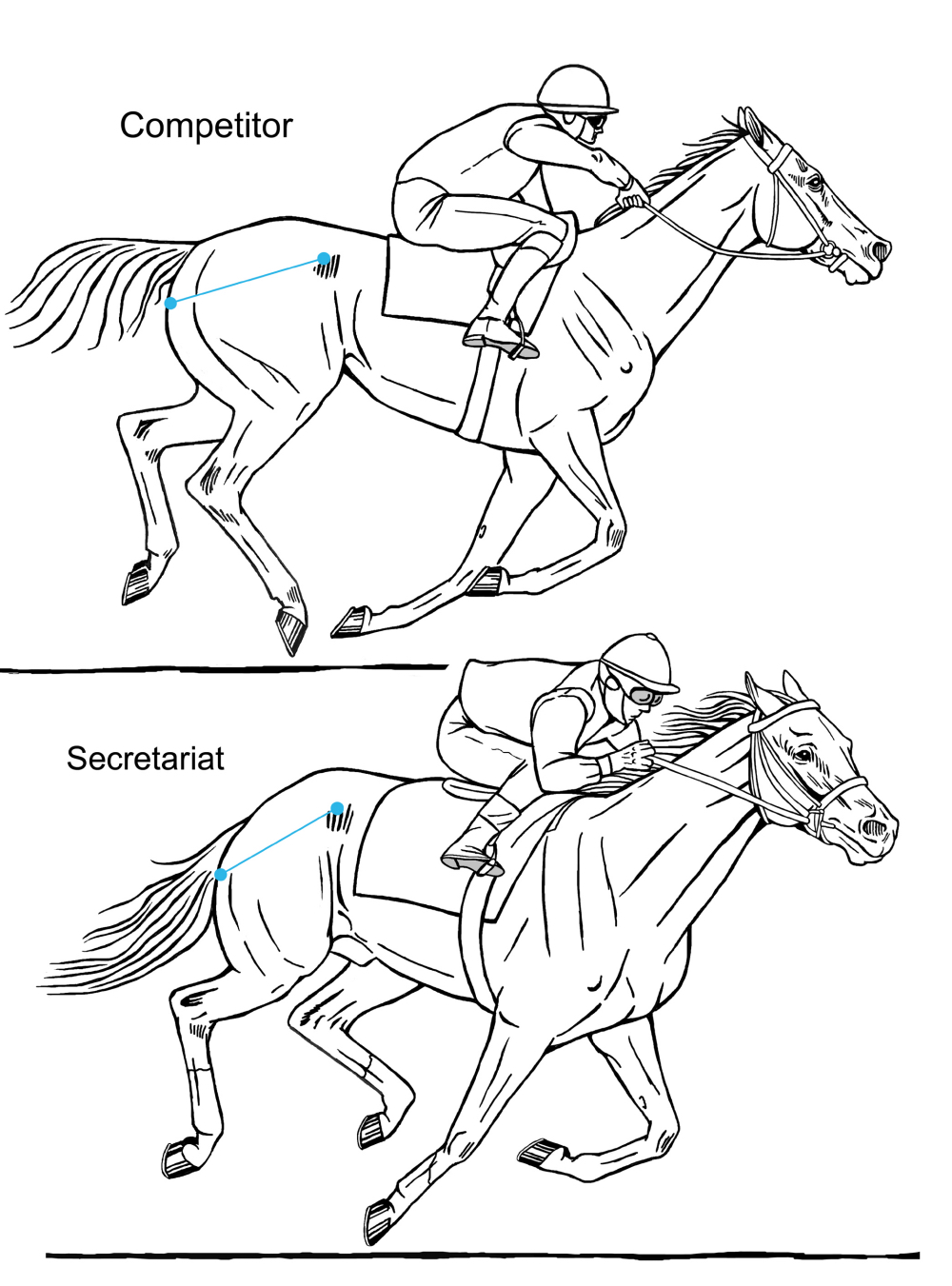
Figure 13: How to pick a winner: look at how much they coil their loins. A stiff-backed horse whose back does not visibly oscillate up and down (the “competitor,” above) is unlikely to beat horses with supple backs. Secretariat is shown below. Note that the forelimbs of both horses are in the same position, yet Secretariat’s pelvis is 14 degrees steeper (his loins are much more coiled) than the competitor’s. Image: Dr. Deb Bennett
I invite anyone who wants to learn how to pick a winner to consider Figure 13, where Secretariat is compared to a competitor — a quality racehorse certainly, but not a champion. Note that although the horses are on opposite leads, the camera has caught them both with the forelimbs in the same position. Now look at the hind limbs and note how much more deeply Secretariat has coiled his pelvis and thus how much farther forward the leading hind limb is than in the competitor. The slightly angled view of Secretariat makes direct comparison of pelvic angle less accurate, but it’s not less than 14 degrees more coiled than the competitor.
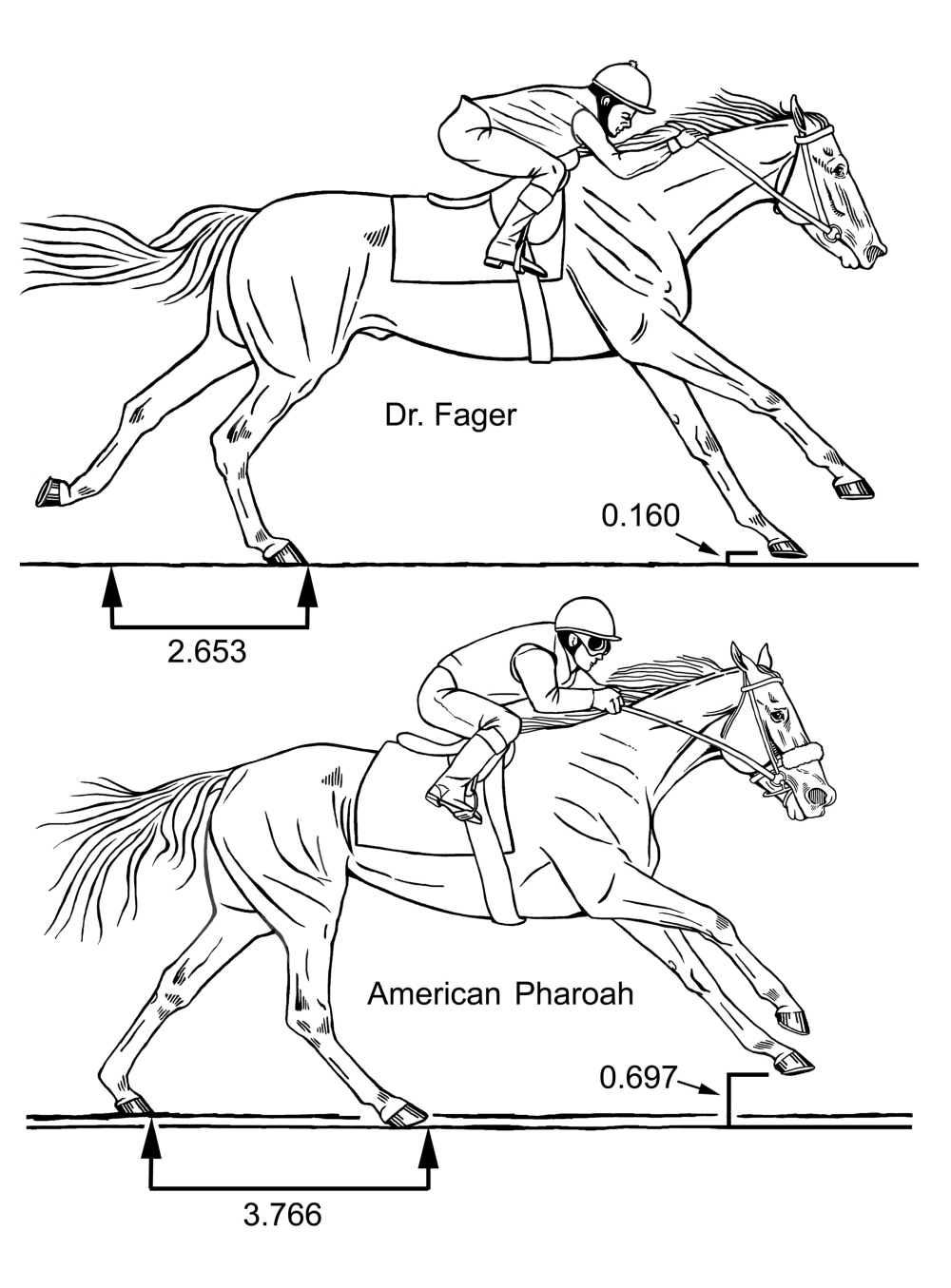
Figure 14: How to pick a winner: look at the width of the hind step, especially how much the forward hind limb is brought forward, another measure of loin coiling. Also note the amount of “loft” or “flying up,” as measured by the height of the lowest forefoot over the ground. The more powerful the horse, the higher the loft will tend to be. The more the horse coils its loins, the longer the hind step will be. Image: Dr. Deb Bennett
Another way to “see” a winner is to compare the length of hind step (Figure 14), because a long hind step not only implies greater coiling of the loins and thus a more flexible back, but also a longer period during which the hind hooves are in contact with the ground and thus a longer period over which the horse can produce effective propulsive effort. Both horses shown (Dr. Fager and American Pharoah) are champions and both are producing rotatory gallop — although that produced by Dr. Fager just barely qualifies. In this comparison, Dr. Fager’s hind step length is shorter by about 30%, and, as a result, the height of the arc traversed by the forehand is about 75% less high and long than that produced by American Pharaoh.