
Horses that pseudo-trot often have abnormally shaped feet, and as a result, tend to have soundness issues that limit their useful lives and/or competitive careers. They thus typically require more farrier skill than the naturally sound horse.
There are three main reasons why horses pseudo-trot: massiveness, misunderstanding on the rider/trainer’s part of what collection is and rider incompetency/lack of skill.
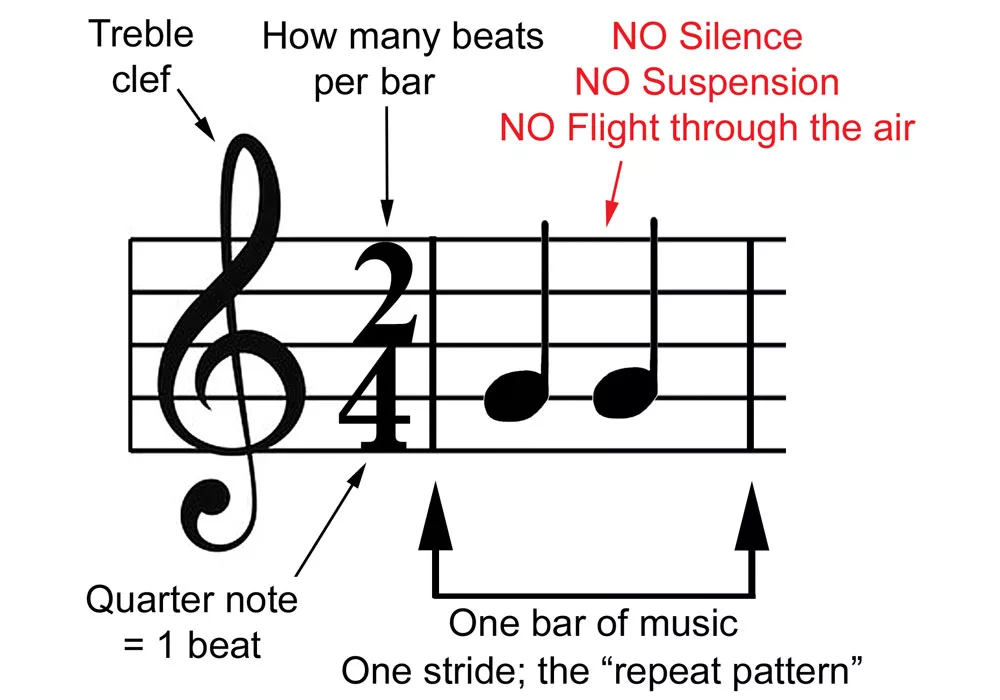
Figures 1 and 2 show the musical notation for pseudo-trotting. Its main characteristic is that it lacks any period of suspension: the horse merely steps from the left to the right diagonal, as shown in Figures 3-5. The difference between the trots diagrammed in Figure 1 vs. Figure 2 is that the diagonal pairs in Figure 1 are synchronous (i.e., they work exactly together), so the hooves strike down simultaneously to make the first sounded beat (“clip”) and the second sounded beat (“clop”).
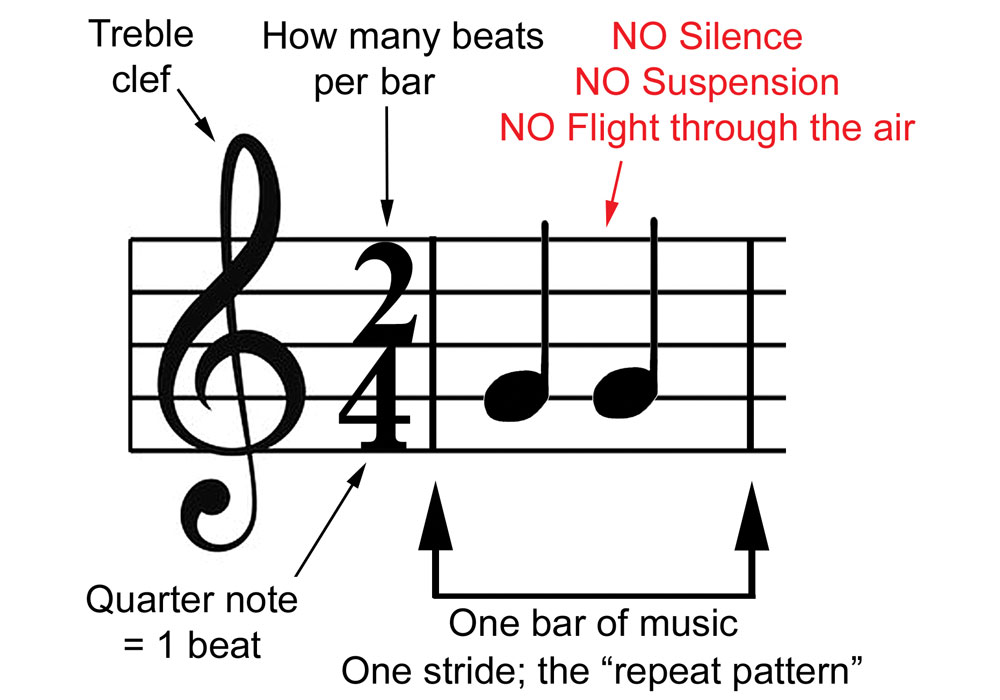
FIGURE 1: The musical notation depicts a literal two-beat trot, in which the diagonal pairs work synchronously but are non-suspended. In this type of pseudo-trot, the two rests (= two periods of suspension) are lacking, although the sound produced is still “clip-clop.” Note the time signature has changed from 4/4 (four beats per bar) to 2/4 (two beats per bar).
In Figure 2, however, the hooves strike down perceptively non-synchronously, i.e., the forehoof of the left diagonal pair strikes slightly before its mate behind, and similarly for the right diagonal pair, so the music produced goes “ca-lip – ca-lop”. Generally speaking, horses that move crookedly produce this latter form of pseudo-trot (see American Farriers Journal January/February 2024, “How Straightness Affects the Hoof”; March 2024, “The Anatomy of Leaning”; and July/August 2024, “How Crooked Carriage Affects Performance”). Crooked carriage is common at harness tracks but is also observed in many other sectors of the industry.
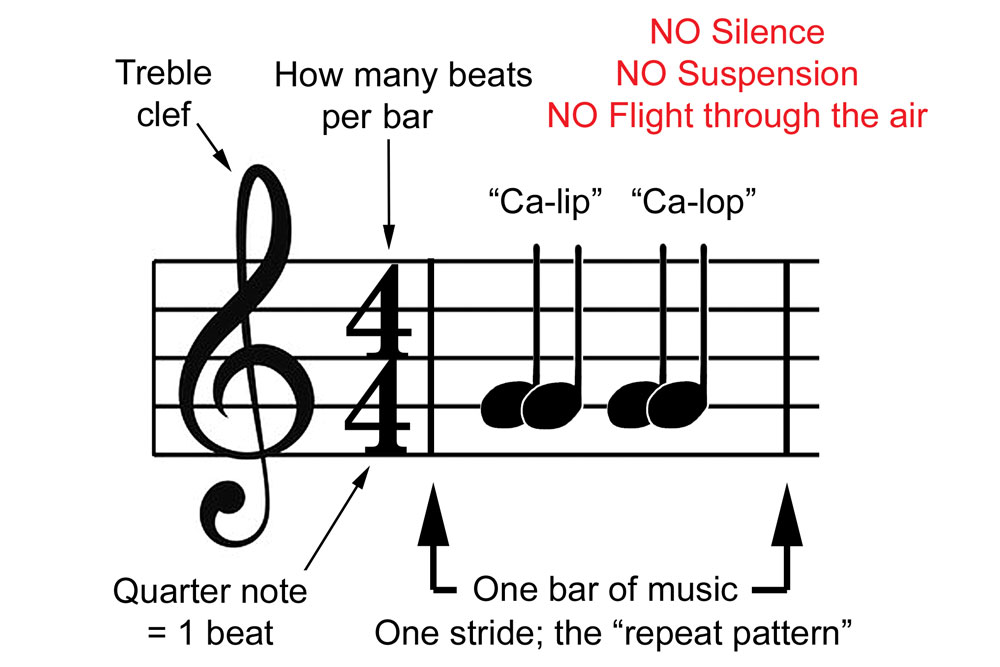
FIGURE 2: The musical notation depicts a non-synchronous, non-suspended pseudo-trot. This variant is usually produced by horses that travel crookedly — i.e., with their spine at an angle to the line of their progression — or else by horses, such as that shown in Figure 5b, in which the animal is grossly tilted off its balance from back to front (i.e., it is traveling on the forehand). Note that this is a four-beat gait which, like the walk, contains no period of suspension.
Massive horses (Figure 4), especially those weighing over 1,400 lb., typically offer pseudo-trot. This is because they are seeking to protect themselves. Nature never produced any equine weighing over about 1,100 lbs., and the hoof as a physiological whole, as well as its component parts, including the keratinous hoof capsule, are simply not designed to withstand the degree of concussion that a draft horse produces when trotting with suspension. As shown in Figure 3, the massive animal may swing its limbs in diagonal pairs, so it looks like it’s trotting, but it’s merely stepping from one diagonal to the other.
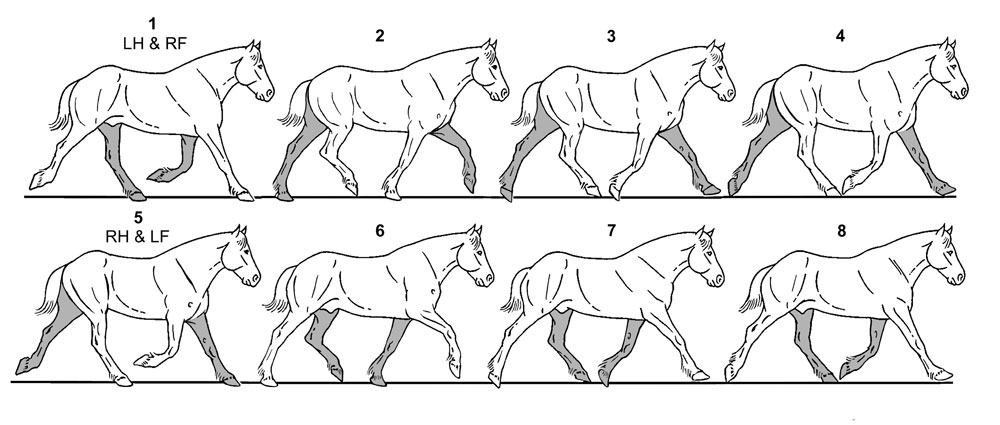
FIGURE 3: A filmstrip sequence shows the stepping-trot typically produced by massive horses. This animal moves with considerable energy but produces no suspension.
Almost all draft horses crush their feet, and the typical deformation is not only due to squashing but particularly the development of the abnormal hoof form familiar to every farrier — “long toe, low heel.” We can understand how this comes about by noting what is going on in Figure 3, frames 3 and 7, in which we find delayed breakover signaled by the kinked position of the forelimb that’s breaking over. Late breakover entails increased leverage and force at the toe of the forehoof that is about to be picked up. Over time, the constant prying of the toe against the ground warps the tubules of the capsule so that the toe becomes dished.
At the same time, in frames 4 and 8 of Figure 3, we see the horse landing rather early on the heels of the forefoot that’s being set down. This tends to crush the heels and run them forward, creating the back-to-front warp that Hall of Fame farrier Gene Ovnicek calls “curly bars.”
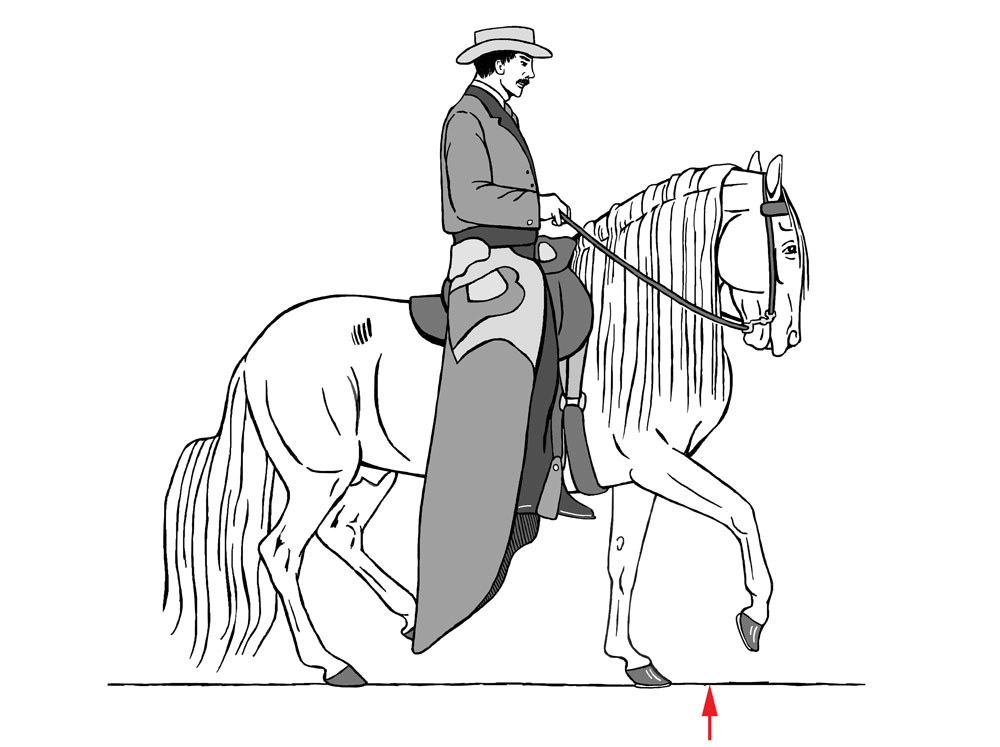
FIGURE 4: This handsome “trote y galope” horse is a recent import from Colombia (“trote y galope” means “trot and gallop”). When they move correctly, these horses go in as high a state of collection and need as much spinal flexibility as elite-class dressage competitors performing the piaffe (trot in place). This stallion, however, has been trained by holding him back, and thus, he moves with a stiff back and neck. With each step, the horse raises a hoof and advances it, but because he is being held back to prevent forward movement instead of being collected correctly, the hoof is moving backward when it strikes down at the red arrow. Back-scraping hoof strike quickly dishes the toes, literally dragging the hoof capsule forward relative to the coffin bone and other internal structures.
Late breakover, plus early and heavy heelstrike, is the formula for producing long-toe/low-heel feet that are out of antero-posterior balance. Given that this is being produced by the unalterable conformation of the horse itself, there is little the farrier can do to prevent it. This leaves the farrier in a catch-up position where the best that can be offered the horse and its owner is to “shoe defensively,” by designing the long-term plan for trimming and shoeing mainly around the need for support.
The current fad in dressage competition, which seems to demand that the winner shall be a huge horse weighing in excess of 1,400 lb., of course, also makes a difficult job for the farriers who work in this discipline. We are not only dealing with massive conformation, but also the demand made in dressage competition that the animal produce a true (suspended) trot. This can be done, but massive horses simply cannot (and do not) produce as much “bounce per ounce” as those whose weight puts them within the ordinary riding-horse range, i.e., 700-1,400 lb. (Figure 5a).
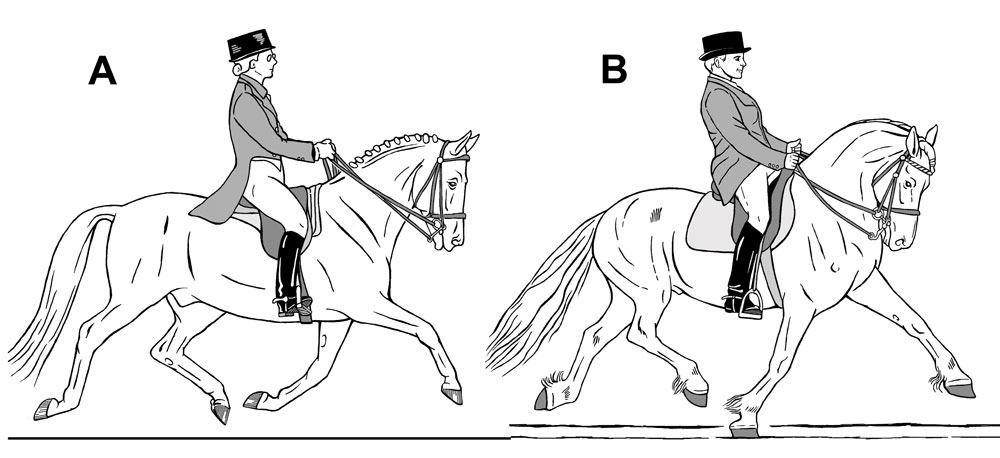
FIGURE 5: Dressage competitors. A is Lendon Gray with her fabulous Connemara-Thoroughbred cross Seldom Seen, who was twice U.S. National Champion and National Champion at every level from second up to Grand Prix. The photo-tracing shows the pair in the flight phase of a correct extension of stride at the trot. Strike down of the diagonal pairs will be simultaneous. The horse is in excellent rear-to-front balance. Note that Seldom Seen stood 14:2 hands and weighed about 950 lb. It’s much easier for smaller horses to generate big suspension than for big, heavy ones. Horse B is a massive horse, standing 17 hands and weighing about 1,650 lb., being shoved so far off its balance from back to front that neither hind hoof is in contact with the ground. There is no time in a true, correct trot in which the camera may catch the horse with just one front hoof in contact with the ground. The horse that goes in this manner is not trotting.
The problem is compounded when (as we very frequently see) the animal is mis-taught “strong trot” or extension of the trot stride. When properly performed, as in Figure 5a, this requires even more than the normal height and duration of suspension.
What we usually see with massive horses is, however, an incorrect pseudo-trot (Figure 5b) with gross decoupling or asynchronous strike down of the diagonal pairs. Because in the attempt to get it to “go more forward,” the animal is being shoved onto the forehand, it will always be the forehoof of whichever diagonal pair that strikes down first.
The horse in Figure 5b is not propelling itself forward by powerful thrust from the hind limbs, since thrust can only be generated by a limb whose hoof is in contact with the ground. Instead, what we see — thanks to fad and folderol, unfortunately often on display in the winner’s circle — is the animal propelling itself by means of effort of the forelimbs. In other words, what we see in Figure 5b is a horse dragging itself forward by means of the forelimbs instead of propelling itself forward by means of the hind limbs.
The bottom line for the farrier is that over time, this horse’s feet are going to become as much or more deformed as those of the draft horse, which is simply heavy. The competitive career of big heavy horses in dressage is typically short — about three seasons. The owners and riders of such horses are dependent upon keeping the horse trimmed and shod in a way that supports the weight and disperses concussion (such as wide-web shoes, oval shoes, pads) while at the same time minimizing toe-leverage and deformation (such as rolled toes, wedges, Ovnicek-style short-toed shoes, shoes applied with heels facing forward).
Learn More
Gain more insight from Dr. Deb Bennett by reading, “How the Trot & Pseudo-Trot Affect the Equine Hoof” in the April 2026 issue of American Farriers Journal.