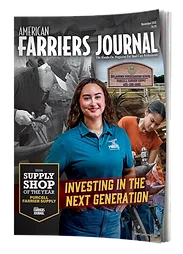
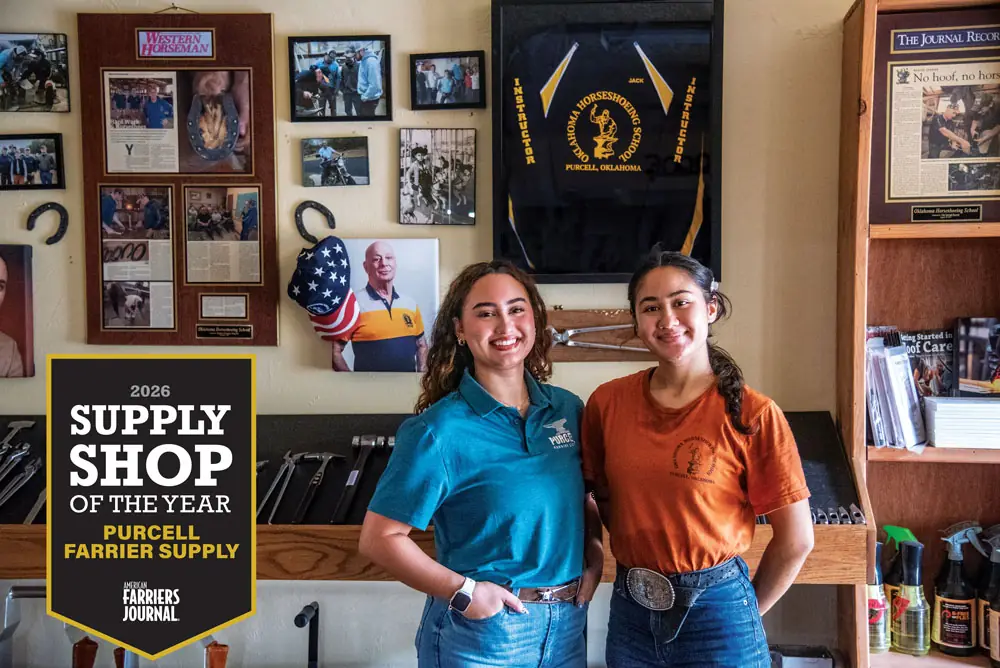
At the heart of Purcell Farrier Supply is a team dedicated to the betterment of horseshoers both at home and abroad. Through hands-on customer service, a personalized course structure at the attached Oklahoma Horseshoeing School (OHS) and direct community engagement, Purcell stands out as a unique and dedicated member of the farrier industry, earning the American Farriers Journal 2026 Supply Shop of the Year.
Owners Sylvia and Rebecca Roth took over the family business when their father, International Equine Veterinarian Hall of Famer Dr. Jack Roth, passed away in 2024. Dr. Roth established himself as a farrier in 1964 and opened OHS 9 years later in Stillwater, Okla., later moving the school to Purcell. In addition to being an educator, Roth was a licensed pari-mutuel horse trainer and served as one of the last official farriers in the U.S. Army. He shod horses such as Leo P-1335, Jet Deck and Sugar Bars.
OHS is one of the oldest horseshoeing schools in the U.S., and Purcell Farrier Supply, which operates on the same property, supplies students and local farriers with the tools they need to succeed — many of which are made in the Roths’ manufacturing plant, Mindanao Forge Co. (MFC), based in the Philippines.
“MFC was established in 1999 when my dad flew to the Philippines to meet my mom and saw the potential to start something. He wasn’t quite sure what that something would be, but here we are,” Sylvia Roth says. “The first product we ever made was a hoof knife. They made about 50, brought them to the U.S., and gave a few away for people to try. With the feedback that Jack received, he saw potential, and, from there, they slowly built up our tool line to what we have today.”
On its website, Purcell lists seven MFC nipper options, three shoe pulloffs, three clinchers, two half rounds, two nail nippers, two crease nail pullers, hot shoe fitting tongs, four fire tongs, three clinch cutters and gouges, a pritchel, five knives, aprons, three shoeing boxes, anvil stands and a stall jack/hoof stand among the MFC lineup. It’s also the manufacturer and distributor of Jim Keith and RG Tools, in addition to offering numerous other brands of tools.
On top of OHS and Purcell, the Roths purchased Oklahoma State Horseshoeing School (OSHS) and the attached American Farrier Supply in 2018, located an hour south in Ardmore, Okla. OSHS was founded by Reggie Kester within a few months of OHS in 1973. After Kester passed away, his son Reagan took over as head instructor.
“Purcell allows us to come to the same place and become united…”
“The school was like a child that grew up with us,” Reggie’s wife, Marcella Kester, told American Farriers Journal in 2018. “It was really important to us to do a good job and improve it all the time. We had two kids who were raised there, and all our grandkids were raised there. Jack didn’t try to change anything, kept everything the same. I think that’s very respectful of him.”
Operating two farrier supply shops, two horseshoeing schools and an overseas manufacturing plant is no easy feat, but Sylvia Roth has an excellent group of staff members, students and instructors who care deeply about its continued success. This passion pays off.
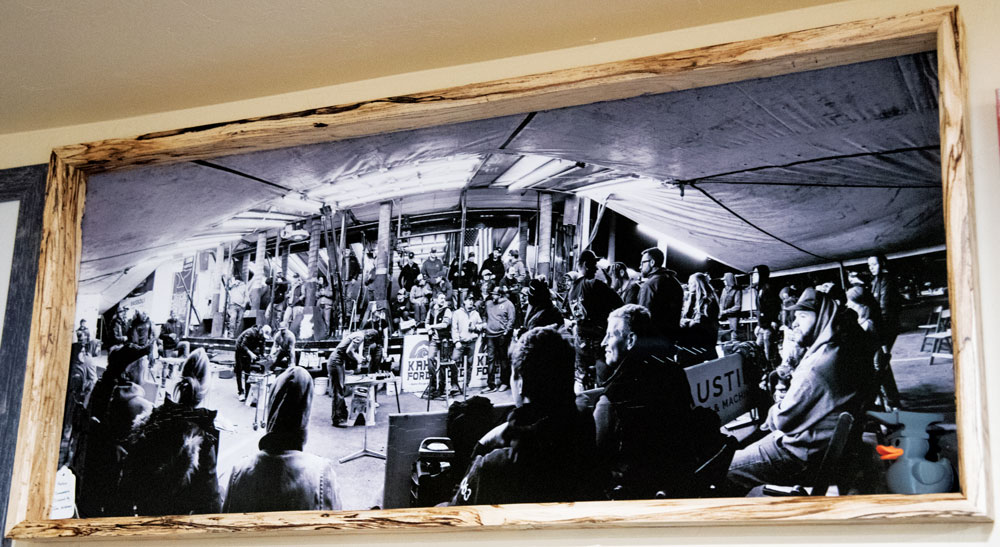
Purcell Farrier Supply sponsors contests and clinics to support continuing education and uplift their customers. This photo by John McNerney of Yukon Forge features Purcell’s staff at a 2025 World Championship Blacksmiths contest. Maclaren Krueger
“My dad, Hank Morgan, has been shoeing racehorses since he was 21 years old,” says Cole Morgan, an Oklahoma farrier and loyal Purcell customer. “He has seen the whole industry evolve, and Purcell is still supplying to a 66-year-old man who makes his living through their company.
“That is the biggest thing you can possibly do for the farrier industry. Not only are the Roths educating farriers, they’re selling supplies so that farriers can make their living. They’re accountable to so many families in our area and out of state.”
Putting the Customer First
Purcell takes a hands-on approach to its operations, centering the customer. Employees make a point to answer phones by the second ring, and any special orders are handled efficiently. One of the reasons customers keep coming back is Purcell’s accessibility and flexibility.
“You always know in your mind that you can get what you need,” says Alex Purus, an Oklahoma farrier. “The other day I needed shoes, and it was an hour before closing. I couldn’t get there in time. They’ll leave them outside for you, no questions asked.
“They have everything you need. They’re good to work with, and the location being so close to me and all my horses is so convenient.”
Not only does Purcell care about getting product to their customers as efficiently as possible, but they also offer comprehensive after-sales support and additional tips and tricks to better support the industry they serve.
All Rise
The independent panel of judges consisting of Margie Lee Gustafson of Woodside, Calif.; Steve Kraus of Trumansburg, N.Y.; and Randy Luikart of Ashland, Ohio; determined the American Farriers Journal Supply Shop of the Year based on the nominees’ responses to a 20-question survey. The identities of the shops were not disclosed to preserve an impartial decision. Here is a look at the blue ribbon panel.
Margie Lee Gustafson
Margie Lee Gustafson has been shoeing since 1982 and has been a certified journeyman farrier since 1991.
Educating others has been a focal point for Gustafson, who served as an American Farrier’s Association (AFA) tester from 1991-2019, co-coordinated the Northern California Classic for 7 years and continues to support continuing education.
She has been a leader in local and national farrier organizations including the Western States Farriers Association and AFA. Gustafson is the only woman to lead the AFA as president (2016) in the organization’s 55-year history.
Gustafson was inducted into the International Horseshoeing Hall of Fame in 2020.
Steve Kraus
Steve Kraus is American Farriers Journal’s technical editor and the retired head of farrier services and senior lecturer at the Cornell University College of Veterinary Medicine. He also taught vet students at the university.
A shoer for 6 decades, Kraus has built a successful farrier practice in the Finger Lakes region. He is a past president of the Western New York Farriers Association and served as a member of the board of directors for Region 5 of the AFA. Before joining Cornell, Kraus owned a supply shop for 25 years.
Kraus was inducted into the International Horseshoeing Hall of Fame in 2016.
Randy Luikart
Few farriers possess the scientific knowledge of the horse and its foot that Randy Luikart does. He is always ready to share with others in clinics, on a one-on-one basis and within the pages of American Farriers Journal.
He specializes in shoeing Saddlebreds and Hackney horses for clients throughout the country. A past president of the AFA, Luikart also served as a member and coach of the American Farriers Team.
He has actively represented farriers with the American Horse Council, American Association of Equine Practitioners and by serving on U.S. Department of Agriculture committees looking at shoeing concerns and the welfare of the horse.
Luikart was inducted into the International Horseshoeing Hall of Fame in 1995.
“We offer guidance on product use, maintenance and application,” says Sylvia Roth. “We also share educational content through platforms like Facebook, posting tips and practical advice to help customers get the most out of their tools. For example, we shared a video demonstrating how to adjust rivet-hinged tools if they become too loose or too tight, so others could benefit from that knowledge.
“Whether it’s over the phone, in-store or through direct messaging, our goal is to ensure customers feel supported not just at the point of sale but long after.”
Another way Purcell supports its customer base is by offering regular discounts. Every second Wednesday of the month, all items both in-store and online are 15% off. Since it began, the sale has been a huge success, drawing crowds into the recently renovated store. In 2022, Dr. Roth expanded the space beyond something that could be crossed in a few strides to one that has room for a coffee corner and a high-top table so farriers can chat during their supply runs.
“I’m usually not the only guy buying,” says Morgan. “There’s three or four of us in there at one time buying shoes, and then we get in our trucks, and we go our separate ways. But one thing Purcell has done for all of us is allow us to go to the same place and become united.
“Our goal is to stay engaged, give back to the community and support the farriers who rely on our tools every day…”
“I’ve seen farriers in there that I haven’t seen for a few years, and I got to see them because I had to go over there to buy supplies. I got to see that guy that maybe I worked alongside for a little while, or maybe I knew him from my childhood.”
Instead of offering a broad 15% discount, the Ardmore location rotates sales each week. In the first week of the month it might be rasps, while the second week might discount supplements or nippers. Both locations, in addition to recurring discounts, offer fun contests and giveaways during Christmastime. For the person who could most closely guess how many nails fit into a mason jar, they’d receive a pair of MFC nippers as a prize. Purus was last year’s lucky guesser. Nine months later, he laughs explaining how a horse trainer was cutting their fingernails with the MFC nippers and was amazed at how sharp they still were.
Product Availability
Understanding what farriers need and making sure they have it is an important part of operating a good business. Purcell excels at this. Between the Purcell and Ardmore locations, shoeing needs and preferences are different. According to Purus, some of the biggest disciplines in the Purcell area — named the horse capital of Oklahoma — are reining, cutting, cow horses, Western pleasure, roping, barrel horses and racehorses due to the close proximity of the Remington Park racetrack. Because of that, raceplates are in much higher demand in Purcell than they are in Ardmore. Other products simply come down to preference.
“We sell more Mustad products in Ardmore than we do in Purcell, and we don’t sell as many raceplates there as we do here. Our raceplates there are more St. Croix, and here they’re more Kerckhaert,” says Shalin Dumos, Purcell’s general manager.
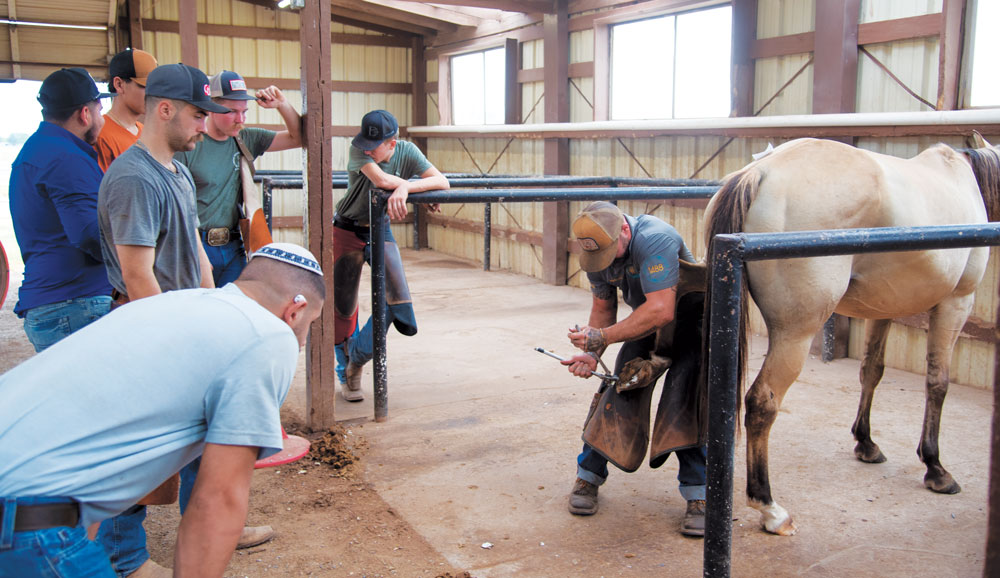
After several students struggled, head instructor Brian Reynolds, CJF, teaches a batch of Oklahoma Horseshoeing School students vital horsemanship skills while taking a nipper to a difficult horse’s foot. Maclaren Krueger
Dumos and Roth estimate that most of their customers come from a 75-mile radius and encompass a wide variety of horseshoers, including a trend of firefighters who shoe part-time on their days off. Because of the difference in shoers and product preferences between stores, communication between locations is excellent.
“There are some things that we carry here that Ardmore doesn’t carry, and things that they carry that we don’t carry. Because Shalin goes back and forth between stores, we’ll often send products up to Purcell and down to Ardmore. If we still don’t have it, I’ll direct them to Nature Farms,” Roth says, who has a very positive relationship with the nearest supply shop in Norman, Okla.
To get a better understanding of what products horseshoers would most benefit from, Roth leans on her customers and their insight and experience, saying that exchange of information has helped them grow and better serve farriers.
“We gather feedback by working closely with vendors and distributing sample products,” Roth says. “When we receive samples, we place them in the hands of individuals who will use them the most. For example, a knife company once provided us with sample knives, which we gave to the instructors at Oklahoma Horseshoeing School. With the volume of horses they work on daily, they were able to thoroughly test the product and provide valuable, experience-based feedback. That feedback was then shared with the vendor to help guide product improvements or confirm performance.
Survey Says …
Q. Can you describe any innovative practices or technologies your shop uses to improve operations or customer service?
A. We use social media as a key tool for engagement and education. Facebook allows us to share product demonstrations, maintenance tips and troubleshooting advice. This helps extend the life of tools and provides customers with useful, real-world information.
While our industry is rooted in tradition, we continuously look for ways to improve through better communication, feedback loops and practical use of technology — all with the goal of better serving the farrier and ultimately improving the care of the horse.
Q. Do you offer any educational initiatives or support for the professional development of farriers?
A. We make an effort to connect farriers with horse owners whenever possible. When we receive calls from individuals looking for a farrier in their area, we do our best to point them in the right direction. This may involve searching for certified farriers through the American Farrier’s Association or reaching out to past students who we know are working in that region. Our goal is to help bridge that gap and support both the farrier and the client.
In the past, we have also hosted clinics at horseshoeing schools, bringing together farriers to learn, share knowledge, and improve their skills. During these clinic days, we typically offer a discount day as a way to give back to and support the farriers who participate.
Q. What are your plans for future growth or improvements to your shop?
A. We intend to expand our role in education by continuing to support clinics, events and hands-on learning. Opportunities have also arisen to conduct an International Outreach Farrier Program in the Philippines, and once all details are finalized, we hope to bring that initiative to life in 2027.
All in all, our goal is steady, meaningful growth — continuing to build on what we’ve established while staying true to the values of quality, service, and commitment to the horse and the trade.
“This process works both ways. At times, I’ll come across farriers online expressing frustration with their current nippers,” she continues. “In those cases, I’ve sent them a pair of nippers of their choice to try. With a wide range of sizes, we’re able to match the tool to the farrier’s specific needs. The goal is to receive honest, real-world feedback. If they like the product, that’s great. If they don’t, that’s just as valuable, as it helps us understand where improvements can be made and why a product may not meet a particular farrier’s standards.
“We take a hands-on approach to customer feedback. By listening, testing and continuously learning from the people who use these tools every day, we are able to make informed decisions that improve both our product offerings and the service that we provide.”
Building Community
Inspiring farriers to come back over and over for their supplies isn’t just about offering the right products or sales support. It’s about treating each farrier like an individual and meeting their unique needs.
“I am blessed to have a great relationship with all the horses and people I work with, and it is no different with Purcell Farrier Supply,” says Purus.
For Morgan, gratitude plays a big role in his loyalty to Purcell.
“A lot of people come up to me and say, ‘Cole, can you fix him?’ I don’t know if I can fix conformation, and I can’t fix navicular issues or deep flexor or suspensory ligament tears. But, with Purcell, they have the inventory I need to shoe this horse to the best of my capability to make him more comfortable,” Morgan says.
“The goal is to receive honest, real-world feedback…”
Recently, Morgan was flown out to Iowa by his clients to shoe three racehorses.
“I got on four planes in one day and traveled 2,100 miles to shoe three horses with Purcell’s shoes,” he says. “A lot of us are family men, and at the end of the day, we want to do the best job we can do, but we’re also trying to support our families. Purcell allows me to do that. I have a wife and 4-month-old son, and if he wants to learn how to shoe horses one day, I would gladly show him and send him to Oklahoma Horseshoeing School.”
At the educational level, the instructors at OHS and the staff at Purcell aim to treat their students like family. In addition to a place to sleep, two meals are provided to students on weekdays by the school, and students often keep in touch long after they graduate.
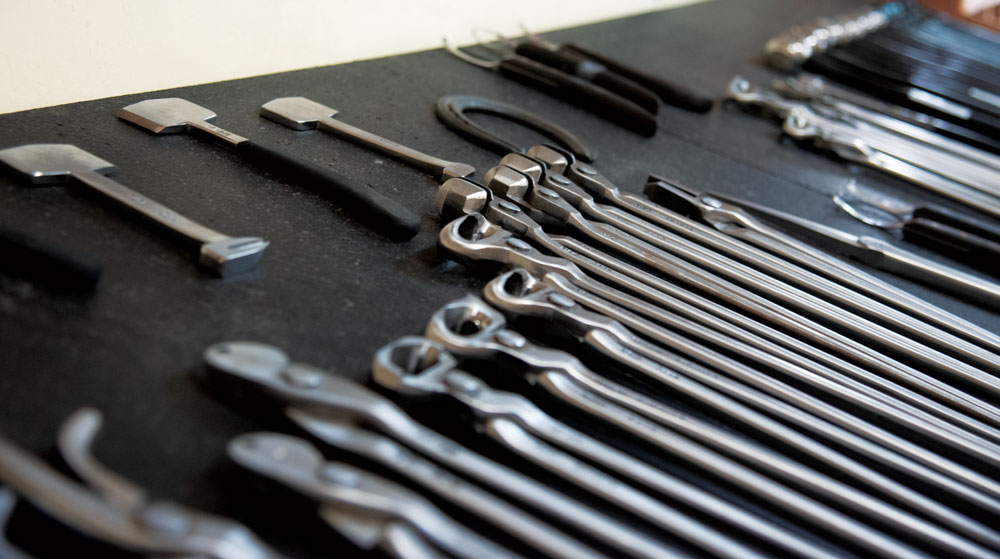
Manufactured in the Philippines, MFC, Jim Keith and RG Tools support farriers’ livelihoods. Continued many decades later, Dr. Roth’s entrepreneurial spirit has fueled the careers of generations of horseshoers. Maclaren Krueger
“Students have my cellphone and Shalin’s,” says Teresa Earnest, OHS’ enrollment coordinator. “I have students call me on the weekend at night. I’ve woken up to text messages in the morning about financial issues. We’re very protective of our students, and parents feel very safe leaving their kids here with us. We’ve even had kids get married who met here.”
Both current and former students are also offered a 10% discount on all Purcell products for life, which motivates them to keep coming back after graduation.
Besides being there for customers at a local level, Purcell also shows up for the wider farrier community through events, clinics and contests. For several years, Purcell Farrier Supply has been a proud educational partner at the International Hoof-Care Summit.
“We regularly participate in major industry events such as the Summit and the American Farrier’s Association Annual Convention, where we showcase our products and connect directly with farriers from across the country.
“They really are the heartbeat of the farrier industry…”
“In addition to event participation, we sponsor tools for numerous state association contests, helping contribute to competitions that promote skill development and craftsmanship within the industry. More recently, we have expanded our involvement through a sponsorship with the World Championship Blacksmiths, further reinforcing our commitment to supporting high-level competition and the continued growth of the farrier trade.
“Our goal is to stay engaged, give back to the community and support the farriers who rely on our tools every day,” says Roth.
Giving Back
Through continuing education opportunities and excellent customer support, Purcell Farrier Supply creates an environment for its customers that makes them want to come back each week. It’s not only about the monthly discounts or product availability but the fact that Purcell treats each customer like family. This loyalty is a two-way street, and Purcell has earned it.
“Purcell is risking their time and money to create this life for all of us,” says Morgan. “As a guy running my own business, I’m just so thankful for them. I can say thank you to their faces, but I don’t know if they really understand how much of that thank you they deserve. When I make insurance and truck and house payments, and when I have 8 head of horses to take care of, and when I put food on the table at night, Purcell is working with me so that I’m allowed to do that.
“That is the biggest thing they could possibly do for a whole community,” he adds. “They’ve created jobs. They really are the heartbeat of the farrier industry. They need to pat themselves on the back and know they’re selling good products to good people.”
Educating the Next Generation
As much as Purcell Farrier Supply has done for its customers, it’s done equally as much for its students and the farrier community at large.
Head instructor Brian Reynolds and additional instructors Bryan Clemmer and Erika Burton emphasize the basics in their courses, building off each small advancement in knowledge. For example, Reynolds starts each new class of students with tong placement at the anvil to minimize arm and wrist strain and maximize stability. Then, they can learn how to make a toe bend or level a shoe.
OHS offers 2-week, 8-week and 12-week classes, each covering slightly more advanced material than the previous. The 2-week course teaches forging fundamentals from bar stock, while the 8-week course dives into clips, bar shoes and fullering. The 12-week course expands on this by adding side bone shoes and sliding plates into the mix. Still, Reynolds and Clemmer emphasize the importance of finding someone to ride with after graduation to expand on the fundamentals covered at Oklahoma Horseshoeing School.
Enrollment coordinator Teresa Earnest estimates that about 10% of the school’s 200 annual students are local to Oklahoma, 20-30% are international, while the remaining come from surrounding states, such as Kansas and Texas. There’s a world map in the dining room where students can place a tack over their home, and nearly every corner is filled.
Combined with skilled second-generation instruction by Reagan Kester at Oklahoma State Horseshoeing School’s 6-week course, the Roths offer a competitive education in Oklahoma.