
Takeaways
- Mechanical intervention and medical intervention are complementary tools that must be integrated and applied strategically over time.
- Small deviations in hoof parameters, such as increased toe length leading to delayed enrollment, can quickly become a source of discomfort.
- Returning to barefoot can be an evolution of the management strategy.
Following the previous phase of Jackson’s management, in which mechanical simplification was paired with medical intervention using Osphos, his progress continued in a positive direction.
In the weeks after treatment, Jackson remained consistently sound, moving comfortably and freely with no observable signs of lameness or postural compensation. This level of soundness was maintained through most of the shoeing cycle. During the final week of the cycle, Jackson’s owner reported a subtle but consistent return of mild discomfort. While the degree of lameness remained minimal, the timing suggested a mechanical etiology rather than recurrence of primary articular pain.
An examination revealed accelerated hoof growth during the cycle, with associated increases in toe length. It was determined that delayed enrollment secondary to this increased toe length was the most likely contributing factor to the observed change in comfort.
Transition Back to Barefoot
At the subsequent appointment, it was decided to remove Jackson’s shoes and return him to barefoot management. This decision was based on several factors.
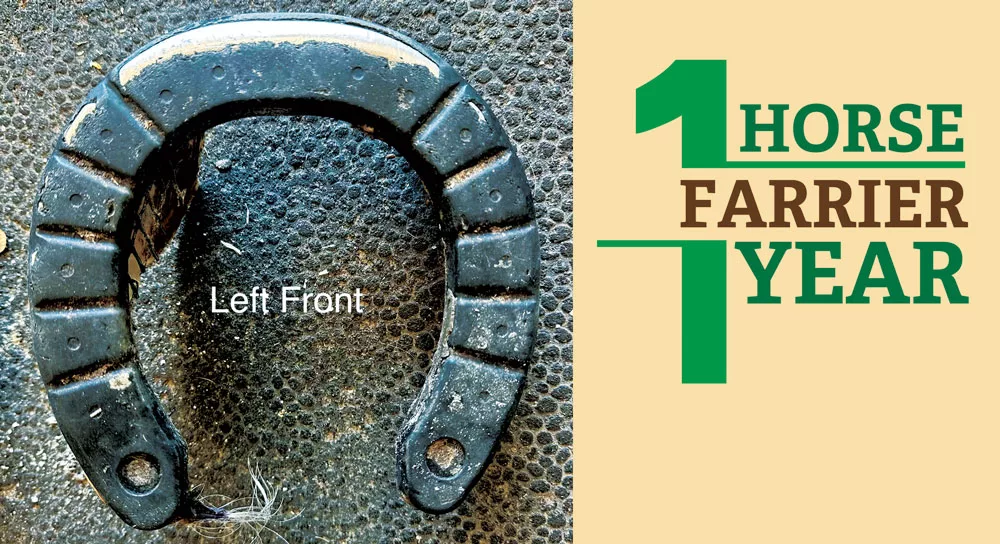
- Increased toe wear on the shoes (Figures 1a &1b).
- Rapid hoof growth exceeding the optimal maintenance window.
- The likelihood that increased toe length was contributing to late-cycle discomfort.
- Jackson’s improved physiological tolerance after medical intervention.
- The desire to simplify further while maintaining comfort.
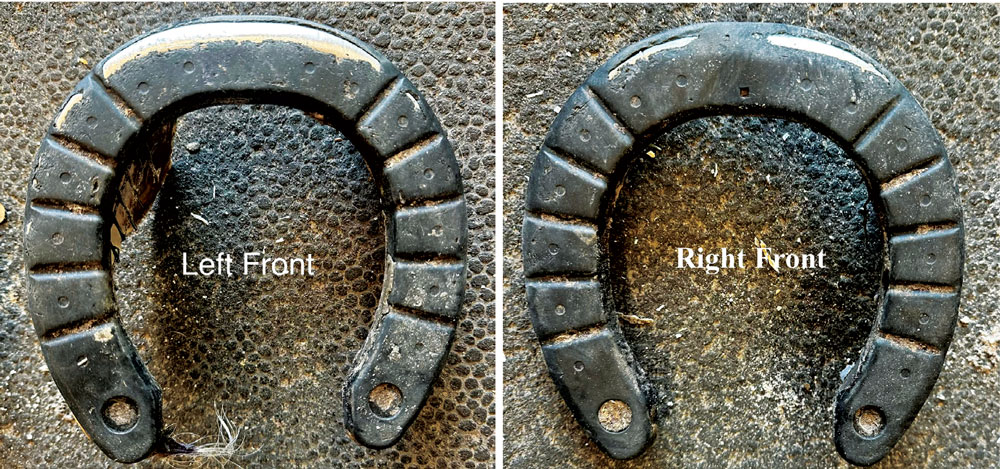
Jackson experienced accelerated hoof growth, resulting in delayed enrollment. The toe wear was more than previous hoof-care cycles. Esco Buff
A conservative trim was performed, with a plan to reassess and rebalance the foot at a shortened interval of approximately 2½ weeks.
Immediate & Short-Term Response
The response to shoe removal and trimming was rapid and definitive. Within 24 hours, Jackson returned to full soundness, moving freely without any observable irregularity.
The owner reported a notable improvement in overall comfort and behavior. The horse demonstrated increased willingness to move in turnout and a more relaxed, engaged demeanor. In the owner’s words, Jackson appears “happier.” While subjective, these observations were consistent with clinical findings and support the overall positive outcome.
At approximately 3 weeks post-transition, Jackson was re-trimmed. At that time, he remained sound, demonstrated a consistent and balanced stance and exhibited fluid, willing movement under regular work conditions.
Clinical Perspective
Jackson’s progression illustrates an important continuum in distal limb management. Initial mechanical simplification reduced aggravating forces, while medical intervention addressed the underlying articular component. Once the pain was sufficiently controlled, the need for mechanical support diminished.
The late-cycle discomfort provided valuable feedback, highlighting that even relatively small mechanical changes, such as increased toe length, can be clinically relevant.
Returning to barefoot was not a regression but rather an evolution of the management strategy in response to improved physiological conditions.
Ongoing Strategy
Jackson will continue on a shortened trim cycle to better match his hoof growth rate and maintain optimal mechanics. The key priorities moving forward include:
- Maintain appropriate toe length to ease enrollment.
- Monitor for recurring discomfort.
- Preserve simplicity and adaptability in management.
- Continue collaborating with the attending veterinarian as needed.
At his next scheduled appointment, Jackson’s progression will be reevaluated, and updated radiographs will be obtained before and after trimming. These images will provide an objective assessment of distal limb structures and help confirm that the current barefoot strategy remains appropriate, given his continued comfort and workload.
Closing Thoughts
Jackson’s case continues to reinforce a central principle in chronic care: Successful outcomes are rarely the result of a single intervention but rather the thoughtful sequencing and integration of multiple approaches.
This case illustrates the dynamic relationship between mechanical and medical management in horses with distal limb pathology. Initial mechanical intervention reduced aggravating forces, while pharmacologic therapy addressed the underlying articular component.
Mechanical and medical strategies are not competing options; they are complementary tools. Knowing when to apply each and when to step back is what allows the horse to dictate the path forward.
Following successful medical stabilization, the horse’s tolerance to load improved, reducing the need for continued mechanical support.
The emergence of late-cycle discomfort provided important feedback, emphasizing that even minor deviations in hoof parameters, such as increased toe length, can become clinically significant in a horse operating at a higher level of comfort.
In Jackson’s case, that path has led to a return to barefoot comfort, soundness in work and an overall improved quality of life.
The transition to barefoot management should not be interpreted as a reduction in support, but rather as an appropriate progression in response to improved physiological conditions. Simplification, when supported by the horse’s comfort and function, can be a desirable outcome.
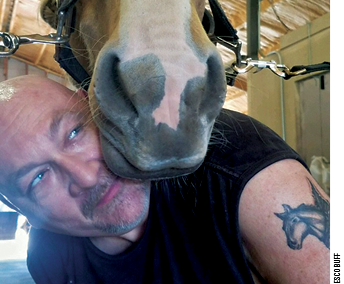
Over the course of a year, International Horseshoeing Hall of Fame member Esco Buff takes us on a hoof-care journey with Jackson, a 15-year-old Clydesdale cross gelding. The Clearwater, Fla., farrier documents each detail — the trim, shoeing, nutritional decisions, vet visits and his job — in this living case study.