Takeaways

  • While breakover is important, reducing it to an extreme can compromise hoof structures, concentrate pressure on the quarters and damage the caudal half of the foot; it should not be the sole factor in determining balance.
  • Farriers should consider the whole horse’s body while achieving balance, including the thoracic sling, neck and back, as these areas often influence movement dysfunctions that cannot be corrected by trimming alone.
  • Attempting to achieve a perfectly flat or heel-first landing by altering medial-lateral hoof balance is often counterproductive. It can negatively affect the orientation of the distal interphalangeal joint and fail to address the root cause of the movement issue, such as restricted range of motion in the upper limb.

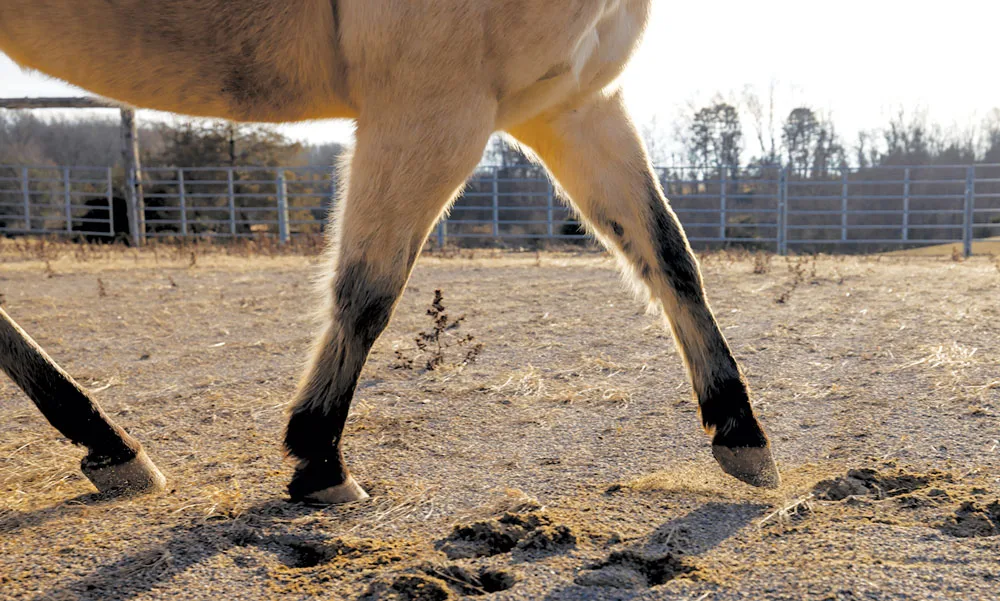
It has been customary to judge the balance of a trim on the orientation of the hoof in relation to the ground upon impact. However, there are many factors that go into dynamic balance and achieving the best possible movement for the horse.

We will discuss some of the reasons why altering medial-lateral balance to achieve a flat foot upon impact can be detrimental to hoof integrity. It’s important to consider the flight and the range of motion of the limb along with the rest of the body when trying to achieve proper footfall.

Trimming & Landing Phase

The definition of inertia is a property of matter by which it continues in its existing state of rest or uniform motion in a straight line, unless that state is changed by an external force.

You might ask what this has to do with trimming horses to land flat or heel first. We have all been taught to trim in such a manner that the horse lands ideally flat or heel first. The problem with this is that the function or possible dysfunction of the thoracic sling, neck, back and other body parts can negatively affect the landing phase.

If we take the orientation of the distal interphalangeal (DIP) joint into account, it’s possible that a heel-first landing on a horse with thoracic sling dysfunction may require a trim that results in it no longer being parallel to the ground surface.

Thinking-Beyond-Breakover-Fig-2.jpg

While breakover plays an important role in hoof function, it is only one element of dynamic hoof balance. True balance is influenced by the entire kinetic chain, from the horse’s body and nervous system to the timing and mechanics of each stride. David Schaefer

If we think about a foot that’s trimmed in such a way that the DIP joint is parallel to the ground surface in the load-bearing phase, but as it moves through the swing phase there is a structure in the thoracic sling that limits movement on the medial or lateral side of the limb, the inertia of the swing phase will be negatively affected. You will see the limb travel in an arch instead of straight. This arch can cause the foot to contact the ground at a sideways angle.

If the angle is steep enough, it can cause the foot to land on the medial or lateral side first rather than flat. In this case, the problem is not the balance of the trim but the crooked flight path of the swing phase. We would be remiss to alter the balance of the foot in hopes of correcting the landing phase. It would be better to correct the range of motion of the upper limb to allow the foot to land properly. We need to realize that achieving a flat landing should not be achieved at the cost of medial-lateral balance.

Toe-First Landing

What does this mean for a horse that lands toe first? Usually, when a foot lands toe first, it’s because of the limb not traveling as far as it should through the swing phase. If the pendulum is stopped short, it’s likely that joints of the lower limb won’t have time to go through full extension. This causes the toe to contact the ground before the heels.

If we were to watch this limb travel from the side, you will notice a shorter stride on the affected limb. It would not be advisable to alter the anterior/posterior balance of this foot in order to correct the landing. Ideally, we would like to identify and release the cause of the restriction. Thus, allowing the limb to travel all the way through the swing phase, which will complete the extension of the lower limb joints and allow the foot to land flat or heel first.


“We would be remiss to alter balance in hopes of correcting the landing phase…”


If instead, we back the shoe up to reduce breakover, the energy transfer between the lower leg’s tendons will be disrupted. There might be many reasons for this dysfunction, and they all have slightly different treatment. The shoulders are often involved and are an area that may be positively influenced when treated. It’s not the responsibility of the farrier to make these changes, but they might advocate for a modality that can.

The farrier should be well educated in equine movement and function. This is a tall order, in addition to the extensive hoof and lower limb knowledge necessary to be a competent farrier. However, it’s our responsibility to learn everything we can to advocate for the horse. We do not need to learn how to provide the treatment for these issues, but we should be well versed in what may be available and who to ask about the issues we see.

Backing Up the Shoe

A common mistake lately in the equine industry is concentrating on only one aspect of lower limb dynamics, that being “breakover.” Breakover has been the long-time primary issue when it comes to shoeing. Many in the industry do not consider all the other variables in hoof balance. This is very detrimental to the horse for numerous reasons.

By backing breakover up to an extreme, we compromise many structures of the hoof and lower leg. The shape of the hoof in its natural form is what gives it strength. The load that’s coming down the bony column is met and balanced out by the forces coming back up from the surface that it lands on. This ground reaction force is absorbed by several hoof structures and travels in several directions. When we remove the toe from this equation, we often concentrate this force on one structure. 

Thinking-Beyond-Breakover-Fig-3.jpg

Excessive heel growth may reflect unbalanced weight distribution, with reduced loading of the heels allowing them to proliferate beyond normal wear. David Schaefer

The result of this is frequently detrimental to hoof integrity. The quarters are likely to break down and flare from this increased force. The arch from the widest point on each side of the hoof provides a lot of strength and dissipates the load evenly and efficiently.

By backing up the shoe and “reducing break over” to an extreme, we concentrate the pressure on two points at either side of the toe. This concentrated pressure can crush the quarters and cause them to become compromised. It’s also common to see the digital cushion forced to transfer too much weight coming down from the skeletal system and back up from the ground. This can contribute to the caudal half of the foot breaking down.

When this happens, the growth at the heels will be reduced and eventually can become nonexistent. Instead of having a normal hoof shape there will be concentrated pressure on the back half of the foot and subsequently poor hoof quality in that area. With the combination of compromised integrity in the heel and quarter, the hoof is in a downward spiral that’s difficult to recover from.

Positively Influencing Movement

Breakover is an important component of hoof balance. However, it should not be the only factor considered. Often, there’s pressure to improve movement issues, and this can fall on the farrier. Podiatry work is very important in this area but it’s not the only way to positively influence the movement in these cases.

It’s imperative to look at the horse as a whole. In many cases, the horse might have a hind-end dysfunction that causes them to bear too much weight on the front end late in the stride phase. If this is the case, it’s nearly impossible to back the hoof up enough to restore fluid movement.

The hind end needs to be addressed first to make it possible to improve the mechanics of the front end. There may be many different reasons for the hind-end dysfunction, and each case has unique treatments.

Thinking-Beyond-Breakover-Fig-4.jpg

Restoring proper heel position by bringing the heels down and back, combined with relieving restrictions within the soft tissues of the front end, helps establish the conditions necessary for healthy hoof form and function. David Schaefer

It’s not the farrier’s responsibility to treat these hind end issues. However, the farrier may be instrumental in identifying these problems and advocating for the proper treatment for the horse. The farrier often notices changes in the integrity of the hind feet, as well as the front in these instances. If these changes are identified, it’s important to bring them to the attention of everyone else involved in the horse’s care. There are many different modalities that can help in these cases.

Another area to focus on is the thoracic sling, neck or skull that may contribute to poor movement. When these structures have a restriction, you often will see a shortened flight phase of the stride. The first instinct may be to shorten the toe and/or back the shoe up. This is not the best course of action.

When breakover is reduced to the extreme, the tension on the deep digital flexor tendon is reduced. There are repercussions when taking that tension. It must go somewhere else, and it’s often the suspensory that’s required to process that load. When that happens to an extreme, you may see lesions in the suspensory that can cause lameness.

It’s imperative that we examine all the aspects of locomotion when we are considering changes. For every action, there is an equal and opposite reaction, and we need to mitigate the opposite reaction. The area where the most improvements can be made is where the restriction originates. It’s important to try to change the culture that only focuses on the hoof’s toe.

Working Together

Farriers can lead the way in that change if they educate themselves and are confident in their knowledge and abilities. It’s frustrating to receive a prescription that you are sure will not provide results, and it’s up to the farrier community to help each other work with the veterinarian community to see the big picture.

We are at the very beginning of these changes and bear the responsibility of fostering them. We have all heard the frustration of others about these misconceptions and probably felt the same frustration. It’s our moral responsibility to work together to voice these concerns in a professional manner to facilitate change.

In the past, the farrier and veterinarian were the only professionals responsible for correcting the problem. Farriers have the advantage in that they see these animals frequently and have the opportunity to notice subtle changes over time.

Thinking-Beyond-Breakover-Fig-5.jpg

Medial-lateral balance is not determined by the hoof alone. The trajectory of the swing phase influences how the limb approaches the ground, affecting hoof placement, weight distribution and overall balance. David Schaefer

When there is an open dialogue among the people involved, the farrier can voice these changes and inform everyone of the direction the horse’s body is going in.

It has been proven in the recent past that alternative treatments can be helpful in a positive outcome. The health care community needs to realize that there are many structures besides the articulating surface of the joint that are likely responsible for the dysfunction.

We need to change the culture of focusing on only muscles and articulating joints when we have an issue. Equine anatomy is so much more complicated than that. Because of this, there are many other areas where we can make improvements. As more equestrians become aware of the choices there are for treatment, the potential for improving these conditions increases dramatically.

From the osteopath’s perspective, there often can be some type of nerve impingement contributing to dysfunction. In front end cases, it’s common to see one or both shoulders affected. When the shoulder is pulled into a dorsal position, the swing phase of the front limb will be restricted. In some cases, this will be exhibited as a shortened stride. However, if the restriction is more on the medial or lateral aspect of the limb, it often leads to a winging or paddling motion of the swing phase. This can cause the foot to land medially or laterally first.

The first instinct may be to alter the medial-lateral balance of the hoof. This isn’t the best course of action because it will cause the DIP joint to no longer be parallel to the ground on impact. By trying to alter the stride with hoof balance changes we have caused more problems and not fixed the cause.


“The farrier should be well educated in equine movement and function…”


The trend in the past of the farrier being the sole responsibility for fixing gait abnormalities has reduced the effectiveness of treatment. A more effective protocol is to add the perspective of the veterinarian and, in some cases, an osteopath or body worker of some kind. With this group effort, the chances for positive results increase dramatically. 

The farrier should be an active participant in this treatment. They are at the tip of the spear, if you will. The fact that the farrier often sees the horse more frequently than the other practitioners means that they can add a lot of value with the information they have collected.

In this more advanced equine health care climate, we will be able to help so many more horses. It’s important for today’s professional hoof-care providers to be aware of the basic needs of horses beyond their hoof care. This adds some educational requirements to the farrier but can help relieve some of the frustration regarding the misinformation that they deal with routinely.

The days of the farrier only being responsible for hoof health may be numbered. To be more effective and respected in the health care system, the farrier will need to challenge themselves and grow in their role. It’s been said that it would be helpful to have two lifetimes to master the art of farriery. This is probably true; however, we need to keep pushing forward and do what we can to influence the health of the entire horse.

Thinking-Beyond-Breakover-Fig-6.jpg

Optimal anterior-posterior hoof balance is influenced by the health and function of the entire front end, whereas unrestricted movement supports more balanced loading throughout the stride. David Schaefer

It’s not the farrier’s responsibility to provide the soft tissue treatment needed by the body, but they should be aware of how and when it might be necessary. It’s important not to get stagnant in this trade, but to keep learning and improving as members of the health care team.

It’s easy to isolate ourselves to only the hoof; however, that mindset negatively affects our effectiveness and our relationships with the rest of the equine community. There are many very talented farriers practicing today with the ability to expand their “reach” more into equine locomotion.

There are many ways to learn this information from clinics, vet/farrier wet labs, textbooks and working with other farriers in the industry. It can be daunting to consider all the variables that go along with dynamic locomotion but the benefits are extremely rewarding, and it’s up to farriers to grow their role in equine health care.