
Takeaways
- Radiographs reveal a mild but measurable advance of arthritis in the coffin joint and the middle and proximal phalanges.
- The joints’ reduced tolerance for mechanical influence leads to the removal of the use of a pour-in straight bar.
- Jackson’s comfort declined after he was no longer fed HEIRO. His comfort level and posture improves in the weeks after the shoeing changes and the return to HEIRO.
Jackson has been struggling with abscesses and consistently loading the caudal structures. At the subsequent visit, his hind feet were trimmed without incident or notable findings.
Attention was then directed to the front feet, which were trimmed conservatively in keeping with his recent history. Importantly, there remained no evidence of abscess recurrence or exudate discharge in the right front hoof. This confirmed the prior infection had fully resolved and was no longer a contributing factor to his ongoing discomfort.
New Radiographs & Information
To better understand the source of Jackson’s inconsistent comfort, the attending veterinarian obtained updated radiographs of the distal limb.
The imaging revealed no progression of the sidebones, an encouraging finding with respect to hoof capsule integrity and collateral cartilages. There were also no changes in the navicular bones. However, there was mild but measurable advancement of arthritic change within the distal limb, most notably involving the distal interphalangeal joint, the middle phalanx and the proximal phalanx.
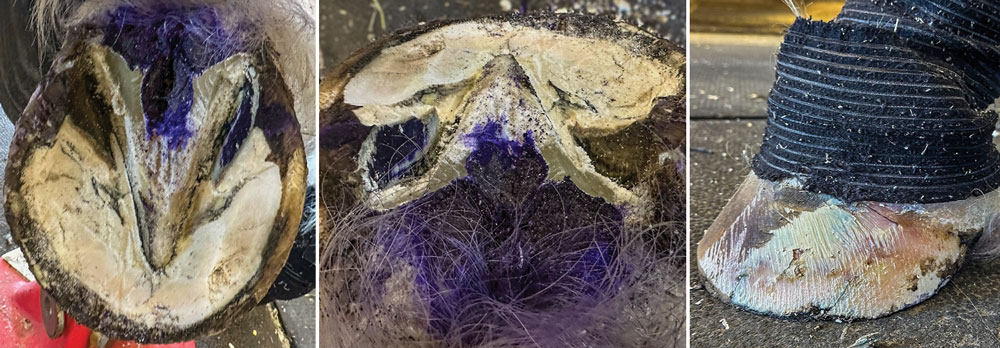
Jackson’s front feet were trimmed conservatively, given his recent history. IMAGES: Esco Buff
These radiographic findings helped clarify why mechanically sound adjustments at the hoof level had failed to produce sustained improvement. The primary driver of Jackson’s pain was increasingly articular rather than podiatric in origin. In short, the limitation was no longer the hoof capsule’s ability to be supported but the joints’ reduced tolerance for mechanical influence.
It was also noted that Jackson’s comfort declined when the owner discontinued feeding HEIRO (Healthy Equine Insulin Rescue Organical). HEIRO is a natural supplement formulated to support horses with insulin resistance, laminitis and chronic foot pain through a blend of organic herbs, magnesium and vitamin E. Based on the owner’s observations and the overall clinical picture, the veterinarian recommended that Jackson be returned to this supplement.
Simplifying the Mechanics
Armed with this information, the shoeing strategy was simplified. A size 7 Glushu was reapplied using a mesh screen for retention but without a frog or bar pour. Farrier’s Choice Sole Pack and Seal was used for solar protection, providing a mild, forgiving interface between the foot and the ground rather than structural augmentation.
As in previous cycles, the toe tab was removed, the shoe’s toe was dressed to ease breakover and the shoe was set slightly back to reduce dorsal leverage and limit stress across the coffin joint.
This approach intentionally avoided adding rigidity or focal pressure to the caudal structures. Rather than attempting to “correct” joint-driven discomfort through increased support, the objective shifted to eliminating excess variables and allowing Jackson’s limb to load as naturally as possible within the constraints imposed by his arthritis.
Response & Clinical Significance
The owner reported a slight improvement the following day. Jackson appeared more comfortable and exhibited less pointing of either front limb.
Two weeks after resuming HEIRO supplementation, the improvement became pronounced. Jackson was more comfortable overall. He was no longer pointing either front limb and moved with greater willingness and fluidity. His resting posture was more symmetrical, and he spent significantly less time shifting weight or unloading his front feet.
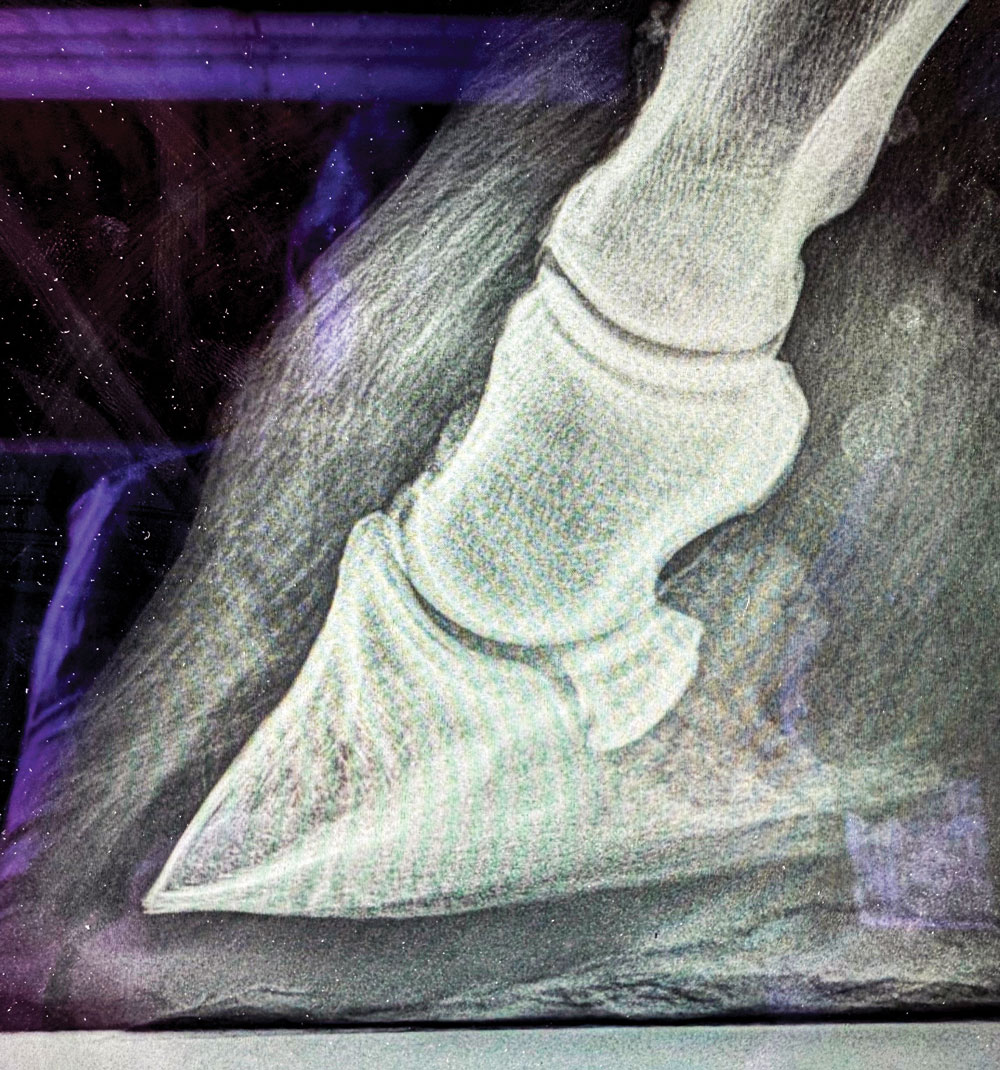
Radiographs show a mild but measurable increase in arthritic changes in the coffin joint, P2 and P1.
This positive response reinforced the conclusions drawn from the radiographs — restraint proved more effective than intervention. By reducing mechanical intensity and avoiding firm caudal engagement, we minimized aggravation of compromised joints while protecting the hoof capsule and sole. Just as importantly, the consistent improvement following the reintroduction of HEIRO further supported its role in helping Jackson maintain comfort.
Chronic Management Reflections
Jackson’s progression underscores an essential principle in managing advanced distal limb arthritis, sidebone and podotrochlear involvement — more support is not always better.
While modern materials and farriery techniques offer powerful tools, their effectiveness depends on the physiological tolerance. As joint degeneration advances, the margin for aggressive mechanical influence narrows, and comfort may depend on subtle reductions in leverage than on structural augmentation.
Going forward, Jackson will remain on a closely monitored, minimalist platform — one that prioritizes ease of breakover, consistent protection and adaptability from cycle to cycle. Any future adjustments will be guided first by his clinical response, second by diagnostic imaging and only then by mechanical support.
Looking Ahead
Managing Jackson’s condition will rely on careful observation, conservative intervention and timely reassessment.
Regular 5-week trimming and shoeing intervals will be maintained to ensure consistent breakover and sole protection, with particular attention paid to subtle changes in posture, stance and movement between cycles. Any indication of declining comfort — such as renewed pointing, shortened cranial phase of stride or increased weight shifting — will prompt reevaluation before mechanical escalation is considered.
Follow-up radiographs will be utilized as needed to monitor arthritic changes and to confirm mechanical strategies remain appropriate for the internal structures they are intended to support. Adjustments to shoe placement, breakover location or materials will be made incrementally, prioritizing reversibility and minimizing risk of joint irritation. The overarching goal is not correction, but supporting comfort and function.
Client Involvement
Clear and consistent communication with Jackson’s owner has been integral. From the outset, expectations were framed around long-term comfort management rather than mechanical resolution of pathology.
The owner was encouraged to report even subtle day-to-day changes, recognizing that early feedback often provides more meaningful insight than scheduled evaluations alone.
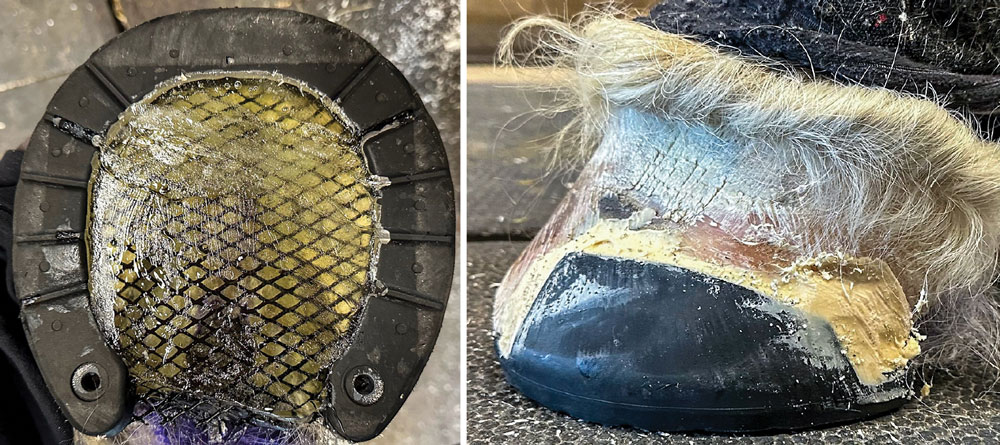
Jackson was shod with a size-7 Glushu with a mesh screen for retention. Farrier’s Choice Sole Pack and Seal was applied for sole protection.
The decision to simplify mechanics and reinstate HEIRO supplementation was made collaboratively, integrating radiographic findings, clinical observation and the owner’s firsthand experience of Jackson’s comfort fluctuations.
This shared decision-making process not only improved compliance but also fostered a realistic understanding of the chronic nature of Jackson’s condition. By maintaining transparency and aligning goals, the care team and owner were able to respond quickly and appropriately as Jackson’s needs evolved.
Conclusion
Jackson’s case illustrates the nuanced balance required when managing advanced distal limb arthritis, sidebones and podotrochlear involvement.
While farriery offers powerful tools for influencing load and leverage, those tools must be applied with restraint as joint tolerance diminishes. In this instance, simplifying mechanics — rather than intensifying them — proved to be the most effective path forward.
The integration of diagnostic imaging, conservative mechanical strategy and supportive nutritional management allowed Jackson to regain a more comfortable and functional baseline.
Perhaps most importantly, this case reinforces a critical lesson in chronic care. Meaningful progress often doesn’t come from doing more, but from understanding when less is enough by respecting physiological limits and responding thoughtfully to feedback.

Over the course of a year, International Horseshoeing Hall of Fame member Esco Buff takes us on a hoof-care journey with Jackson, a 15-year-old Clydesdale cross gelding. The Clearwater, Fla., farrier documents each detail — the trim, shoeing, nutritional decisions, vet visits and his job — in this living case study.