
Takeaways
- As Jackson’s arthritic pain became better controlled medically, the need for intensive mechanical intervention diminished.
- Farriery is not simply the application of mechanics to the hoof capsule. It’s the ongoing interpretation of movement, pathology, environment, nutrition, behavior and time itself.
- Jackson’s journey stands as a reminder that progress is often found not in dramatic changes but in the steady accumulation of thoughtful ones.
Over the course of this yearlong series, Jackson’s case evolved from what initially appeared to be a straightforward hoof-care chronicle into a detailed exploration of chronic distal limb management, farriery decision-making and the delicate balance between mechanical support, medical treatment, environment and physiology.
Jackson — a 15-year-old Clydesdale cross gelding used for pleasure and trail riding — presented with a complex but familiar collection of challenges: sidebones, podotrochlear changes (i.e., navicular bone changes), pastern arthritis (ringbone), endocrine influences (nonthyroidal illness syndrome), prior orthopedic injury (left hind stifle meniscal tear), intermittent sole sensitivity and chronic anhidrosis (i.e., problems sweating). While none of these issues existed in isolation, each influenced the others in subtle but clinically important ways.
Throughout the year, the series documented how seasonal conditions, hoof growth, footing, nutrition, workload and metabolic status continually shaped his comfort and movement. Early observations of sole bruising, shifting posture and altered gait mechanics eventually led to updated radiographs, which confirmed progressive arthritic and podotrochlear changes. Those findings redirected the mechanical strategy away from simply protecting the hoof capsule and toward reducing leverage, easing breakover and improving caudal support.
No Single Fix
As Jackson’s chronicle progressed through subsequent cycles, one theme became clear: Chronic distal limb problems are rarely managed through a single “fix.” Instead, successful management depends on continual reassessment, thoughtful restraint and the willingness to adapt mechanics as the horse’s physiological tolerance changes over time.
Glue-on technology became an important part of Jackson’s management when hoof wall quality no longer allowed safe traditional nailing. Size 7 Glushus paired with various pour-in materials provided improved support, shock absorption and comfort while preserving hoof integrity. Different approaches were trialed over multiple cycles, including softer sole support, firmer frog engagement, straight-bar-style support and periods of simplified mechanics.
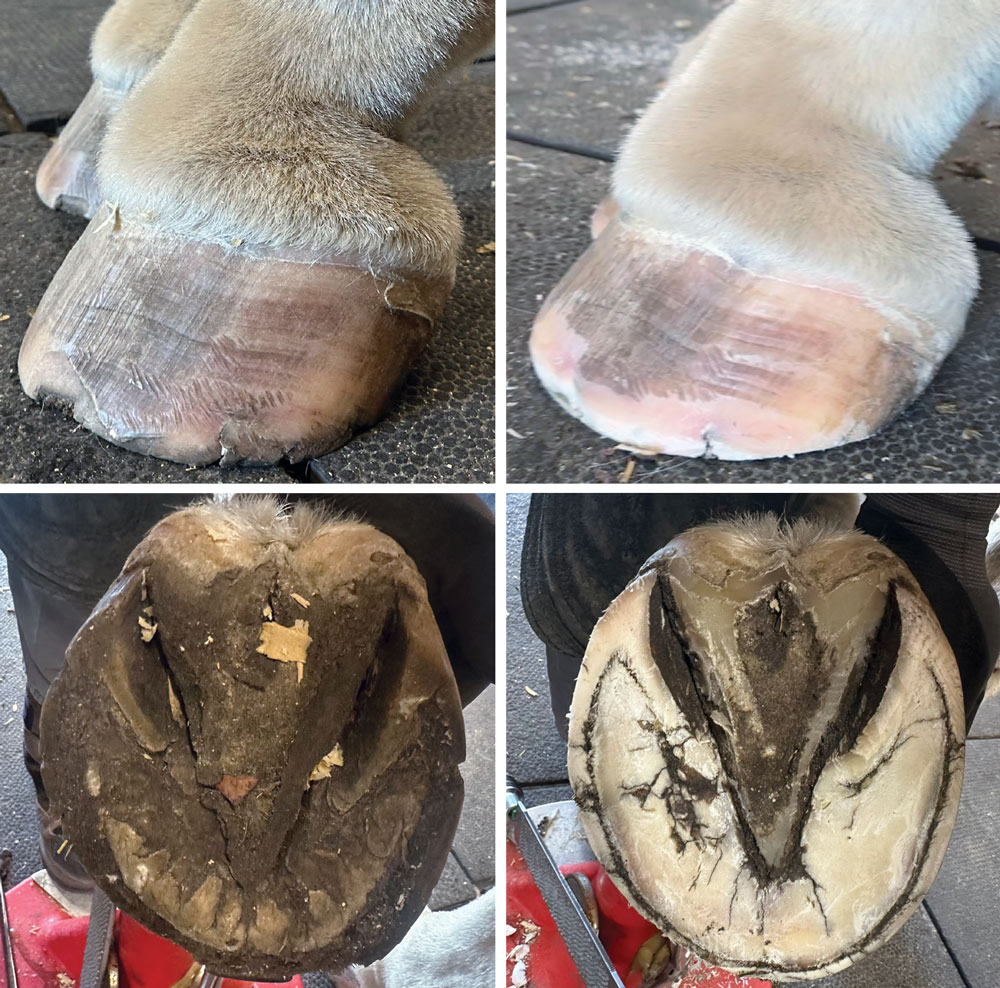
Jackson’s left front hoof, pre- and post-trim. The 15-year-old Clydesdale cross gelding has a collection of foot-related challenges, including sidebone, podotrochlear changes, ringbone, endocrine influences and intermittent sole sensitivity. Esco Buff
Following an abscess cycle, mechanical support was cautiously reintroduced using a revised glue-on configuration designed to reduce dorsal leverage and restore caudal support while minimizing additional stress on compromised structures. Yet, despite structurally successful applications and excellent durability from the Glushu platform, Jackson’s comfort continued to fluctuate. Subtle stance adaptations, intermittent pointing, shortened stride length and inconsistent caudal loading revealed that the source of discomfort extended beyond hoof mechanics alone.
Simplifying Mechanics
Updated radiographs ultimately clarified the picture. While sidebones and navicular structures remained stable, arthritic progression (ringbone) within the distal interphalangeal joint and adjacent phalangeal structures had advanced. These findings reinforced an important lesson: Mechanically correct solutions do not always translate into clinical comfort when articular pathology becomes the dominant driver of pain.
At that stage, the strategy shifted from increasing support to simplifying mechanics. Frog pours and rigid caudal engagement were removed, leaving only protective solar support and a carefully positioned Glushu designed to ease breakover and reduce joint stress. Rather than attempting to force stability through increasingly aggressive mechanics, the goal became minimizing variables and allowing the limb to function as naturally as possible within the limitations imposed by chronic degeneration.
The response was revealing. Jackson became more comfortable, his stance normalized, and the constant weight-shifting behaviors diminished. Reintroduction of HEIRO supplementation improved his overall comfort and willingness to move, reinforcing how nutritional and metabolic management influences horses with chronic foot pain and inflammatory joint disease.
Improving Comfort
Perhaps the most significant turning point came following Osphos therapy and subsequent medical stabilization. As Jackson’s articular discomfort improved, his load tolerance increased and the necessity for continued mechanical support diminished. By the end of the cycle, accelerated hoof growth and increasing toe length — not structural instability — became the primary source of mild discomfort. This realization prompted another thoughtful transition: a return to barefoot management.
“Farriery is the interpretation of movement, pathology, environment, nutrition, behavior and time itself…”
At the subsequent appointment, Jackson’s shoes were removed and a conservative trim was performed to maintain balance while reducing delayed breakover caused by increased toe length. Rather than representing a reduction in care, the return to barefoot reflected an evolution in management — a progression made possible because the horse’s physiology, comfort and movement had changed.
The response to shoe removal was immediate and striking. Within 24 hours, Jackson returned to soundness, moving freely and comfortably. Over the following weeks, he remained balanced, willing and notably happier in turnout and work. His posture normalized, his stride became more fluid and his overall demeanor appeared brighter and more relaxed.
Controlling Arthritis Pain
Medical management also played a critical role throughout the process. Nutritional stabilization, endocrine monitoring, HEIRO supplementation and Osphos therapy all contributed to improving Jackson’s overall comfort threshold and willingness to move. As his arthritic pain became better controlled medically, the need for intensive mechanical intervention diminished.
Today, Jackson remains stable and continues to do very well. He is comfortable, sound in regular activity and maintains a consistent level of function and quality of life. While his chronic conditions still require ongoing monitoring and thoughtful management, his current stability reflects the success of a collaborative, adaptable approach built around the horse’s individual responses rather than rigid adherence to any single method or philosophy.
Jackson’s case ultimately reinforced several enduring principles.
- Chronic cases demand flexibility rather than rigid adherence to one philosophy.
- More support is not always better.
- Mechanical and medical management are complementary, not competing, strategies.
- Radiographs and clinical feedback must guide decisions together.
- Simplicity can sometimes provide greater comfort than complexity.
- Hoof care can never be separated from the rest of the horse.
- The horse’s response — not the farrier’s preference — must determine the path forward.
Thoughtful Changes
Throughout this series, Jackson continually reminded me that farriery is not simply the application of mechanics to the hoof capsule. It’s the ongoing interpretation of movement, pathology, environment, nutrition, behavior and time itself. Every trim, every material choice, every radiograph and every conversation with the owner and veterinarian became part of a larger process of listening to what the horse was telling us.
In the end, Jackson’s story was not about achieving perfection. It’s about listening carefully, adapting thoughtfully and making incremental decisions. It was about preserving comfort, maintaining function and respecting the limits imposed by chronic disease while still allowing the horse to live comfortably and willingly within those boundaries.
Jackson’s journey stands as a reminder that progress is often found not in dramatic changes but in the steady accumulation of thoughtful ones. One trim, one decision and one cycle at a time.
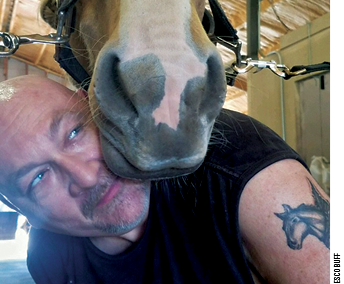
Over the course of a year, International Horseshoeing Hall of Fame member Esco Buff takes us on a hoof-care journey with Jackson, a 15-year-old Clydesdale cross gelding. The Clearwater, Fla., farrier documents each detail — the trim, shoeing, nutritional decisions, vet visits and his job — in this living case study.