Takeaways
- While springtime is often associated with laminitis, fall is also a critical period for monitoring equine health due to specific climatic and hormonal factors.
- Contrary to earlier theories focusing on fructan, recent research identifies high insulin levels as the conclusive risk factor for pasture-associated laminitis.
- Owners should monitor for non-obvious symptoms that precede laminitis, such as unexplained weight loss, loss of topline, potbelly appearance, increased appetite, lethargy or new skin sensitivities and allergies.
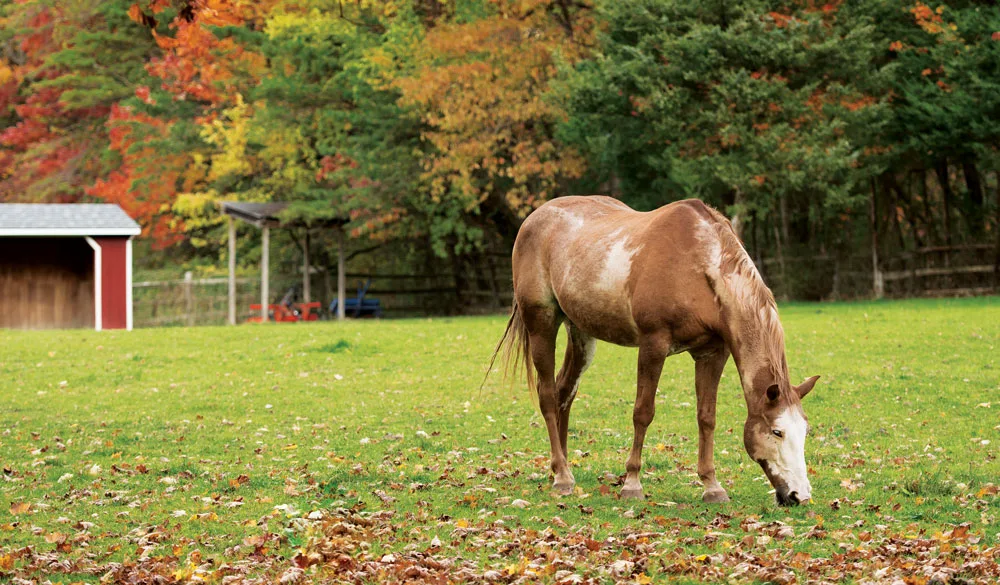
We tend to associate springtime with laminitis, but fall is also a high risk for many horses.
Two decades ago, it was shown that laminitis in some areas correlates with a rise in pasture fructan levels and that tubing a horse with large amounts of fructan can induce laminitis. The fructan theory of pasture laminitis was born.
However, association is not causation. We now have many studies, including an excellent 3-year prospective study by Drs. P.A. Harris, J. Elliott and N.J. Menzies-Gow (2016), clearly showing high insulin is the conclusive risk factor for pasture laminitis.
Fructan is not digestible in the horse’s small intestine and does not cause an insulin rise. It causes laminitis by the same method as the “horse broke into the feed room.” It’s rapidly fermentable, causing hind gut acidosis, bacterial product leakage across the damaged intestinal wall and a systemic inflammatory response.
Furthermore, the fructan type used to induce laminitis was chickory root inulin, while grasses primarily have Levan, a more complex and slowly fermenting form. The amount of chickory inulin that could reliably induce laminitis, delivered as a bolus by stomach tube, was 3,750 grams (8.27 pounds). This would be the equivalent of a grass with 37.5% of its dry matter as fructan, while typical concentrations in North American hays are in the single digits.
Climate Influence
The warm days and cold nights of fall contribute to laminitis risk on pasture for horses with metabolic syndrome and high blood insulin. This is because when temperatures at night fall below approximately 40 degrees Fahrenheit, the grass stops using the sugars accumulated during the day for growth. The common practice of turning at-risk horses out at night or in the early morning will no longer be effective, but high sugar in fall pasture is not the only driver of high insulin and fall laminitis.
The major contributor to fall laminitis has nothing to do with pasture and can affect any horse. There is a seasonal rise in the hormones produced by the middle lobe of the pituitary, the proopiomelanocortins or POMCs. These include endorphins, melanocyte-stimulating hormone, ACTH (adrenocorticotropic hormone) and CLIP (corticotropin-like intermediate peptide). These are the same hormones produced in high levels in horses with pituitary pars intermedia dysfunction (PPID), commonly known as Cushing’s disease.
“Seasonal rise in hormones are the major contributor to fall laminitis…”
In normal horses, this temporary elevation does not cause problems, but horses in the early stages of PPID have an exaggerated rise that can push them into an unexplained laminitis by causing insulin resistance and high insulin levels.
In horses with metabolic syndrome, it’s possible the normal increases in all hormones may be enough to tip them over the edge to laminitis from hyperinsulinemia. A common scenario is a horse in its teens that has never had a full-blown laminitis episode but has a history of easy weight gain and cresty neck, getting worse with age, coming down with its first laminitis bout in the fall.
Subtle Changes
Equine Cushing’s and Insulin Resistance (ECIR) Group members have seen laminitis in their horses in their teens, often not a typical metabolic breed, that begin losing weight late in summer/early fall with no apparent reason. The owner may have tried adding protein and/or calories with continued report of unresolved muscle loss in the top line. These cases may well have early PPID but often test negative for ACTH, which is an insensitive test, missing 35-40+% of early cases.
Many subtle changes not picked up by owners and professionals in the early cases of PPID are the following. All of these commonly occur before fall laminitis in adult horses with or without obesity.
- Loss of topline and a potbelly appearance.
- Weight loss.
- Increased appetite.
- Lethargy.
- Skin sensitivities.
- Minor shedding changes.
- Worsening insulin resistance.
- Appearance of new allergies.
- Unexplained tendon or ligament problems.
- Increased drinking and urination in the fall.
Horses previously diagnosed as PPID need to be followed to ensure their disease is managed and insulin is controlled. High insulin often can be driven by PPID and should be especially noted in the typical nonmetabolic breeds. ECIR Group recommends endocrinopathic (metabolic) testing and a careful assessment of clinical signs as described above.
What is ECIR Group?
Started in 1999, the Equine Cushing’s and Insulin Resistance (ECIR) Group is the largest field-trial database for PPID and EMS in the world and provides the latest research, diagnosis and treatment information, in addition to dietary recommendations for horses with these conditions. Even universities do not and cannot compile and follow long term as many in-depth case histories of PPID/EMS horses as the ECIR Group.
In 2013, the ECIR Group Inc., an Arizona nonprofit corporation, was approved as a 501(c)3 public charity. Contributions and grants support ongoing research, education and awareness of Equine Cushing’s Disease/PPID and EMS.
The ECIR Group’s mission is to improve the welfare of equines with metabolic disorders via a unique interface between basic research and real-life clinical experience. Prevention of laminitis is the ultimate goal. The ECIR Group serves the scientific community, practicing clinicians and owners by focusing on investigations most likely to quickly, immediately and significantly benefit the welfare of the horse.
Contributions support ongoing education and awareness of Equine Cushing’s Disease and Insulin Resistance. ecirhorse.org/how-to-help-ECIR.php
If your client’s horse develops unexplained fall laminitis, follow these steps:
- Advise them to ask their veterinarian to check ACTH and insulin levels.
- Remove the horse from any grass access.
- Submit a hay analysis, including wet chemistry ESC and starch to determine safety of the hay (ESC + starch % should be less than 10).
- Contact a nutritionist to get the diet correctly balanced.
- Advise them to speak with their vet about the possibility of using pergolide at least on a seasonal basis (late June to mid-December) to control the hormones.
Learn More
Gain more insight about endocrinopathic laminitis by reading:
Resources
- Menzies-Gow NJ, Harris PA, Elliott J, Prospective cohort study evaluating risk factors for the development of pasture-associated laminitis in the United Kingdom. Equine Veterinary Journal, Volume 49, Issue 3 pp. 300-306, Article, 01 July 2016, doi.org/10.1111/evj.12606.
- Seasonal Rise, ECIR Group Inc. ecirhorse.org/seasonal-rise.php.