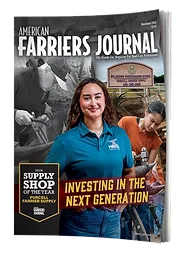
Below are key farrier takeaways from several of the features found in the November 2025 issue of American Farriers Journal.
Adjusting Jackson’s Hoof-Care Plan
- The rapid wet-dry cycle stresses the white line and hoof wall strength.
- Although Jackson’s metabolic management remains stable, vigilance is required to keep him on the correct path.
- Limited horn quality leads to the application of GluShus and Vettec Equi-Pak pour-in pads.
Missouri Farrier Keeps Arabian Show Horses Dialed in
- Providing hoof care in the show world requires quick thinking, problem-solving skills and extreme efficiency.
- When dealing with a medial hoof crack, the lateral toe will be long and pull the foot open. Release the inside heel and outside toe to stop the crack from recurring.
- The foot tells you what it needs, if you listen to it. Wear on the shoe’s lateral toe tells Mike Norris the medial heel is too high.
Can Hot Shoeing Horses Harm Farriers?
- Studies examining incineration of keratin-rich materials report that burning releases ammonia, nitrous oxide, hydrogen sulfide, carbon dioxide and methane. These gases contribute to environmental pollution and would also irritate the respiratory tract.
- Although studies on hot‑shoe smoke are rare, farriers often report symptoms reminiscent of chronic smoke exposure, including persistent coughs, sinus irritation and breathlessness.
- Farriers should consider respirators with P100 or N95 filters capable of capturing ultrafine particles and gases.
Measuring the Effects of Shoe Placement
- The size of each horse and its corresponding hoof influences shoe placement and the degree of setback.
- An optimal point zero moment toe liftoff, or breakover, is best facilitated with a shoe placed in such a way that a line can be drawn from the point of the coffin bone straight down to the start of the roll.
- Although the frog distorts, it is a useful visible fixed reference point for shoe placement.
Good Financial Planning Can Safeguard Farriers’ Future
- Analyzing costs and weighing them against profits can help farriers better understand their current financial situation. This can lead to better spending habits and help prioritize setting aside money for the future.
- Protecting yourself and your business from liability concerns through insurance is crucial. It’s also important to have an emergency fund ready for unexpected expenses.
- Avoid debt at all costs, as it’s a barrier to building equity. Part of being financially successful is being free to make purchasing, investment and savings decisions without the added weight of debt.
Successful Farriers Set Goals, Stay Organized & Build Trust
- Establish personal and career goals and communicate them clearly to your mentor so they can help you achieve them. Build trust with your mentor by meeting their expectations and pushing yourself out of your comfort zone.
- Set yourself up for success by staying organized and being on time, which garners client respect.
- Build positive relationships with your peers and clients so that you can expand your business and customize it to fit your needs.
Lean on Your Farriery Village & Always Give Back
- Build a network of mentors and peers to lean on. Resisting isolation is a key to growth.
- Get involved in local and national organizations and attend clinics, contests and certifications to continue to learn and improve as a farrier.
- Stay self-motivated and passionate, and say yes to any opportunity that presents itself.