
Takeaways
- The rapid wet-dry cycle stresses the white line and hoof wall strength.
- Although Jackson’s metabolic management remains stable, vigilance is required to keep him on the correct path.
- Limited horn quality leads to the application of GluShus and Vettec Equi-Pak pour-in pads.
In the opening installment, I laid the foundation for Jackson’s yearlong chronicle — his history, management and the delicate balance of health factors that make him both representative and instructive to footcare professionals.
With the first month of documentation behind us, his story is beginning to take shape. Subtle lameness observations, shifts in hoof quality and environmental stressors are already influencing farriery decisions, owner management and our shared preparation for what lies ahead.
Hoof Observations
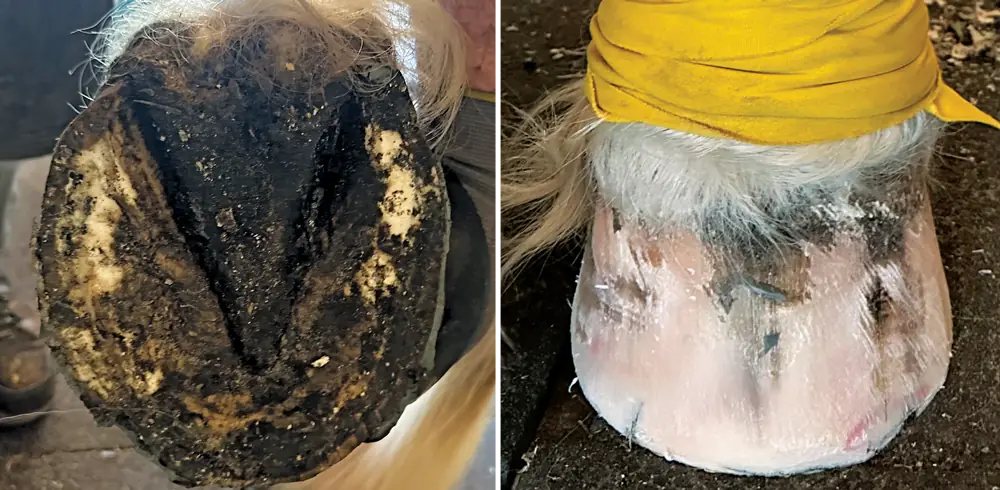
Fronts. A slight medial-lateral imbalance persists due to Jackson’s preferred posture. Hoof wall integrity is better than expected despite summer rains and humidity. His sole depth is adequate, but minor bruising is emerging in both fronts.
Hinds. The left hind (site of prior meniscal injury) continues to load unevenly.
Environmental Effects
The Southeast summer is testing Jackson. Afternoon thunderstorms soften pasture footing, only for intense heat to harden it again within a day.
This rapid wet-dry cycle stresses the white line and hoof wall strength. Early thrush is developing in the left hind frog commissures, which is starting to be managed by the owner with a topical thrush treatment.
Metabolic Assessment
Jackson’s metabolic management remains stable on pergolide and levothyroxine for pituitary pars intermedia dysfunction (PPID). However, recent bloodwork shows normal insulin levels (15.35 ulU/mL), a low free thyroxine hormone (T4) (0.82 ng/dL) and a low total T4 (2.56 ng/mL), accompanied by a high post-TRH response value (239 pg/mL).
These findings, according to the veterinarian, may indicate a nonthyroidal illness syndrome (NTIS) or euthyroid sick syndrome rather than true hypothyroidism. This condition occurs when thyroid hormone levels appear low despite normal thyroid function, often influenced by factors such as age, seasonal hormone rhythms, diet, climate, reproductive status and level of physical activity.
“Calibrated weight scale tracks subtle fluctuation…”
Additionally, certain medications, including those used to manage PPID, can displace thyroid hormones from their protein-bound state in the bloodstream, resulting in artificially low laboratory values. Because of these influences, dynamic testing and broader clinical context remain essential before adjusting thyroid therapy.
Nutrition
Jackson’s forage adjustment after colic surgery remains steady with no decline noted. His diet remains unchanged: forage twice per day, one-half cup of Triple Crown Senior per day and one-half cup of Tribute Essential K per day.
The 15-year-old Clydesdale cross gelding is maintaining a consistent weight around 1,720 pounds as verified by a calibrated weight scale, which provides a far more accurate assessment than weight tape estimates. Regular use of the scale allows me to track even subtle fluctuations that might otherwise go unnoticed, offering an early indicator of metabolic or dietary adjustments needed.
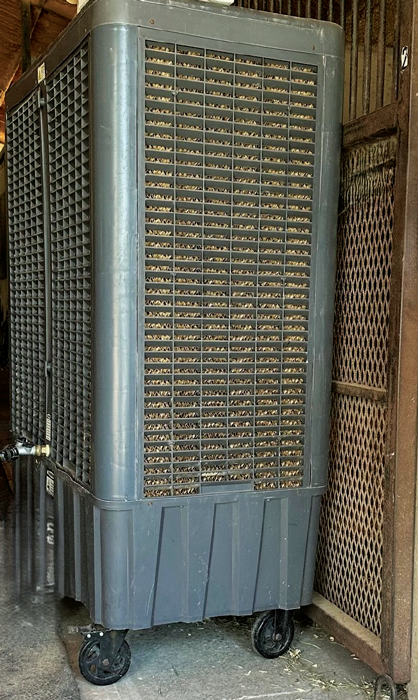
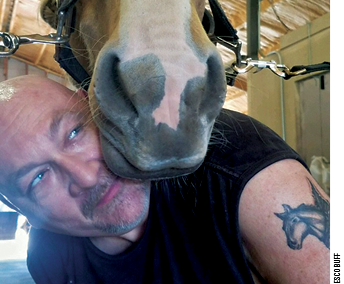
Jackson continues struggling with regulating body temperature due to anhidrosis. The gelding’s owners try to make him more comfortable with several management techniques such as shade, hydration, electrolyte supplementation and cooling fans. Source: Esco Buff
His hoof quality holds steady despite humidity, supported by careful pasture management and consistent farriery. I remain alert, however, to Jackson’s metabolic influences. Pergolide and levothyroxine help, but vigilance is required.
Persistent Challenges: Anhidrosis
Jackson continues to struggle with sweating. Due to having anhidrosis, Jackson’s sweat glands fail to function normally when his body temperature increases.
Despite shade, hydration, electrolyte supplementation, cooling fans, daily alcohol baths and adjusted turnout (late night to sunrise), his ability to regulate body temperature remains limited. While not directly tied to hoof care, this condition influences workload, conditioning and overall comfort — factors I must weigh in every trim and discussion with his owner.
The exact cause of anhidrosis is unknown, although hormonal and neurological factors may play a role. There is no known cure for this condition.
When considering an alcohol bath, it’s essential for owners to consult the veterinarian first. Rubbing alcohol should be used sparingly, as it can dry the skin.
Alternative cooling methods, such as cold-water baths or ice packs, are often safer and can provide effective relief without the risk of skin irritation.
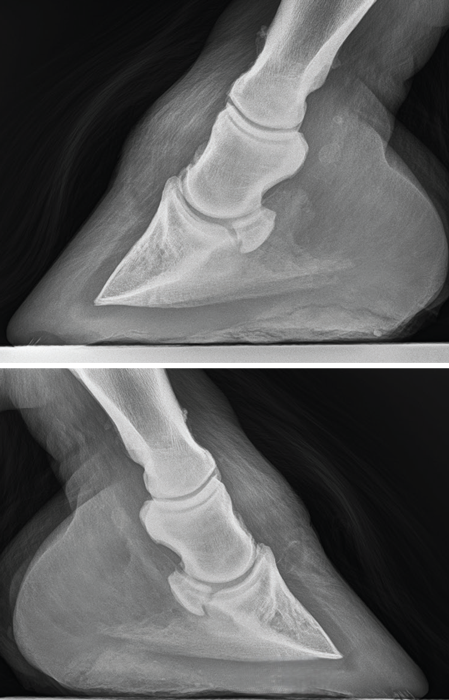
While Jackson’s sidebone remains unchanged, radiographs show early navicular remodeling in the right front and arthritic changes in the lower half of both front pasterns. Source: Esco Buff
Radiographic Revelations
In mid-July, radiographs confirmed unchanged sidebone progression but revealed early navicular remodeling in the right front and arthritic changes in both front pasterns.
These changes are occurring in the lower half of the second phalanx (P2 or short pastern bone), affecting both articular (in the joint) and non-articular surfaces — classic ringbone.
This shifts my priorities. My focus now is on improving enrollment and easing caudal hoof loading, especially in the right front. The veterinarian and I agreed to monitor with quarterly imaging.
When Nails aren’t an Option
The radiographs clarified another challenge: Jackson’s front hoof walls offered too little quality horn for safe nailing and the ability to maintain a shoe on the hooves. Rather than compromise the hoof further, I turned to glue technology.
- Application: Size 7 Glue-U Glushu applied to both fronts.
- Support: Equi-Pak pour-in pad for uniform solar support and shock dissipation.
“The focus is on improving enrollment and easing caudal hoof loading…”
This combination delivered immediate results. Jackson’s stride lengthened, his weight was distributed more evenly, and the shortened, guarded step I’d observed eased noticeably. His owner quickly confirmed the difference — Jackson simply moved more comfortably.
Training & Behavior
Groundwork was reduced during the hottest weeks. Before trimming and gluing on shoes, Jackson showed more reluctance to walk on gravel, aligning with the sole sensitivity I noted. He is now moving more comfortably across gravel.
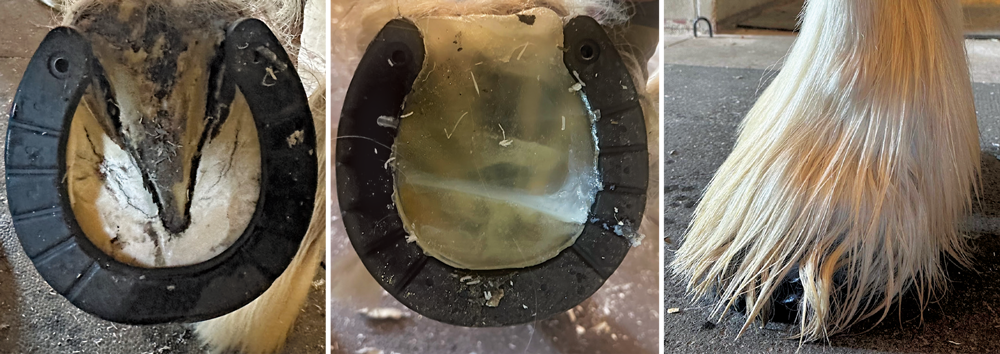
Jackson’s horn quality isn’t safe for nailing. A size 7 Glue-U Glushu was applied to both front feet. In addition, a Vettec Equi-Pak pour-in pad was provided for uniform solar support and shock dissipation. Source: Esco Buff
Reflections for Farriers
- Environmental vigilance is critical. Rapid wet-dry cycles can erode wall integrity faster than many owners realize and can create retracted soles. Proactive education about turnout times and conditions can help prevent setbacks.
- Radiographs redirect. July’s imaging shifted my management away from a “sidebone horse” model toward podotrochlear changes (navicular syndrome) and pastern arthritis (ringbone). Imaging redefined the plan before lameness became more obvious.
- Glue-on shoes are not a last resort. They are strategic tools. In Jackson’s case, they preserved his limited hoof wall integrity while providing mechanical support and comfort.
- Support materials matter. Equi-Pak distributed pressure, provided shock dissipation and boosted overall comfort.
- Soundness is multifactorial. Arthritis, hoof quality, environment and endocrine factors all intersect. Managing them in concert will be a challenge and will be the key to progress.
- Documentation catches patterns. Journaling sole depth and consistency, sole bruising and hoof imbalances creates a living timeline that links causes with effects.
Looking Ahead
The next phase of Jackson’s chronicle focuses on how he responds to the latest developments, as well as monitoring existing challenges.
- How well the glue-on horseshoes hold up due to his size and the environment he lives and works in.
- Whether pastern arthritis and navicular changes progress.
- If nutritional stability continues through late-summer grazing.
- Ongoing strategies to mitigate anhidrosis.
Jackson underscores a truth that farriers often carry quietly: our work extends beyond hooves. We shape the well- being of the whole horse — and, in a sense, time itself. Each trim influences immediate comfort while laying the foundation for what lies ahead.
Gain more insight about “1 Year, 1 Farrier, 1 Horse” by:
- Reading “A Year in the Life of a Horse,” in which Esco Buff establishes Jackson’s baseline.
- Watching the “1 Horse, 1 Farrier, 1 Year Podcast,” presented by Triple Crown.
- Visit the Triple Crown Feed Farrier Resources page for a comprehensive guide that details not only how to manage common conditions such as laminitis and leaky gut syndrome, but also how to prevent them through nutrition.
- Download the Triple Crown “Feeding Metabolic Horses Prone to Laminitis,” which details how diet affects horse’s hooves.
Access this exclusive content by visiting November's Online Extras page!
Over the course of a year, International Horseshoeing Hall of Fame member Esco Buff takes us on a hoof-care journey with Jackson, a 15-year-old Clydesdale cross gelding. The Clearwater, Fla., farrier documents each detail — the trim, shoeing, nutritional decisions, vet visits and his job — in this living case study. This installment was made possible by Triple Crown Nutrition.