
Takeaways
- The size of each horse and its corresponding hoof influences shoe placement and the degree of setback.
- An optimal point zero moment toe liftoff, or breakover, is best facilitated with a shoe placed in such a way that a line can be drawn from the point of the coffin bone straight down to the start of the roll.
- Although the frog distorts, it is a useful visible fixed reference point for shoe placement.
Have you found yourself so frustrated with this job that throwing in the towel becomes a serious consideration?
The story I’m about to share sparked a 7-plus-year return to academics, two postgraduate degrees, a U.S. patent for a novel horseshoe and a research study examining breakover.
They say, “necessity is the mother of invention.” I argue that frustration might be. I find frustration and maybe aggravation a close second to be terrific motivators.
I’m a well-reputed grouch. I’ve been one for many years. However, I embrace and own my grouchiness. Don’t let it fool you, though, I care about horses. I care about the job I do and its outcome. I make every effort to ensure a horse’s comfort, and when possible, optimize their performance. I want my clients and their horses to be happy because when they are happy, I’m happy for them. I often argue that all farriers feel this way.
Frustration: The Mother of Invention
Once upon a time, in a hunter/jumper account far, far away, I shod for a journeyman professional jumper rider with an “OK” string of horses. I was a rider then, too. My passion for riding predates my start in our shared vocation. The rider came up under several top former Olympic riders and had a gift. However, the rider lacked the deep pockets often necessary to get onto the bigger stage. They did their best with what they had, winning and placing in some regional Grand Prix events, despite the stark reality that many of these horses had quirks, making their rideability and competitiveness tricky.
“Most horses perform in spite of what we do…”
Most riding professionals work hard to delay the end of a horse’s career and this professional was no different. An envelope was occasionally advocated to be pushed to improve or prolong performance, regardless of how potentially extreme the treatment or intervention. At some point during my tenure as farrier, a progressive veterinarian was enlisted for alternative therapies.
To put it simply, the veterinarian was a proponent of the “wild horse foot.” Notably, the horses at this farm didn’t come and/or live in the wild. They were mainly larger warmbloods, shod for performance that included jumping at the Grand Prix level.
For the record, I don’t have any issue collaborating with veterinarians. In fact, I had a professional, congenial working relationship with this vet. They were often complimentary of my work. Frankly, I didn’t necessarily disagree with their theory of improving toe length, alignment, breakover, etc. I mainly differed with their prescribed execution. The vet strongly advocated making significant changes to a hoof’s presentation in one shoeing. I normally attempt such a change in 3 to 6 months, up to a year, depending on the circumstances.
To avoid aggravation, I appeased the rider. I routinely worked at the farm alongside the vet when requested. Typically, the vet would make comments on effectively every horse they evaluated, noting how far I should go with the trim and where the shoe should be placed. I quizzically looked on. The recommendations seemed radical, and I feared the worst possible outcome should I comply.
Recognizing my horrified look, the vet reassured me, “It’s OK, I’ve spoken to the associated rider/trainer/owner. They accept that initially the horse likely will be unsound, but we will have achieved in one shot what would have taken a year, and that’s what is necessary.”
Let’s keep a few things in mind. None of the horses had any major or minor foot-related issues, nor did they require anything “special.” If another veterinarian had been enlisted, I believe they would have been most likely satisfied with my performance.
I was fortunate enough to have learned from some of the best in the business and made every effort to replicate their example. Chief among my teachers, and arguably the best in his time, was Seamus Brady. Of the many things Seamus stressed, after horses are shod, they better be able to work without issue, be as sound as when you started or even better. Creating a situation where things went sideways was to be avoided and, on the off chance they happened, they had better get resolved quickly.
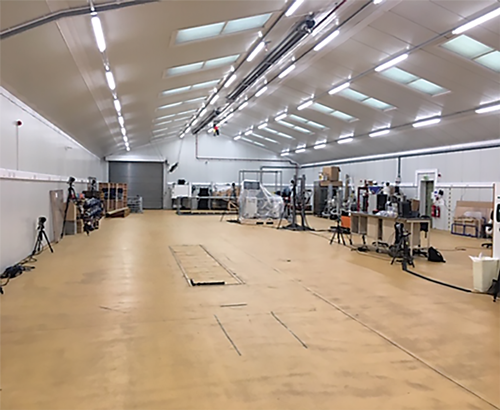
The Royal Veterinary College’s Structure and Motion Laboratory in Hawkshead, U.K. Source: Jude Florio
For a time, I appeased all the parties, tweaking as much as I could, staying within “conventional” boundaries. When appeasement was detected, I received a call from the rider requesting a more aggressive approach.
In fairness to the vet, it’s likely their recommendations were embellished, with the rider seeking a greater degree of change. For example, the rider spoke of shoeing changes to their horse, which had recently won a regional Grand Prix. The horse was a large (17’2hh +) warmblood, shod in #4s (Kerckhaert sizing) all around. The rider indicated “the vet” advised perhaps a smaller shoe, #3 or #2, would facilitate the significant backing necessary, placing the shoe’s toe near or in very close proximity to the apex of the frog. I thought the suggestion was pure lunacy and shared my concerns.
The conversation became somewhat one-sided. Have you ever found yourself on the phone, starting to wonder if the person got cut off? (“Hello, hello?”)
“How about the nails?” I asked.
“What about potential soreness, unsoundness?”
“When people ask you where your horse is at the shows, what will you reply?”
“Will you say, ‘He’s lame,’ and then provide a detailed explanation that includes vet instructions to the farrier or will you just simply say, “He’s sore because of the farrier?” Most likely followed up by asking, “Who is your farrier?” Essentially, smearing mud all over my good reputation, which we all know is everything in this business.
At some point after my filibuster, there was silence.
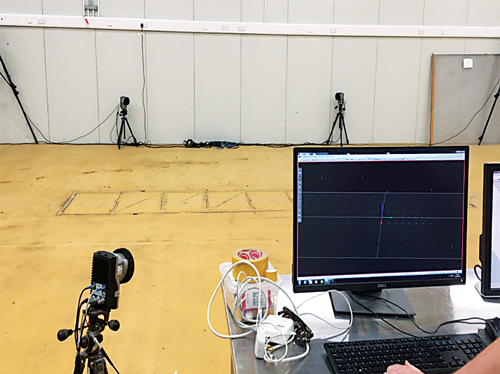
Motion capture cameras, Qualisys System and force plates (center floor boxes), at the RVC’s Structure and Motion Laboratory in Hawkshead, U.K. Source: Jude Florio
The rider finally chimed in with a displeased tone, “Just so I am clear, you are not willing to do what the vet is suggesting?”
“In good conscience, I could not,” I replied. “I don’t feel comfortable being that radical. I don’t believe it is necessary, nor do I want to be responsible for any possibility that I may intentionally cause harm or discomfort to a horse.”
With that, I heard a very curt reply, “OK.”
The rider hung up and with that, my tenure as their farrier ended. Twenty-five or more good-paying clients, as it was my impression, were very satisfied with my service. All of it went out the window with the click of the phone. It would be a painful pill to swallow, along with the negative financial ramifications, but I’ve learned everything happens for a reason. One door closes and another one opens.
GradDip Program
Several years later, the phone rings. It’s Tom Ciannello. I’ve known Tom for the better part of 20-plus years. We speak almost daily. Tom is another shoer in New Jersey, now enjoying his much-deserved retirement after 50-plus years in the industry, maybe doing an occasional trim or two to stay limber.
Tom has the distinct honor of being the last full, true Seamus apprentice, having learned the skill from scratch. Tom will proudly show you the signed contract and mention the necessary payment to Seamus for his tutelage. I worked for Tom early on in my career, usually on weekends or the odd days when I wasn’t needed elsewhere.
Tom has been and continues to be a great sounding board on all things career and life related, having twice positively intervened in my career.
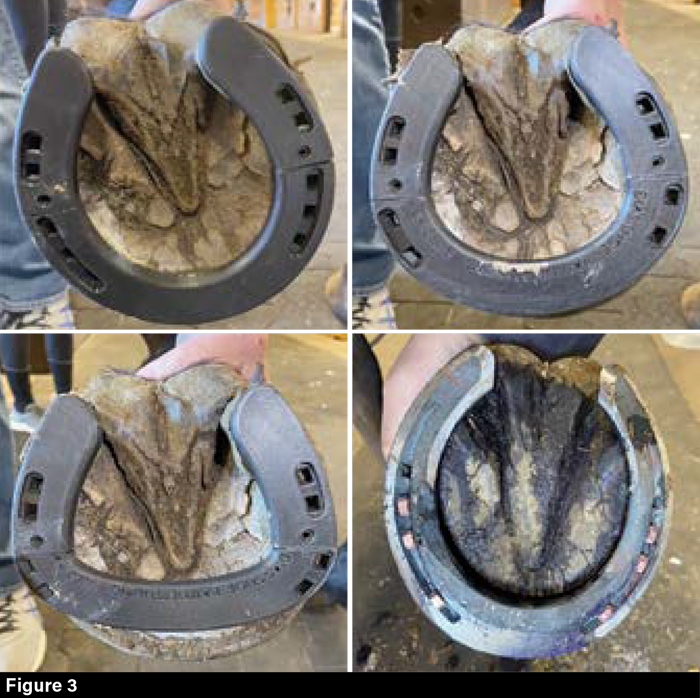
Shoeing conditions trialled in the study. A) DIAS shoe with a long toe. B) DIAS shoe with intermediate length toe. C) DIAS shoe with short toe. (D) Steel shoe. Source: Jude Florio
The first call was that Seamus needed a helper. And the second was when Tom read an article that the Royal Veterinary College (RVC) was offering a degree program for farriers through the University of Pennsylvania. He stressed, “You really should apply.” And I did.
I had phoned it in as an undergrad some 30-plus years ago, a long-held personal disappointment, and here was my opportunity to right some educational wrongs and, hopefully, improve my knowledge along the way. As fortune would have it, I was accepted.
The Graduate Diploma in Equine Locomotor Research course was the brainchild of Dr. Renate Weller, a veterinarian and researcher with a special interest in farriery. Originally established in the United Kingdom, visa restrictions precluded individuals from the U.S., leading Weller and her team to establish an accredited program in the States.
Admittedly, before my acceptance, if you were to ask me who Weller and her husband, a noted gait analysis researcher and instructor, Dr. Thilo Pfau, were, I would have said, “Who?” I was totally disconnected from research, lecturers, scientific publications, farrier conferences, etc. I read the occasional article, but my focus was keeping clients’ horses happy, staying busy, making money, and avoiding repeating stories like the one recounted earlier.
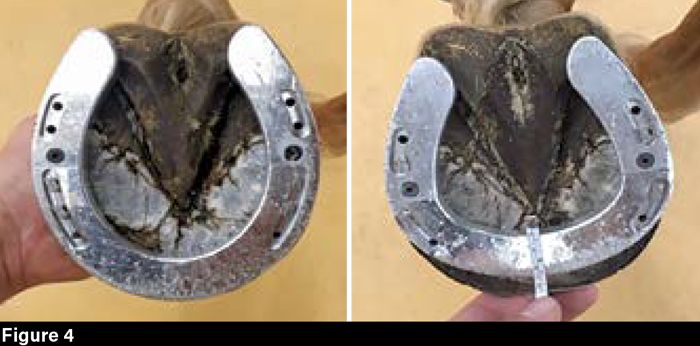
Subject horse with a DIAS prototype (left). The right image demonstrates the differing toe arc and its proximity to the frog's apex, evidenced with the tape measure. Source: Jude Florio
Weller’s vision was to foster a farrier’s ability to produce original research, noting in our first resident weekend, horseshoeing lacked comprehensive examination and existing research originated mostly from veterinarians.
Resident weekends at UPenn’s New Bolton Center were periodically required for intensive instruction. Unknown to me at that time, but on the first resident weekend, I would need to establish a future research project. The weekends included instructors from the U.K., participating farriers from the length and breadth of the U.S. and Europe. I had no clue who most of the farriers were, with a few exceptions.
The nice thing about this group was that egos were checked at the door. The group’s demographic varied and everyone had seemingly achieved some level of professional success. Ostensibly, we gathered with the singular notion that this opportunity would provide some useful knowledge and tools, offsetting the personal and professional sacrifice in costs, travel and time.
As the weekend unfolded, I began to recognize how far behind I was in the technical scientific aspects of farriery, anatomy, biomechanics and the use of associated terminology. Most of the participating farriers were well-versed in these subjects, including knowledge of recent trends in research and examination. I was the kind of guy who would observe the foot and decide how I would want it to look when I’m finished. Asking me to explain my approach using technical jargon, chapter and verse, with labels was another story. Fake it until you make it.
A Research Project is Born
During a particular lecture, Weller went around the room looking for participants to discuss an area of interest that would later form the basis of their research a few years later in the program. I sat there dumbfounded. I had no clue what I was going to do.
Adding to my anxiety was listening to everyone else ramble off every detail of what they wanted to explore. I had nothing. I’m pretty sure Weller and company might have chuckled. As we work-shopped my thoughts, I likely shared frustrations about my experiences related to these anecdotal arguments from veterinarians on backing and wanting to quantify whether it had the miracle effect some veterinarians claimed. It was a watershed moment, pie in the sky idea, but it was worth the shot. I’m an all-or-nothing character, “go big or go home.”
Huddled around a blackboard, a group of farriers, including New Bolton’s own Pat Reilly, helped brainstorm ideas for my project. I vividly recall Pat drawing examples of how to back the fulcrum point on a shoe, possibly applying a plate and then shifting it, while also detailing earlier studies that examined backing.
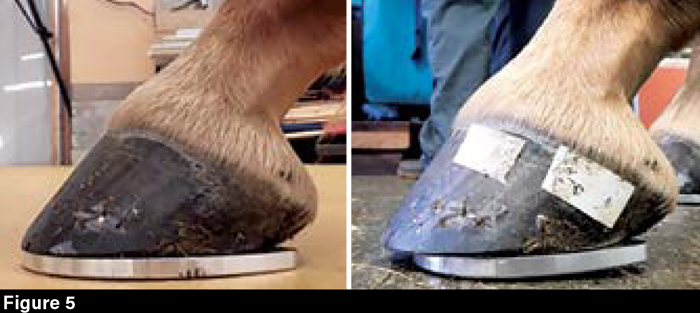
Lateral view of subject horse hoof in Figure 4, highlighting differences in application of long toe vs. short toe. Source: Jude Florio
The Grad Dip program would consist of 1½ years of prerequisite courses, requiring passage in preparation for the dissertation year. I had some time to think this problem through and I would need every bit of it to get this project off the ground and to the finish line.
To properly conduct research, a few things are necessary to have some measure of validity, including repeatability, variability and a robust homogeneous study group, a close third. Repeatability implies another researcher’s ability to follow your exact methodology, resulting in the same or similar conclusions. Variability is more involved, multi-faceted, but essentially, the more variables that exist in each study, the greater possibility exists to question the results and any conclusions drawn. The greater the numbers in a homogeneous study group, the stronger the argument one can make regarding the conclusions.
Examining breakover and possible changes resulting from backing the horseshoe’s placement would essentially require that a farrier only change the positioning of the horseshoe’s toe, as any additional changes would raise the variability or confounder questions.
Confounders being an unstudied variable potentially affecting results, e.g. the horseshoe’s geometry and weight. The study needed to measure and establish the timing of loading and unloading of the hoof, first contact of the heel, stance and the point zero moment (PZM) when the foot has rotated and lifts off. But what system could accurately detect, measure and quantify the hoof’s unrollment, or breakover, continued to be a nagging question.
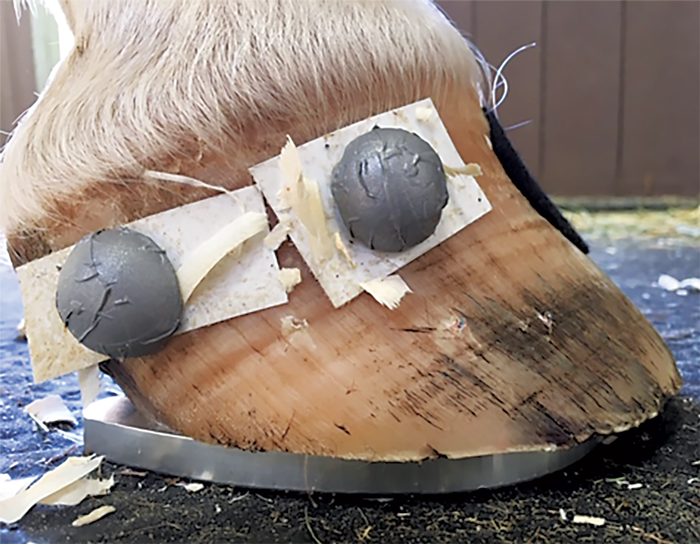
An example of a subject horse with hoof markers affixed. Source: Jude Florio
Sensor technology has certainly improved in recent years; however, affixing sensors to the hoof would require funding for their purchase and an ability to correctly interpret data and eliminate connected “noise” picked up by virtue of its attachment to a hoof, making analysis tricky.
Fortunately, Pfau supervised all the kinetic, kinematic, breakover-related projects, including mine, which eventually led to a generous invitation to use the RVC’s Structure & Motion Laboratory to collect data (Figures 1-2). The lab is one of the largest of its kind, containing several systems, including multiple motion capture cameras and a gauntlet of force plates, measuring and quantifying movement, pressure and forces.
Prototype Horseshoe Development
The first challenge was that any observation and measurement of breakover requires multiple trials and changes to shoe placement. Theoretically, this requires multiple shoes with varying toe arcs, altering the horseshoe’s toe proximity to the frog’s apex, a measurable fixed reference point. Morphing into a mad scientist, my literal mind imagined each shoe needed to be a mirror copy with one difference, the toe arc. Realistically, pre-making sets of shoes for unknown subject horses seemed daunting, coupled with the logistics and overseas travel. My “all or nothing” philosophy presented a problem, most definitely creating extra work and connected costs.
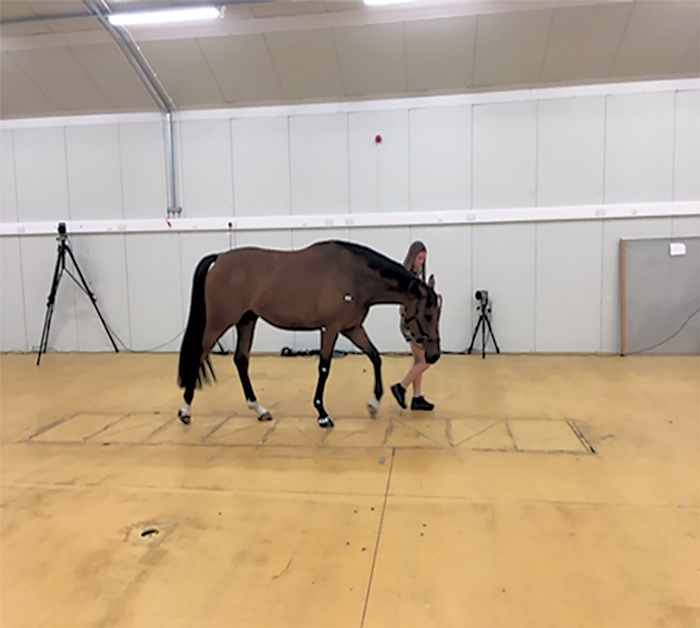
Motion capture and force plate trial of subject horse, highlighting marker positioning and trial observations. Source: Jude Florio
Enter another good friend and frequent collaborator, Dr. David Adam-Castrillo, VMD. With his help and input, a prototype shoe was created. Adam-Castrillo has been another catalyst in my professional journey, being a strong proponent in my return to academia and hoof-related investigation. Like the veterinarian highlighted earlier, he is always looking at feet and, when necessary, makes recommendations to tweak them, much to the chagrin of those on the receiving end. However, to his credit, he puts his money where his mouth is, having tried much of what he suggests on his own horses.
Minus the examples of odd hoof wall abnormalities, deformities and distortions, most horses fit into a pattern. Frequenting clients, friends and colleague horses, I measured countless hooves devising a pattern, variable sizes, including a mechanism to interlock that would facilitate an ability to affix on differing sized and shaped hooves. Experimentation had eventually landed on a multipiece shoe, allowing for toe arc changes minus quarter piece removal (Figures 3 & 4). The 3D-printed samples were sent to a milling company and aluminum prototypes were created for field use.
The idea would later morph into presupposing that veterinarian and farrier collaboration could afford every possible shoe modification at their fingertips. A multifaced shoe would theoretically streamline the formulation of a prescriptive shoeing plan by enabling the application of any design, simplifying and reducing legwork necessary to create multiple shoes, possible repeated visits, including the frequency of changes to find the right one. The Diagnostic Interactive Applied Shoe (DIAS) for horses was born, having later received a U.S. Patent No. 11,540,502 B2.
Data Collection
Introduced via email to Peter Day, the RVC’s long-time farrier, Day was a frequent collaborator with Weller on multiple research projects. Day was also a graduating member of the inaugural U.K. GradDip program. He would effectively become my liaison, laying the groundwork for the trip, organizing procurement of subject horses, logistics, as well as providing farrier services due to U.K. licensing restrictions. I had received a temporary license; however, it came with several limitations.
Traveling to the U.K. in the middle of July, I arrived during unseasonably high temperatures (north of 95 degrees). Upon arrival, I was introduced to Dr. Kate Horan, another member of Pfau’s team. She would also assist throughout the week, including charitably fielding my countless questions. To say both Day and Horan (as well as the many owners and volunteers) were generous with their time, effort, energy and assistance throughout would be an understatement.
The study consisted of a convenience sample of four horses and one pony from the surrounding Hawkshead area. Observations, measurements and data collection consisted of a series of multiple in-hand walk/trot trials, including pre-existing shoeing condition (baseline), making each subject their own control and successive toe arcs changes using the following equipment.
- Qualisys Motion Capture System in the Structure and Motion lab on a hard, high-friction ground surface composed of grit embedded in polyurethane concrete.
- High-speed cameras in an outdoor arena with synthetic-blended footing.
- Multiple force plates are also in the Structure and Motion lab.
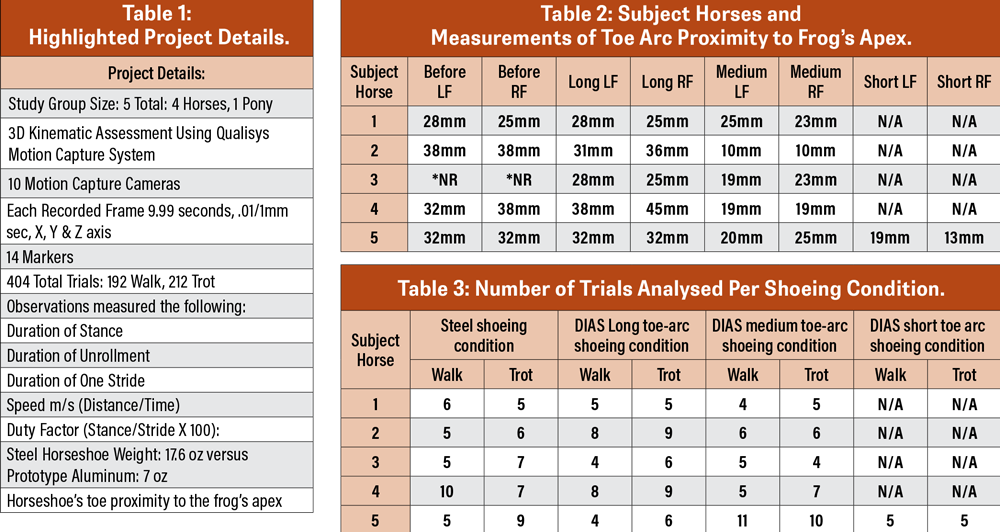
Using the frog’s apex as a fixed reference point, successive arc placement changes were quantified using a tape measure (Table 2). As noted in Table 2, not all the conditions were applied, primarily due to an abundance of caution when applying an extreme setback and an ability to affix conventionally with nails. Subject Horse No. 3 arrived barefoot, and a set of steel shoes was later affixed for continuity. The “before” measurement for Subject Horse No. 3 failed to be recorded due to logistics.
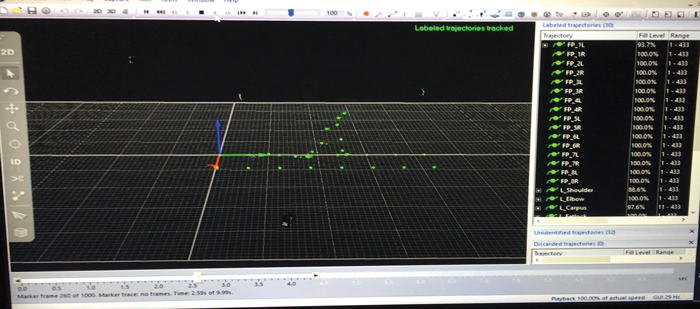
View of Qualisys grid, X, Y, Z axis, force plate gauntlet (center) and subject horse (middle of screen). The applied markers and coordinates are seen on the right. Source: Jude Florio
Multiple markers placed on each subject allowed the motion capture cameras to mark and quantify positioning in 3D space and time (Figures 6 & 7). Each marker’s position was numerically quantified with a coordinate on the X, Y, Z axis for each frame, 0.01/1 mm second for approximately 10-second trials.
Observations of coordinates and their numerical value were used to quantify the heel’s first contact, stance’s duration, lift off at the PZM and calculate what, if any, significant measurable changes resulted from caudally shifting the shoe (Figure 8). First contact was determined by the halted downward motion of the heel marker through stance.
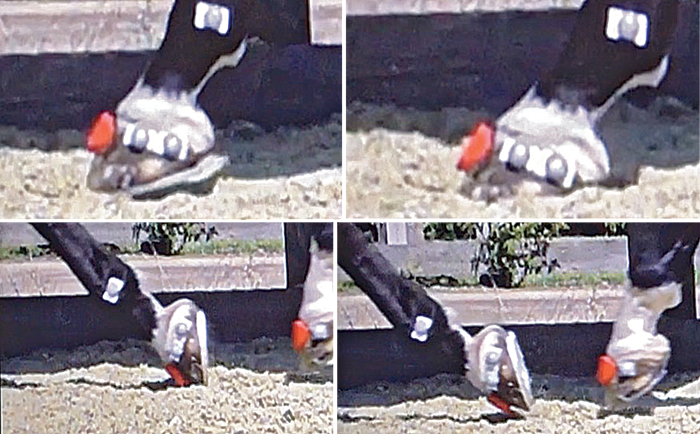
Using a high-speed camera’s marker positioning is highlighted at first contact, stance, hoof’s unrollment and point zero moment lift off of the toe. Source: Jude Florio
These observations would show multiple static frames with unchanged hoof coordinates, followed by rotation and breakover (Figure 9). Also quantified: stance duration, unrollment duration, one-stride cycle, speed and duty factor. Duty factor is defined as the percentage of the stride for which the hoof is in contact with the ground.
Omitting the singular use of short-toe arc data, mixed model analysis used shoeing condition and leg as fixed factors with speed as a fixed covariate (control variable), revealing that all timing parameters decreased with speed. Stance time in trot was affected by shoeing condition changes, with stance duration increasing at trot with the medium arc (0.268 seconds) vs. long toe arc (0.257 seconds) vs. baseline (0.267 seconds). Stance time in walk, duty factor in trot and stride time in both gaits showed significant interactions between speed and shoeing condition changes, with the hoof’s unrollment only significantly affected by speed.
Interpreting Results
The results and their interpretation need to be tempered due to the small subject sample size and its diversity, as well as the inability to apply every shoeing condition for each subject. The project is a pilot study, essentially a road map for future possible examination. A larger sample size of homogeneous subjects with an ability to apply every condition would likely improve analysis, result validity and conclusions.
Things to keep in mind: the subjects were jogged in-hand. How well the subject jogs and/or is handled will likely influence natural movement and rates of speed. Additionally, future study and/or the analysis of recorded high-speed camera data with subjects on mixed sand/synthetic footing would likely reveal a more accurate “real-world” effect on unrollment vs. the laboratory’s surface.
Listed below are highlighted analyses, including noting other previous studies with similar conclusions:
- When the fulcrum point is shifted caudally, the moment arm is shortened, increasing forelimb retraction, which increases speed, affecting breakover.
- No significant change to unrollment’s duration was observed, although the moment arm is decreased, comparable to findings of other previous studies (van Heel et al, 2006; Eliashar et al, 2010).
- Greater effects on stance than unrollment/breakover duration could be connected to the mechanics of the limb. Reducing the moment arm, the PZM is shifted toward the toe, increasing rotational speed (Eliashar, 2010).
- Proprioceptive feedback constricts the pattern of unrollment to prevent injury to the musculoskeletal system. It is conceivable that breakover beginning too early would shift the PZM farther away from the center of rotation earlier, but at a high force. A prolonged breakover will have negative implications; conversely, a shortened breakover may increase loading rate and peak forces on the distal limb, with limitations and possible negative effects on gait characteristics and quality (Clayton 1987; Clayton 1990; Glade & Salzman, 1985; Weishaupt 2013; Duberstein et al, 2013).
- Minimizing peak loading optimizes the fluidity of movement and coordination. This can be considered more important than altering unrollment’s duration (Spaak 2013, van Heel 2006).
- Stance measurements did reveal significant differences in interactions between gait and shoeing conditions. It is plausible that shoe length (unmeasured) possibly impacted heel height and hoof angle. Some previous examinations have noted the effect of wedges, increasing heel height and effects on stance duration. For every degree that heel height is increased, the PZM shifts caudally, resulting in unrollment’s advance.
- Significant differences in speed measurements, a consequence of caudal shifts, also impacted stance’s duration, increasing the length of stride and its rate, increasing velocity (Ratzlaff et al, 2005).
- Differences in shoe weight and geometry (prototype vs. baseline steel shoe) are potential confounders that can mislead conclusions.
- Some previous studies have noted the effect of shoes, specifically weight and geometry, on movement. Shoe weight (Table 1) and geometry may have influenced results (steel 8mm vs. aluminum 10mm). Horseshoes impact gait quality, hoof loading, unloading and rotation. Subjects had a carpus marker affixed. Future examination could measure effects on the carpus, a potential consequence of shoe weight and/or geometry. (Duberstein, 2013; Stutz et al, 2018; Eliashar, 2007).
Putting it into Perspective & Practice
The size of every horse and its corresponding hoof influences shoe placement and the degree of setback. As in all things horse, guidelines exist, but hard and fast rules do not.
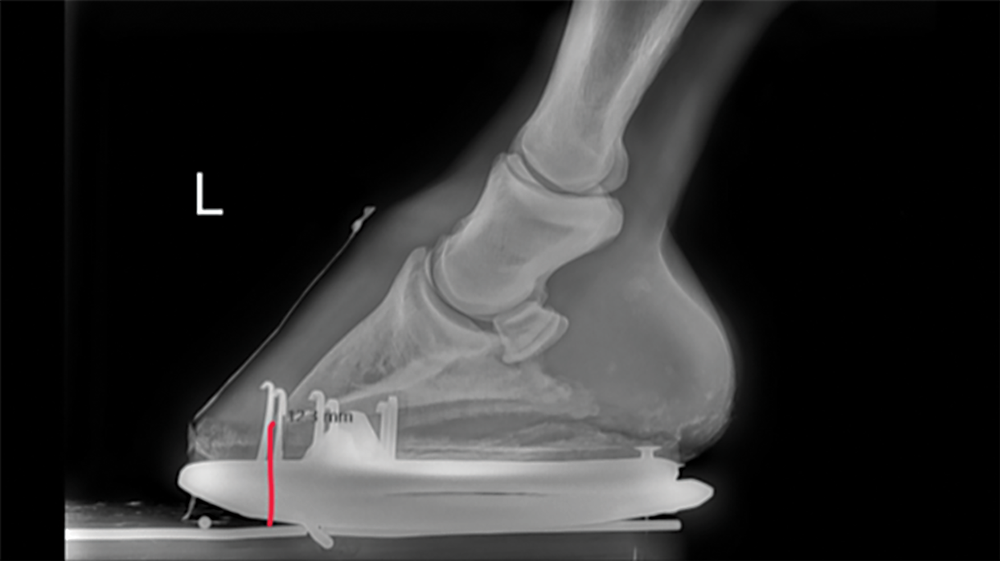
Lateral radiograph demonstrating horseshoe placement in line with the dorsal wall; however, breakover is optimized, starting directly under the point of the coffin bone with a rolled toe modification. Source: Jude Florio
Producing an optimal point zero moment toe liftoff (breakover) is best facilitated (when possible) with a shoe placed in such a way, including certain modifications (e.g. rolled toe), when a line can be drawn from the point of the coffin bone straight down to the start of the roll (Figure 10).
Using this as a guide will most likely not require farriers resorting to extreme setbacks; however, it will likely necessitate some elbow grease for “hot rasping” old schoolers or others (me included) channeling their inner “grind smith,” a Myron McClaneism. As highlighted in Figure 10, radiography is a necessary and useful tool, not only to establish a baseline but quantify improvements over time.
Generally, I try to place shoes with the inner web of the toe set to approximately an inch (25 mm) to the frog’s apex (horse and foot size dependent). This is only a guide. Yes, the frog does distort; however, I find it to be a useful visible fixed reference point, including for owners who tend to only look at toe lengths with hooves on the ground.
As I continue to plunge further into research, including observations of colleagues and other present-day farrier practices, I’m left with the impression that when interventions are correctly executed (trimming, nailing, etc.), fractional differences in shoe placement, types of shoes used, and some of the individual nuance that every farrier brings to their skill, will have minimal imperceptible affect. Frankly, most horses perform in spite of what we (correctly) do.
Footing, environment and a balanced riding program likely have a greater effect. Moreover, I wonder if recent trends that seek to achieve a perceived perfection (bony column alignment, optimized breakover) have led to the promotion of radical interventions to “correct” issues.
Have we become too invasive? Are we negatively affecting hooves and robbing them of the much-needed shock-absorbing, force-dampening properties?
There are strong arguments to support a middle path forward, identify issue(s) and work to correct them through mitigation, without negatively impacting soundness and performance.
In Conclusion
My advice for any aspiring hoof researcher is to tackle simple questions. Avoid the temptation of taking on too much or going way off into the weeds. As Weller states, there are plenty of “low-hanging fruits” to be explored in farrier science. It is a wide-open area of research that implores the people on the ground, in the trenches (farriers), to answer the questions.
Publishing in peer-reviewed scientific journals is not for the faint of heart, nor is it for those unwilling to accept criticism, rejection and/or a potential need to throw out a manuscript and start over.
Scientific writing is a learned skill and requires many hours of patience and persistence. However, rest assured, the journey will be rewarding. It will not only provide one with a sense of accomplishment, but it will also improve and strengthen abilities to formulate salient arguments and share opinions when collaborating with veterinarians, colleagues and clients. I encourage you, where/when possible, to elevate your game and challenge yourself.