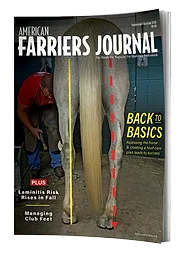
Below are key farrier takeaways from several of the features found in the July/August 2025 issue of American Farriers Journal.
Optimum Distal Limb Mechanics are Just a Few Measurements Away
- Measured lengths provide a clear mechanical perspective for how the hoof and distal limb is operating. It also provides a means to compare one contralateral leg with another, front or back and on a diagonal.
- Good record keeping and farrier practices allow you to shoe the performance horse for optimum so that hoof can grow “into” optimum balance during the shoeing period.
- It takes 50 pounds of additional weight on the horse to alter the preferred gait stride length and frequency and oxygen consumption.
Shoeing Mismatched Horse Hooves
- Most literature on high-low hoof care focuses on balancing the difference between the two front hooves to help the uneven balance believed to be caused by different shoulder blade heights.
- However, movement issues in high-low horses are found in the hind limbs.
- The authors’ claims have not been objectively tested. The experiences are made by several farriers and the results remain independently those who shod the horses.
2025 Farrier Business Practices Survey: How Does Your Hoof-Care Business Compare?
- Assess Your Business. Compare your income and charges with farriers around the country and within your region. Many farriers are reluctant to raise prices for fear of losing clients or simply because they sell themselves short. Seeing the national and regional averages can help quell those fears.
- Educate Clients. If a horse owner thinks you’re charging too much for your services, and you’re closer to the national or regional average, show them these survey results. Trends such as mileage driven, time and money spent on continuing education and types of horses shod can help clients understand your business practices.
- Set Goals. Being able to accurately identify your gross income, money spent on supplies and other key metrics of your business can help you assess its health in the short- and long-term. Comparing yourself with the national average can also help you set financial, business and personal goals for the future.
Coronitis & Canker: Distinct but Interconnected Equine Hoof Conditions
- Coronitis is inflammation of the coronary band and is often accompanied by swelling, ulcerations, heat and pain. The hoof can flake, scale or crust.
- Chronic coronitis can predispose horses to canker, especially when combined with environmental factors.
- Coronitis and canker treatment often include trimming and balancing hooves, medications, improved hygiene and, in some cases, surgery.