

Takeaways
- Higher diesel prices may be of costing you an extra $35.17 for each of your clients.
- Among farriers responding to the 2026 Farrier Business Practices Benchmark survey conducted by American Farriers Journal, the average diesel fuel charge was $1.63 per mile or $33 per barn visit.
- A Midwestern farrier would need to increase trim only and trim/shoeing prices by $ 2.33 to cover increased fuel costs.
With nationwide diesel prices going through the roof to over $6.20 per gallon in mid-September, you may want to consider adding a fuel charge to your hoof-care invoices. And it’s even worse for California farriers where diesel has reached an average price of $8.10 per gallon.
Data from the 2026 Farrier Business Practices Benchmark survey conducted by American Farriers Journal indicates only 15% of full-time farriers are already adding mileage fees to invoices. Among farriers adding trip or fuel fees, several options are being used:
$1.63 per mile.
$32.50 fuel charge for each client visit.
Based on the 2026 AFJ survey data, full-time farriers drive an average of 418 miles per week, or 21,736 miles per year.
Heavy-duty diesel pickup trucks (3/4-ton and 1-ton like the Ford F-250/350, Ram 2500/3500 and Chevrolet Silverado 2500/3500 HD) typically achieve 15-21miles per gallon when unloaded.
In mid-September, the average price of diesel in California was $8.10 per gallon…
Diesel Prices Going Up, Up, Up
The average U.S. retail price for on-highway diesel fuel in September 2025 was approximately $3.75 per gallon, according to the Bureau of Transportation Statistics and the U.S. Energy Information Administration.
If your heavy-duty diesel pickup truck averages 15 miles per gallon and you drive 22,736 miles per year as dada shows from the AFJ survey that amounted to a total outlay of 1,450 gallons. At $3.75 per gallon, that totals $5,438 in diesel fuel costs for the year.
With 2026 mid-September diesel priced at $6.20 per gallon you would be paying $8,990. That represents an increase of $3,552 in fuel costs this year that most farriers need to find a way to pass along to hoof-care clients.
With full-time farriers averaging 101 clients, that difference works out to an extra per client expense of $35.17 that you may be losing this year.
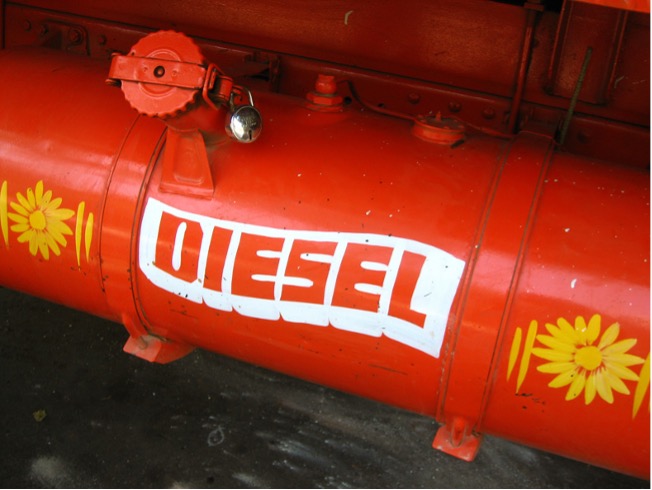
Many farriers are saying they are going to have to pass along higher fuel costs to clients.
Photo courtesy of Meena Kadri/Wikimedia Commons.
What If You Drive Almost Twice as Far
Now let’s say you put 40,000 miles on your shoeing rig this year. Using the same 15 miles per gallon, you need to purchase 2,667 gallons of diesel fuel. At $6.20 per gallon, that is a yearly fuel cost of $16,535. And if you are a California farrier paying $8.10 a gallon for diesel, the yearly expense would be a shocking $21,603.
If you were a Midwestern farrier, you would need to increase your yearly trim only (760) trims) and trim/shoeing (765 trims/shoes) prices by an average of $2.33 to cover the $3,552 increased fuel cost increase from September 2005 to 22026.
With diesel selling at $8.10 in September, California farriers would need to increase their prices by $5.14 per horse to cover the increased cost.
There’s More to the Story… You’re Actually Paying Twice
While fuel is a major expense, the actual economic impact of higher diesel prices extends much further.
When diesel prices rise, farriers actually pay twice: first through their own equipment and again through higher freight and supplier charges for hoof-care supplies. This multiplier effect can dramatically raise your total costs far more than just buying diesel for your shoeing rig.