
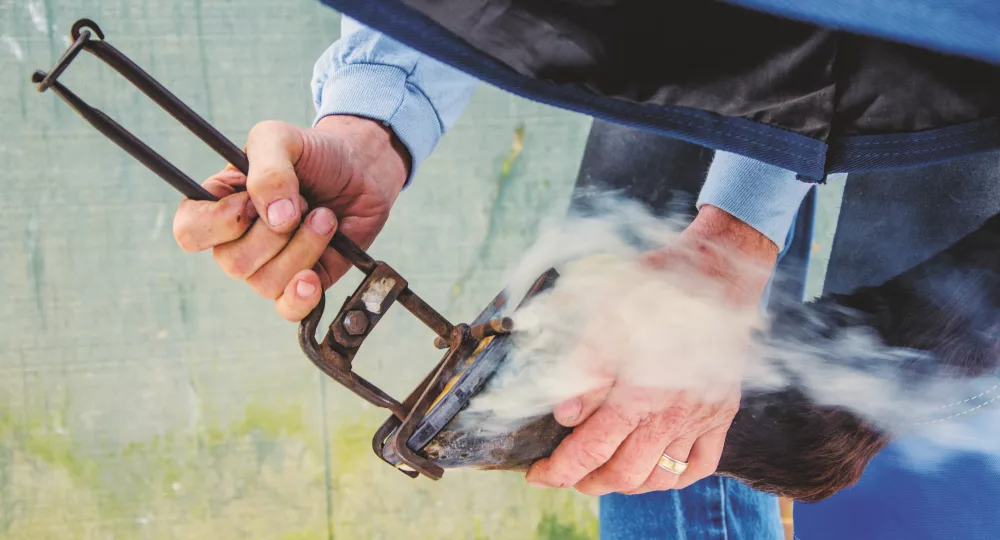
A recent controversial topic in the farrier world has been about the safety of hot-fitting shoes. It has been suggested that the fumes generated from burning on a shoe may be detrimental to long-term lung health in humans and animals. To understand this issue, it’s important first to examine the range of education within the industry.
Farrier education is determined by social exposure, demographics and a farrier’s commitment to learn. While many state organizations encourage certification and provide excellent schools, no prior education is needed to begin working in the United States as a farrier.
Many do not attempt certification due to the high skill level required and the gatekeeping within these organizations. The certification process can be exclusive to those who have the time, training, tools and funds.
The unspoken norms also create a challenge for farriers who have not been apprenticed by someone who is already involved in the certification process. Apprenticeships are a typical educational route for many, a concern for this could be possible bias of technique, a lack of range on what is taught, and it may depend on who socially the apprentice has access to.
Apprenticeship can also be difficult for female farriers who could be at an educational deficit due to not being able to find a reputable male farrier to safely work under. The educational disparity in the industry in many subjects is shocking. In an attempt to close one of the many educational gaps, here is what I have come to know about toxic fumes in relation to hot shoeing.
The Hoof
The outer covering of a horse’s hoof is mostly keratin; the hoof wall consists of densely packed keratin cells. Keratin is a protein full of the amino acid cysteine that contains sulfur.
When a shoe is set hot on a foot, a small portion of the outer layer of keratin is burned off into the atmosphere. The heat breaks disulfide bonds and releases volatile sulfur compounds, which are the culprit for the rotten egg smell.
The fumes consist of organic material from the outer hoof wall; this contains trace gases like carbon monoxide or sulfur compounds and whatever product has been soaked into the foot recently.
There is little danger from inhaling these fumes in well-ventilated areas. However, farriers are at risk in enclosed barns, which is typical when weather conditions don’t permit.
The side effects are caused by prolonged exposure when the smoke doesn’t dissipate. The immediate effects from inhaling the fumes can range from headaches and dizziness to respiratory and eye irritation. The long-term health complications can include chronic bronchitis, asthma-like symptoms, reduced lung capacity and an increased sensitivity to irritants (such as dust and smoke). Farriers who have pre-existing lung conditions may be more at risk, especially with long-term repeated exposure.
Limiting Smoke
The correct heat of 1,300 Fahrenheit can play a part in generating less smoke.
“You can get caught up in a cloud of smoke, but really the proper shoe temperature to go to the foot with for clip fitting is a black heat,” Carbondale, Ill., farrier John Voigt told American Farriers Journal in its January/February 2017 issue. “The color that’s left in the shoe is a very important factor. If the shoe is an orange or even a red, you should not be going to the foot with it. You get to a black heat, you’ve leveled your shoe, you’ve pitched your clips in; there’s still plenty of heat in that shoe to complete your burn. If you put the shoe on black, you don’t get quite as much smoke.”
To avoid inhaling the fumes, farriers who work in harsh winter conditions use a push-pull method in enclosed barns; this system requires a box fan and a small exhaust fan. The push fan is to be placed behind the workspace and the pull fan next to an open door or a window; this works best if the hoof is slightly downwind from the shoer.
A simple battery-powered fan can also be placed in the farrier’s toolbox and positioned to blow air directly in the face. This method does not dissipate the smoke but can provide a small clean air space for the farrier to breathe.
Hot Shoeing
Why is hot shoeing necessary? There has been a debate about the safety of the practice of hot shoeing, tracing back to 1890 in the book The Practical Horseshoer by M.T. Richardson.
Arguments are made that setting hot creates a clean surface between the shoe and the hoof and seals the horn tubules that were just opened after trimming. This bars nature's elements from entering the hoof capsule after being trimmed, i.e., moisture, excessive dryness.
The brief heat also sterilizes the surface area from bacteria and fungi such as Fusobacterium necrophorum, the anaerobic bacteria responsible for thrush. The opposing argument might suggest that friction is necessary to keep a shoe from being pulled and a hot shoe improperly set on a foot, especially on horses that lack sole depth, could increase the risk of abscesses.
It’s also important to note that the small amount of material burned off may be all the horse has to keep them sound. Clips are another reason for hot fitting; the metal appendage is designed to lock the shoe into place and can be difficult to set cold. Clips are beneficial for shoe pullers and competitive horses that perform many medial-lateral movements. Clips help to ensure that the shoe stays on with the extra stress the horse is placing on the shoe and nails.
In conclusion, it’s the job of the farrier to determine whether hot shoeing is necessary. There are many continuing education opportunities for farriers, but education cannot be left up to the farrier alone.
One person cannot bear the responsibility of researching and gaining the knowledge that could be handed down from hundreds of years of experience. Creating a required simplistic criterion for farriers’ education that encompasses not only safety for the horse, but also safety knowledge of tools and chemicals could help with a set of standards for the profession, for the health and well-being of everyone involved in the shoeing process.
Understanding the process of hot fitting can help the farrier understand the risks involved and make informed decisions that benefit the long-term health of himself and the equine. Ultimately, a structured and accessible education standard could ensure a healthier, more educated farrier in today’s modern world.
Reference
Cota, J. (2017). Are you using the Correct Heat While Hot Shoeing? American Farriers Journal. americanfarriers.com/articles/8933-are-you-using-the-correct-heat-while-hot-shoeing