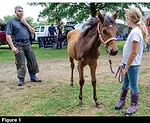
With Rood & Riddle Equine Hospital being based in central Kentucky, a fair amount of Dr. Scott Fleming’s work is with Thoroughbred foals. Clients turn to him as a veterinarian and farrier to help these foals while they are still growing — particularly before the sales. His success in helping these horses requires determining when the issue can be corrected through farriery and/or surgery.
Several years ago, one of my customers had a mini foal born with a serious angular limb deformity. This experience set me on a course to tap into my engineering background to develop a process for correcting angular limb deformities.
Farrier science has been noted in literature for the beneficial effects in supporting lower limb pathology for hundreds of years. The farrier’s selection of shoes, approach to workmanship and focus on pathology is still relevant in today’s modern, progressive farrier industry.
“Avery,” a 12-year-old Suffolk Punch gelding used for trail riding, was referred to the Virginia-Maryland College of Veterinary Medicine (VMCVM) Large Animal Teaching Hospital on June 27, 2018, for further evaluation of a suspected keratoma.
There never can be too many tools in a farrier’s shoeing box. After all, the immeasurable quantity of variables involved in equine hoof care is staggering. Why limit yourself?
The University of Illinois at Urbana-Champaign is seeking a farrier to work in the Veterinary Teaching Hospital. The ideal candidate would have a minimum of 2 years as an active farrier. A high school diploma or GED is required, as well as proper licenses to drive and operate machinery associated with this position.
Laminitis likely can’t be cured by the time the intricate structures of the hoof degrade, it’s impossible to reverse the damage. That means that prevention, early detection and stopping progression of the disease are critical.
The practical art of shoeing horses is often a combination of necessity and the desire to provide therapeutic or athletic advantage to the horse. Hoof capsule variances can provide untold obstacles and challenges that might need addressing during the life of a horse.
An 11-year-old Haflinger mare was presented to veterinarians at the UC Davis Equine Surgery and Lameness Service on Nov. 21, 2017, for a lameness evaluation. Maribelle became acutely lame after a 3-hour hilly trail ride 5½ weeks earlier.
Oleo Acres Farrier and Blacksmith Supply owner Rob Michel walks viewers through the Littleton, Colo., warehouse. Inventory is organized with the customer in mind. If the product is in stock and easy to find, farriers can spend more time under a horse, which Michel says is more money in your pocket.
At Doc Foal's, we manufacture The Black Pads and The Black Pads PLUS (featuring embedded magnets and copper). Our hybrid pads work seamlessly with your choice of conventional horseshoe, combining metal for structure with polyurethane for exceptional comfort and shock absorption.
Designed as a...
We stock a wide range of high-quality products from trusted brands to ensure durability, performance, and reliability in every job you undertake. Our extensive inventory of horseshoe products and farrier tools means you can find everything you need in one place, saving you time and effort. Your satisfaction is our top priority. We are committed to providing excellent customer service, prompt shipping, and hassle-free returns.
Equilox International Inc. specializes in equine horse hoof adhesives. Developed in 1988 after many trials and extensive research at leading universities and equine centers throughout the U.S., the Equilox Adhesive Hoof Repair System was originally used to treat competitive horses. Now, Equilox Adhesive is used by farriers, equine centers, and horse owners — as well as various zoo and wildlife centers — throughout the world.