Takeaways
- Greg Martin focuses on basic, practical and efficient techniques to maintain soundness and balance.
- Horses might object to the concussion of hammer blows during cool weather. They often tolerate it more when the nails are started, then the hoof stand is removed to complete the application.
- When clinching nails, watch for a reaction in a horse’s chest or hip. If it twitches, the nail could be too close and cause discomfort.
After nearly 30 years of farriery, Greg Martin’s approach to hoof care is straight forward — keep it simple. The owner of Hill Country Hoof Care relies on the basics and embraces efficiency and practicality.
“Honestly, we don’t do anything fancy,” says the Boerne, Texas, certified journeyman farrier. “We follow the KISS method — Keep it Simple, Stupid. We just try to run a good business and keep the horses sound and balanced as much as we can; nothing really remarkable.”
The fanciest Martin gets is his unusual marketing approach (Please see “Hoof Care on Parade” below) and applying glue-on shoes for a client, but the latter will have to wait. Mother Nature has other ideas today.
“I decided against doing them today because it’s supposed to rain, and they don’t have a dry facility,” he says. “It’s rough applying glue-ons when it’s soaking wet.”
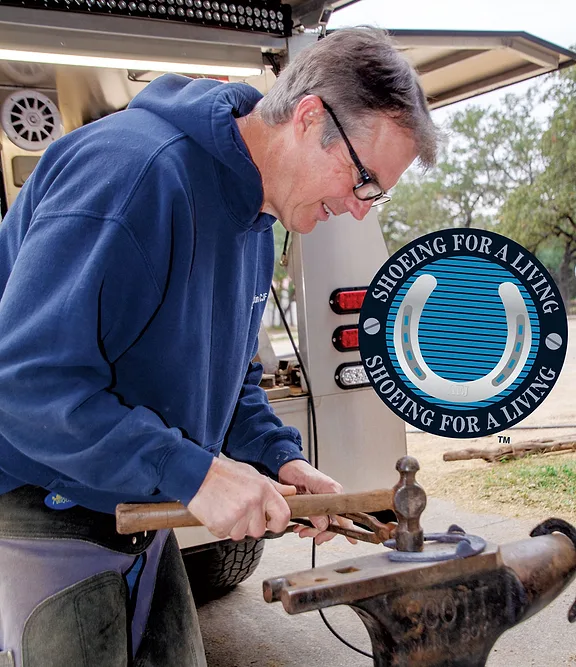
December in the Texas Hill Country is typically mild and dry with average daytime high temperatures in the low to mid-60s. On this Shoeing for a Living Day, it’s cloudy, drizzly and in the mid-40s. Yet, it’s a welcome change.
“Any time I set a shoe back, I don’t drive a higher nail because the hoof wall is thinner…”
“Before the recent rain, it was pretty darn dry,” Martin says. “Trimming the hoof was like cutting on rock.”
Backyard Trims
The seasonal change benefits his first client’s horses of the day — a pair of backyard horses that are due for their 6-week trim. One is a former U.S. Bureau of Land Management (BLM) mustang, while the other is a mare that has developed metabolic laminitis within the past year.
“The owner slowly noticed some changes in how she was moving,” Martin says. “The vet did some bloodwork and, sure enough, tested positive for equine metabolic syndrome. She’s really flat-footed, and you can tell something’s going on with her. They have her on medication, which seems to be keeping her comfortable while in the pasture.”
Greg Martin performs a conservative trim on horses that remain unshod. “We want to leave something between the rock and the sole,” he says. Images: Jeff Cota
The pasture is riddled with rocks, though, necessitating sole protection.
“We could shoe her, but the owner prefers barefoot,” he says. “She’s never had shoes before. She’s hurting a little bit, and hammer blows are unpleasant for her, so boots are a good alternative.”
She’s fitted with an Easyboot Cloud. Manufactured by EasyCare, the Cloud is a therapy boot designed for comfort and support horses with laminitis, thin soles, abscesses or founder.
“They have this nice, cushy insert,” Martin explains. “Remember that old Dr. Scholl’s commercial where the actors ask, ‘Are you gellin’?’ That’s this on steroids. A lot of vets and shoers in this area, especially those with horses that are in the acute laminitic phase, put them in them right away to get them through it. Some customers let them live in the boots.”
After catching up with the owner about the horses’ progress, the duo gets to work. When working together, James Roseland typically pulls shoes and Martin trims. The senior farrier applies the shoes with two nails. Roseland secures the shoes with four more nails, clinches and finishes the feet. When tackling barefoot trims, Martin trims the bottoms and Roseland finishes.
“We just try to be efficient,” Martin says.
Like many farriers, he trims differently when a horse is barefoot vs. shod.
When working together, James Roseland typically pulls shoes while Martin trims. The senior farrier applies the shoes with two nails. Roseland follows by securing the shoes with four more nails, clinches and finishes the feet.
“We want to be conservative on the bottom, especially on this terrain,” Martin says. “No sharp edges on the hoof, just round it. We want to leave something between the rock and the sole.”
The 20-year-old BLM mustang is a blind on his right side and a bit jumpy. Yet, he’s come a long way.
“He was in pretty bad shape when we got him,” Jamie Blanz says. “He was a basket case. I had to sit in the pasture waiting for him to come to me. Now, he takes care of everybody. If anyone gets upset, he lets them know it’s OK. I used to say that he’d end up in the next county anytime something happens. If he spooks now, he spooks in place.”
Roseland slides under the mustang while Martin turns his attention to the mare. Blanz notes she hasn’t been as sensitive when the boots are off.
“The good news is we’ve had some moisture and rain,” he says. “It’s pretty rough when they’re as dry as they were. The rain softens the foot. It makes it a little more flexible, and it gives a little bit more. So does the dirt.”
A Roper & a Mystery
The duo wraps up the pair of trims, and Martin navigates his Ford F-150 truck toward the next destination — Cordillera Ranch. The 9,100-acre gated community features a Jack Nicklaus-
designed golf course and clubs for various activities, including hunting, fishing, tennis, swimming and more. Lots start at 5 acres, and horses are welcome.
Residents can also board their mounts at the community’s equestrian center, which boasts lighted and covered arenas, as well as 15 miles of trails that run along the Guadalupe River.
Martin backs his truck up to the shoeing area entrance for easy access to his Iron Range shoeing body.
Raven’s conformation promotes distorted hoof growth, prompting therapeutic shoeing to bring his foot underneath him.
While Roseland sets up, Martin makes his way into the barn to find the two horses — a Palomino and a red roan — ready for them. The former is a recent purchase by Steve Davis. The gelding lost his left hind shoe a few days ago. Davis cleaned up the hoof with a rasp to tide him over until Martin’s visit.
“I don’t know a lot about him,” Davis says. “I’ve been working with his feet, and he’s kind of slow. He’s stiff on the back end when cleaning out his hoof. I’ve been holding his feet up and stretching him.”
The red roan is Davis’ roping horse.
“This is Smarty,” Martin says, gesturing to the gelding. “He’s not related to Smarty Jones. He’s just as fast, though, right?”
“He’s got a lot of go,” Davis replies. “I won the Cow Horse Classic on him in ’23. He’s pretty versatile. I didn’t train him. I bought him off Craigslist. The second ropin’ paid for him. He acts pretty gentle, but sometimes he kind of wakes up.”
Martin picks up Smarty’s left hind after Roseland pulls his shoes and begins his trim.
“It’s nice having lots of foot to work with,” he says. “They do a good job here, for sure. Having shoes on them holds the feet together a lot better.”
Bisecting the foot with a rasp illuminates how Raven’s conformation creates distortion.
Like most Quarter Horses, Smarty has smaller feet. Martin prefers St. Croix SureFits for these equine athletes.
“The SureFits are a good match for the hoof wall thickness,” he says while Roseland cleans them up at the grinder. “I really like them for these smaller-footed horses that are aughts or double aughts. We don’t want anything clunky on these guys when they’re doing athletic speed events.”
Of course, there’s a trade off when the shoes aren’t clunky. There are fewer resets. Although Smarty will be reset today, Martin doesn’t expect another after this cycle.
“Steve generally rides quite a bit, so he typically gets reset once,” Martin explains. “There’s also not a lot of steel to the SureFits, so you don’t get as many. Eventers are the same way because they have a rolled toe. They’re going to wear out at the toe quickly.”
Retrieving the shoes from Roseland, Smarty lifts his left hind as Martin approaches.
“He’s like, ‘Yeah, I know what this guy wants,’ ” he says with a chuckle. “Steve does a good job of working with them and teaching them to stand for the farrier. We’re not going to hot fit anything here. These guys might not like it.”
While nailing up Smarty, Martin uses irregular hammer blows.
Martin moves Raven’s footprint to where it should be. “That’s how you achieve it over time. It’s not going to happen overnight. If you keep shoeing to the distortion, it’s just encouraging it to grow distorted.”
“The concussion can sting a bit on these cool days,” he says. “I’m just taking it easy with him and trying not to whack him too hard. Sometimes it’s the last hammer blow that stings the most. I’ll often get the nail started, take the foot off the stand and they seem to like it better. I won’t use a clinch block either. We’ll use a race nail for a better fit when shoes have a little bit of wear. We don’t want a big, bulky nail sticking out.”
Martin drives a nail on each side of the shoe and sets it on the concrete floor.
“Generally speaking, I’ll nail the shoe on with two nails and James will come back and finish it,” he explains. “He’ll add four nails, clinch, finish and then pull the front shoes. This is our most efficient way of doing two horses at a time. Instead of taking 2 hours on two horses, we can do them in about 1½ hours.”
Martin moves onto Leo (the Palomino) after finishing up Smarty.
“It looks like he has pretty good feet,” he says to Davis. “Is he a keeper or are you going to flip him?”
“I don’t know yet,” Davis replies. “They had a good jockey on him at the auction. He looked good in the sales ring, but he wasn’t super when I got him home. The guy who showed him to me had him for just 10 days. The first day here he was terrible, but he got better each day.”
Martin replaces Leo’s left hind shoe, which was lost while Davis rode him in the arena.
“He was a little crumbly on the inside where he had some low nails,” Martin says. “Sometimes the weather makes it crumbly. When the nails are too fine, low and shallow, particularly when nailing into the outer hoof wall, they can split. So, your best bet is when you have high, safe nails in the right spot and you have enough foot. It doesn’t make a difference on some horses, though.”
“Why does a horse get sore a week or so after a shoe is nailed on close to the quick?” Davis asks.
“That’s a hot nail,” Martin replies.
“Everyone who has shod many horses is going to quick one,” Davis says.
Martin avoids this scenario by keeping a close watch on the horse while clinching.
Raven’s shoe is fit tight to the side of the hoof where support isn’t needed.
“Use your clinches similarly to hoof testers,” he says. “When you’re applying pressure to the clinch, look at the horse’s chest. If he’s clenching his chest each time you clinch, he’s feeling it. Same thing with the back end. If you see a reaction in their hip when you apply pressure, you might be close. It depends on the horse and hoof wall quality.”
Roseland also considers shoe placement when driving nails.
“Anytime I set the shoe back, I don’t want to drive a higher nail because the hoof wall is going to be thinner,” he says. “It might look like you have symmetry up top, but I want to taper down a little bit. Otherwise, you are more likely to get a hot nail.”
Martin also notes Leo has thrush in the central sulcus.
“I’ll put a little medication in there for you, Steve,” he says. “Some use iodine, which does a good job of drying it out but doesn’t promote much healing. We have a clay — FootPro CS Plus — that works well. Some people use Neosporin.”
“If the horse clenches his chest when you clinch, he’s feeling it…”
When Roseland finishes with Smarty, he removes the gelding from the cross-ties and leads him back to his stall.
Martin completes Leo’s trim and retreats to the anvil at his Iron Range body to prepare the new set of three-quarter fullered St. Croix Eventer shoes with quarter clips.
“We use St. Croix Eventers or Kahn Forge Certifiers when the horse needs traction,” he says. “His hoof wall is a little thin. You can drop race nails in there, if you want to. When you’re giving them new shoes, though, you want a strong nail in there.”
While Martin is hot-fitting a shoe, Roseland takes advantage of the hot forge to warm up a tamale.
“The secret is, once the forge is hot, throw a cold shoe in there and put your food on top of it,” Martin says. “Otherwise, it’ll burn.”
“It works surprisingly well,” Roseland says.
After nailing up Leo, Martin wishes Davis well while Roseland packs up the shoeing station.
Distorted Growth
Martin pulls his pickup into the Rocking KC boarding facility in Fair Oaks where they will tend to Raven, a gelding used for pleasure riding.
Raven’s conformation promotes distorted hoof growth, prompting therapeutic shoeing to bring his foot underneath him.
“His foot offsets to the outside,” he explains. “He also breaks over toward that side, which isn’t all that uncommon. We’re not trying to fix him. We’re just trying to put that foot back underneath his leg where the weight is.”
Martin accomplishes this by focusing on Raven’s anatomy.
Roseland warms a tamale in the forge. “The secret is, once the forge is hot, throw a cold shoe in there and put your food on top of it. Otherwise, it’ll burn.” Martin says.
“You trust that the center of the coffin bone is in the center of the frog,” he says. “Move the shoe or footprint where it should be, making sure he’s not going to step on it. That’s how you achieve it over time. It’s not going to happen overnight. If you keep shoeing to the distortion, it’s just encouraging it to grow distorted.”
As Martin begins trimming the foot, he points out that it’s critical that the heels are level, especially with a distorted hoof like Raven’s. Then he turns his attention to the frog, which is rough.
“We don’t do a fancy frog trim,” Martin says. “We want to leave as much for him as we can, especially if it’s not diseased. Nowadays on Facebook, you see a lot of really nifty, manicured frogs. It looks pretty, but the frog is there for a reason.”
After completing the trim, Martin places the hoof on the floor. Seconds later, Raven is licking and chewing, indicating he’s happy with the results.
Greg Martin advertises his Hill Country Hoof Care practice by entering a float in the Boerne and Comfort, Texas, Christmas parades.
Hoof Care on Parade
Marketing your hoof-care business is often hit-and-miss. Common methods include advertising your services in a horse owner Facebook group, posting your business card to a tack shop bulletin board or simply word of mouth from satisfied customers. Greg Martin takes a different approach — entering a float in the popular Christmas parades in Boerne and Comfort, Texas.
“Through the years, we’ve taken our kids to a lot of local parades,” he says. “We always had a blast doing them and seeing different companies advertise their businesses with these floats. I began imagining what a farrier float would look like.”
Enlisting his wife Shannon, Martin recreates a shoeing area, complete with a fiberglass horse, an anvil and a working forge on a flatbed trailer.
“We can be pretty creative,” he says. “I built a fireplace around a propane forge. The horse is in cross-ties under mistletoe and wearing an ugly sweater. The back foot is fitted with a wet block of wood so we can burn a shoe on it.”
The crowd took to the float adorned with garland, lights and a Christmas stocking.
“You could see people were wowed when they saw the smoke from hot shoeing,” Martin says. “It’s a large parade with over 100 entries. They give awards to the top floats and we received second place. So, we’re really pumped about that.”
Click here to watch a video of Greg Martin’s Christmas parade float.
“You know, I hear farriers say, ‘Oh, he’s licking and chewing. He likes what I did,’” Martin says, setting up his punch line. “That may be true. Or, maybe he thinks, ‘Oh, I have all four feet on the ground.’ ”
Roseland returns from the anvil with Raven’s shoe. Martin places it on the bottom of the hoof to check the fit.
“Let’s adjust it to the medial side,” he tells Roseland. “If we need to adjust it to the medial side, that’s good. We know we’re moving in the right direction. We’re not changing his conformation. We’re just supporting him.”
When Roseland returns with the adjusted shoe, it’s exactly what Martin is looking for.
“That’s beautiful,” he says. “I don’t mind fitting him tight on the side where doesn’t need the support. Doesn’t bug me one bit. Don’t do it during certification. There are things you’re going to do in your everyday shoeing that are going to be beneficial to the horse that you wouldn’t do during a standardized test.”
When Martin is done, Raven walks off sound and balanced — thanks to keeping it simple.