Farrier Takeaways
- Farriers must constantly consider the effects that environment, conformation, shoeing and other factors have on hoof distortion.
- A solution to a hoof-care problem can sometimes introduce a negative consequence, so thoroughly think through the cause and effect.
- Longeing is about the worst thing clients can do to a horse, as horses are designed to run in a fast, straight line and aren’t meant to run in circles.
Bob Pethick likes to kick off his lectures by showing an Ontrack Equine slow-motion, close-up video of hooves in action. The Califon, N.J., farrier treated the attendees at a University of Tennessee Equine Podiatry Conference to this thought-provoking movie.
“It’s amazing they stay sound at all,” remarks the Hall Of Fame farrier. “They need all of the help that we can give them.”
The video set the stage for Pethick’s discussion of hoof capsule management. Here are some of the highlights from his presentation.
Understanding balance. Before diving into a series of cases, Pethick asked the audience what do we really know about balance. The first citation in Pethick’s talk goes back to William Russell’s 1903 book, Scientific Horseshoeing, and his work on the “center of gravity” and other reference points — the chief among these being the center line of the frog.
“As far as medial-lateral balance goes, that’s a reference point of the hoof capsule that stays the same,” says Pethick. “It is stuck between the wings of the coffin bone and can’t really go anywhere, so it is a good guideline to see how much distortion is in the hoof capsule, both in toe quarters, as well as the heel quarters.”
Also paramount to our understanding of balance is the work by Pennsylvania farrier Dave Duckett, including the use of Duckett’s dot to determine distortion in the toe quarter, Duckett’s bridge to determine anterior-posterior balance and the posterior support reference being the origin of the frog as far as the length.
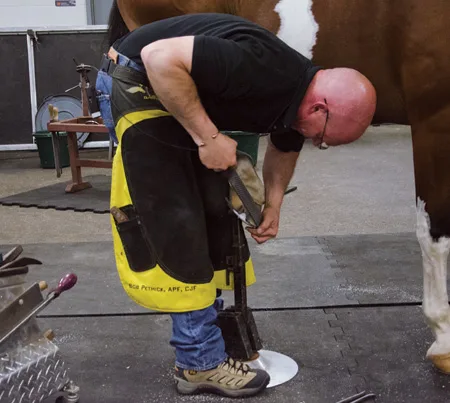
Bob Pethick feels the word “breakover” is overused and says "easing 'turnover'" may be a better way of saying it...
“What’s important about these lines is that this is the center of weight bearing,” Pethick says. “If that hoof capsule moves inside or outside of the line — base wide or base narrow — or rotates around it — toes in or toes out — it will affect the bottom of the hoof capsule. Keep in mind, this line stays the same — the hoof capsule just goes around it.”
Environmental effects. Farriers know that distortion is caused by various factors, including environment. Among environmental considerations, moisture content of wet climates like in Pethick’s area present frequent challenges for farriers during the spring and summer. The higher the moisture content in the hoof capsule, the more distortion that will occur with the hoof.
“The good thing about that is it takes less time to get that foot back,” reasons Pethick.
More clients are using rubber mats in stalls instead of thick layers of bedding, so farriers must be aware of this when managing distortion. Since many horses tend to spend the most time in stalls, they stand on their hoof walls with no sole pack.
“Weight bearing is huge as distortion goes,” says Pethick.
The problem with longeing. Pethick reasons the horse often spends more time in the cross-ties than being exercised under saddle. He adds that longeing is about the worst thing clients can do to a horse. Horses, being a prey animal, are designed to run in a fast, straight line and aren’t meant to run in circles.
“For some reason, the thinking has become to run horses in tighter and tighter circles,” he says. “This is hard on the feet. If you think about hoof distortion and how these horses are landing, it makes it clearer why you need to tighten up your toe quarters and flares.”
Shoeing contributes to distortion. Pethick then discussed the role shoeing plays in hoof capsule distortion.
“Traditional shoeing tends to compound distortion due to the platform effect,” he says. “Barefoot distorts less, but we can counteract the platform effect with shoeing materials. What’s the platform effect? Look at a shod horse as it lands on a hard surface. The frog, sole and bars don’t react to the ground the same way they would barefoot.”
To illustrate his point, Pethick showed slow-motion video of a barefoot horse walking on blacktop. Watching the back of the foot, when the frog loads on the ground there is little movement.
It’s amazing they stay sound at all …
“This foot is functioning the way it should,” says Pethick. “The frog loads and the wall loads — together.”
Then showing video of the same horse shod, the Hall Of Fame farrier pointed out how the center of the foot drops through the shoe.
“That puts a tremendous amount of load and pressure on his coronary band and walls. This is the platform effect — this compounds distortion,” he says. “This is what we as farriers must consider when we apply horseshoes and need to support the center of the foot.”
Conformation’s role. When discussing how conformation contributes to distortion, Pethick highlighted a rotational deviation case. This conformation is most prone to quarter cracks.
“When that foot rotates inward, it places that medial heel quarter directly in the center line of weight bearing,” he says.
In previous years, the preference would be a leather pad and bar shoe to give a basis of support for the medial side of the foot. Today, with advances in pad material, there is more flexibility.
Caution when floating a crack. Pethick showed an example of a heart bar, pad and Equi-Pak in the sole with the medial quarter wall floated. Although this is a common approach, Pethick stressed that there was a mistake in it.
Showcasing The Benefits Of Collaborative Work Drives Podiatry Conference
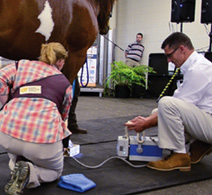
The clinic setting allowed real-time clinical work on a live horse for the attendees. Greg Staller, right, shot and analyzed X-rays, before Bob Pethick shod the horse based on what the radiographs revealed.
Around 100 farriers and veterinarians attended the May Equine Podiatry Conference at the University of Tennessee in Knoxville. Dudley Hurst, the farrier for the university’s college of veterinary medicine, emceed the event. When he assumed that role a few years ago, one of his first actions was to organize an annual footcare conference because he feels strongly about promoting hoof-care education.
“Continuing education is how we become better horsemen and how we grow in what we see our horses do,” says Hurst. “What we do here is an inverted pyramid — we tend to see and learn more than when we started out.”
The unique, annual conference features presentations by an equine veterinarian and farrier who work together. This year’s gathering featured the team of horseshoer Bob Pethick and vet Greg Staller, both of Califon, N.J.
Pethick led off the day with the hoof capsule presentation and sport horse presentation highlighted in the main article.
Staller followed with a lecture on lameness cases in which vet-farrier teamwork is imperative, and how he and Pethick commonly address these problems among sport horses.
From his perspective as a veterinarian, Staller feels vets and farriers are bridging the gap of understanding. However, there is work to do.
“To adequately preserve soundness or treat lameness in the foot, the team must address the complex forces between the foot and ground that may result in injury to internal structures, to hoof capsule distortion or failure and ultimately to lameness,” he says. “But first we must agree on what those forces are and how to address them.”
Staller followed with a discussion on the responsibility of both parties when coming to an understanding by surveying several case studies. One of the most common issues Staller sees in his practice is when the trim and shoe didn’t take into account the conformation of the foot.
“A tip off for me sometimes is when I see a horse wearing a circular shoe,” he says. “I don’t think that I’ve seen many horses with a circular foot, so if the shoe is circular, the farrier is likely fitting the foot to the shoe. It is little things like this that reduce performance enough that horse owners come to me.”
Staller highlighted coffin bone fractures because of the variety of configurations, but also because of the necessity for veterinarian and farrier teamwork. Along with rest for the horse, the construction and application of a specialized shoe is critical in all cases. He showcased his preference for a type three (mid-sagittal) fracture shoe. In most cases, he prefers using a bar shoe, double clipped on medially and laterally, Equi-Pak and a hospital plate.
He also showed a hoof wall resection as another need for close collaboration.
“By removing large segments of the hoof wall, the mechanical factors that perpetuate the separation can be minimized and the area exposed for treatment with anti-infective agents,” he says.
Because hoof wall resections, by their very nature, destabilize the foot, a farrier needs to select and apply a shoe to stabilize the foot as it grows out.
The duo was presented with a live horse for a demonstration. Staller worked with a radiography technician to capture various views of the horse’s feet.
Staller and Pethick discussed the findings before the farrier trimmed and shod the horse according to its needs.
As the audience waited for the radiographs to be captured and downloaded, Dudley joked about the need to “hurry up and wait” for the radiographs when in a clinical setting as a farrier. This gave Pethick an opportunity to make an important point about business practices.
“Diagnostics take time, you shouldn’t schedule another horse within a couple of hours, so don’t be afraid to charge for that time,” he adds.
The horse is clubfooted on its left fore. Pethick mentions that he doesn’t like using a bar shoe on feet like this because they can be restrictive at the heel.
“The foot is already restrictive, why add more?” he asks.
His preferred shoe in a case like this is a Kerckhaert Classic Roller because it offers turnover in any direction. The shoeing cycle, which he tries to keep at every 4 weeks, also depends on establishing expectations for the client. As he finished shoeing the horse, Pethick provided one last observation.
“We did what we did with what he had,” he says. “That’s just what we do every day.”
Farrier Product Distribution sponsored Pethick and Tribute Equine Nutrition sponsored Staller.
Hurst reports that the university will hold the third annual conference in mid-May 2016 on the Knoxville campus.
“If anyone ever told you that floatation doesn’t work, this is why,” he says. “The bar is supported, but so is the sole — it’s all attached to the wall. The medial heel quarter won’t settle. It will still be there when you come back 4 to 5 weeks later.”
According to Pethick, a better option for managing that foot is to still use the 3/4 pad and heart bar, but to float the medial quarter from the second nail hole all the way back.
Showing another crack case, Pethick floated a foot using a 3/4 frog support pad. He recommends filling up the gap of the area you are floating with Play-Doh before injecting pad material. When that sets, he’ll remove the Play-Doh and then seal the area with the pad material.
“This will completely unweight that medial quarter,” he says.
Treat the crack. When addressing a crack there will be disrupted tubules, which are prone to bacterial infection.
“It is important to keep an anti-bacterial product on these feet, like a copper sulfate or thrush medication to kill bacterial in those areas,” he says.
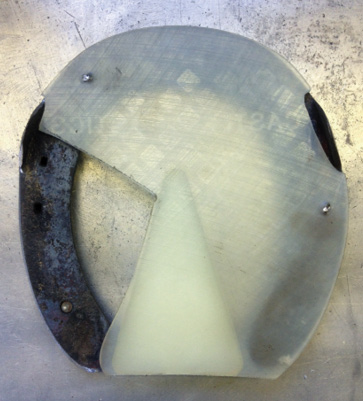
Figure 1
Keeping a tab. Showing a horse he shod as a demonstration at the April 2015 Bruce Daniels Memorial Clinic, Pethick used his common approach with an open shoe, 3/4-frog support pad and pad material. If the horse’s job and other factors allow for using this approach, Pethick says he prefers it because he’s had great success with it for years. He pointed out subtle details with how he cuts the area out of the pad.
“Just leave a little tab of the pad to catch the inside heel (Figure 1) so it doesn’t touch that buttress, but keeps the frog support pad underneath the shoe.”
Getting it straight. Over the last few years, Pethick has seen farriers confuse center of rotation and center of articulation, unfortunately using the terms interchangeably.
“They are not, they are about 1/4 of an inch apart,” he says. “But both are reference points. If you are shoeing around them, you aren’t doing too badly because either one of these lines is fairly close to center, giving you a better idea of distortion and where your shoe placement should be.”
Cause and effect. It is important for farriers to consider how a potential shoeing application can introduce a negative consequence. Showing a hind foot shod with a squared-toe shoe, Pethick asked if this is how the horse gets propulsion.
“If you think of how that horse’s foot goes into the ground with a flat edge, it won’t get the spade effect it needs to push off,” he says. “This horse is going to have to work that much harder to push itself forward.”
He followed this with another hind shot, with the shoe set way back. The good intention of taking stress off the limb is there, but in actuality it is putting more stress on the limb.
“The horse can’t use its toe because it has lost its toe,” he says.
Showing a horse diagnosed with degenerative suspensory ligament desmitis, in which the fetlock starts to drop behind. Pethick talked about shoeing solutions. He modifies an SX8 shoe to widen the toe and narrow the branches using a hand grinder and welds a piece of 3/16-in. by 1/2-in. bar stock at the toe to provide even more surface area.
“This should allow the heels to drop, provide more floatation for the toe and take stress off the suspensory,” he says.
Better word for breakover. During a discussion of whether breakover occurs with the hind feet. Pethick commented that he doesn’t like the word, feeling it is overused.
“Easing ‘turnover’ may be a better way of saying it,” he suggests.