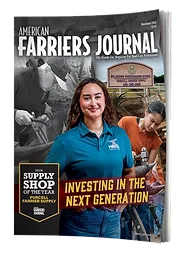
For more than two decades, the bright yellow “Briefings” page that regularly appeared in American Farriers Journal was among the publication’s most popular features. Now, we’re bringing back this valuable content that offers 4-5 quick-to-read items on the AFJ web site. “Hoof-Care Briefings” will be coming your way on the last Monday of each month, and highlight farrier tips, industry news, maybe a bit of shoeing history from time-to-time and insights of special interest to footcare professionals.
— Frank Lessiter, AFJ Editorial Director
Takeaways
- Of the six horses that remained in competition, no recurrence of equine osteoarthritis or lameness was reported.
- Researchers did not detect any clinically relevant changes in gait symmetry following vaccination into the pectoralis descendens.
- Identify the extent of the puncture wound and determine whether it’s near a synovial structure.
Arthritis in Horses: Use of Intra-Articular Nanogels
A proof-of-concept study revealed that a novel intra-articular nanogel infused with medications, referred to as an intra-articular drug delivery system, is a promising therapy for horses with osteoarthritis.* If effective, nanogels, also called hydrogels, could halt disease progression, restore joint function, and improve mobility.
According to the research team, a functionalized nanogel containing bioactive molecules serves two purposes. First, the nanogel, which contains hyaluronic acid, provides joint lubrication and has other viscoelastic properties. Second, it serves as a drug delivery system, capable of providing the sustained release of biomolecules possessing analgesic, anti-inflammatory, anticatabolic, or pro-anabolic features that are key to the long-term management of osteoarthritis.
“To date, nanogels have been studied in vitro, in a laboratory setting, showing positive features such as chondroprotection and cartilage-building effects,” said Catherine Whitehouse, M.S., a nutrition advisor for Kentucky Equine Research. “A small study in healthy horses was also conducted showing no adverse events associated with the gel.”
In the current study, the researchers used a functionalized nanogel in eight horses diagnosed with naturally occurring OA of the fetlock or coffin joint. Horses were all used for international level competition, including showing jumping and three-day eventing. All horses showed grade two or three lameness (out of five), and radiographs disclosed a combination of joint space narrowing, osteophyte formation, subchondral bone sclerosis, and synovitis, all hallmarks of osteoarthritis.
Steps can be taken early in an athletic horse’s life to help protect its joints.
Key Findings
- The functionalized nanogel was well tolerated with no major adverse events following mild, self-resolving joint swelling occurred in two horses.
- At week six, one horse returned to competition, two resumed training, and three were in full flat work.
- At week twelve, seven of the eight horses had improved lameness scores compared to baseline: four by one grade and three by two grades. Two horses had complete resolution of lameness.
- Four horses achieved a return to the same competition level as before the onset of lameness. One horse also returned to the same highest level of competition but competed at fewer events. One horse returned to a lower level of competition, and two horses were retired.
- Of the six horses that remained in competition, no recurrence of lameness was reported, and no additional treatments were performed for the OA between week twelve and the last follow-up.
These results show a relatively delayed but prolonged clinical effect. This nanogel therefore demonstrates “promising potential for long-lasting return to competition.”
“Steps can be taken early in an athletic horse’s life to help protect its joints. Multiple studies have shown that offering oral joint health supplements containing glucosamine and chondroitin sulfate have a prophylactic effect, helping maintain joint function,” said Whitehouse.
Transient Hindlimb Asymmetry Following Intramuscular Vaccination in Horses
By J. Lenarz, I.H. Smit, M. Rhodin, C. Lischer, M.C. Fugazzola, Journal of Equine Veterinary Science (2026), Vol 159,105820.
Vaccination is an essential part of preventative healthcare in horses and plays a major role in protecting equine populations from infectious diseases such as influenza and tetanus. Most vaccines are administered by intramuscular injection, meaning the vaccine is delivered directly into a muscle. Although vaccination is considered safe and routine, mild side effects can occasionally occur.
A recent study investigated whether intramuscular vaccination into either the semitendinosus muscle or the pectoralis descendens muscle could temporarily affect a horse’s movement and gait.
The semitendinosus is one of the large muscles located in the horse’s hindquarters. It forms part of the hamstring muscle group and contributes to propulsion during movement, particularly when the horse pushes off the ground during walking, trotting, or cantering. Because of its size and accessibility, this muscle is sometimes used as an injection site for vaccines or medications. The pectoralis descendens (also known as the cranial superficial pectoral muscle) forms part of the ‘thoracic sling’ between the front legs that supports the torso. It is a common site for intra-muscular Injections.
Intramuscular vaccination into the semitendinosus muscle may cause short-term hindlimb asymmetry, but the effect appears mild, temporary and self-resolving in healthy horses.
The study found that routine intramuscular vaccination into the semitendinosus resulted in a “transient, measurable push-off-type hindlimb asymmetry.” In simpler terms, the vaccinated horses showed a temporary unevenness in the way they used their hindlimbs during movement. This asymmetry was most noticeable 48 hours after vaccination but had resolved by 96 hours.
A “push-off-type” asymmetry refers to changes occurring during the propulsion phase of movement. During locomotion, the hindlimbs generate the force needed to push the horse forward. If one hindlimb produces less force because of soreness or stiffness, the horse may shift more weight onto the opposite limb. This can create a subtle unevenness in gait that may resemble mild lameness.
The asymmetry observed in the study was described as measurable, meaning it could be detected using objective gait analysis techniques. Modern gait analysis often uses motion sensors or inertial measurement units attached to different parts of the horse’s body. These devices can identify very small changes in movement that may not always be visible to the human eye. Such technology is increasingly used in equine sports medicine to improve the accuracy of lameness detection.
The research team did not detect any clinically relevant changes in gait symmetry following vaccination into the pectoralis descendens or after saline (control) injection at either site.
Importantly, the effect observed after vaccination in the semitendinosus muscle was temporary and short-lived. The horses returned to normal symmetry within four days of vaccination, suggesting that the effect was likely related to temporary muscle soreness or mild local inflammation at the injection site rather than any serious injury. Mild inflammation is a normal immune response following vaccination, as the body reacts to the vaccine and begins developing immunity.
This finding is particularly relevant for veterinarians, owners, trainers, and equine therapists because temporary gait asymmetry following vaccination could potentially be mistaken for orthopaedic lameness or poor performance. Horses competing or undergoing lameness investigations shortly after vaccination may therefore show altered movement patterns unrelated to musculoskeletal disease.
Overall, the study suggests that intramuscular vaccination into the semitendinosus muscle may cause short-term hindlimb asymmetry, but the effect appears mild, temporary, and self-resolving in healthy horses.
Late-Breaking News & Views…
Scottsdale Community College is building a 22,000-square-foot equine science facility that includes a dedicated farrier station… Data from the 2026 American Farriers Journal Benchmark Study shows 74% of farriers recommend products to horse owners … Research shows 50% of small businesses can’t identify their best clients…Research indicates horses waste 10-20% of the hay they are fed … In his first appearance in American Farriers Journal, retired California farrier Blake Brown called on farriers to resist pressure from trainers to shoe horses in a way that pleases show judges rather than benefitting the animal.
Homeschooled Scholar and Farrier Trainee Originally Turned Down For Pre-Vet Training
The University of Hawaii originally told a high school senior she was not eligible for certain scholarships because she is homeschooled.
But when lawyers demonstrated to university officials that their original denial was based on a misunderstanding of the law, the university quickly reversed course and pledged to update its scholarship policy.
Hawaii homeschool student Jodi-Lynn Ayers-Kawakami did everything right: straight-A’s, clear goals, timely college application. But when she applied to the University of Hawaii at Hilo last fall hoping to earn scholarships to help pay for her studies in pre-veterinary medicine, admissions officers told her she didn’t qualify for one reason: She was homeschooled.
The initial denial came as a severe disappointment for the high school senior, who has invested years of work pursuing her dream of helping and healing animals.
Jodi-Lynn’s parents contacted HSLDA for assistance and its legal team quickly demonstrated to university officials that their decision was based on outdated information.
“Once we clarified what the law says, they were very prompt in saying they would correct not just their message to our members, but the university’s scholarship policy in general,” said Peter Kamakawiwoole, HSLDA’s litigation director and a Hawaii homeschool graduate himself. “We appreciate their responsiveness in clearing up what was really just a misunderstanding.”
Special Skills
Jodi-Lynn and her three younger siblings have been homeschooled since kindergarten.
Jodi-Lynn’s interests go further. Alongside martial arts and horseback riding, she trained in horseshoeing—a specialized skill that took her to California for 2 months at age 16 for training at the Pacific Coast Horseshoeing School.
“Homeschooled farrier trainee uses scholarship for pre-vet classes.”
Since then, Jodi-Lynn has helped shoe the horses at the family’s ranch on the Big Island of Hawaii. Her love of animals has motivated her to pursue studies in veterinary medicine. She’s augmented her existing skills by taking online college courses; she expects to have earned more than 40 credit hours by the time she finishes high school.
“While bills to regulate homeschooling or landmark cases that set major precedents tend to grab the spotlight, much of the work we do involves helping individual families with discrimination or difficulties, says Kamakawiwoole. “While those situations may seem small, they make a huge difference to homeschooled students, especially graduates who want to engage in further study, follow their dreams, and give back to their communities.”
How to Treat Puncture Wounds to the Equine Foot
Dr. Jaret Pullen explains the steps he takes when assessing and treating solar punctures in horses.
By Alexandra Beckstett in EquiMangement
During the 2025 American Association of Equine Practitioners, Jaret Pullen, DVM, APF-I, of JP Hoofworks, walked attendees through the steps he takes when treating solar punctures. “There are very few podiatry emergencies that ‘Can’t wait till morning,’” he said. “This is one of those that cannot wait until morning.”
When you first get the call from the client, make sure they know to leave the foreign object in place. Have the owner implement temporary hoof protection and relief for the horse while you’re en route. Pullen described one case where the owner affixed a roll of Duct tape to the bottom of the horse’s foot—an effective strategy because it has a giant hole in the middle and can withstand the weight of a horse. Another cut a hole out of the center of a hoof boot.
“Be creative,” he said. “Protect the wound with a wooden donut, foam, Duct roll, anything.”
The Initial Assessment
The first step? Identify the extent of the puncture wound and whether it’s near a synovial structure. Pullen said he’s a big proponent of performing stall side CT, which will provide you with every oblique image you need. Otherwise, if the foreign body or nail is still intact, take radiographs.
“Know your anatomy, and know exactly where your synovial structures end,” he advised. “Think about whether you want to do a fistulagram versus an arthrogram or a bursagram—it’s going to depend on where that nail is.”
If the nail is no longer present, determine whether you can see the tract. “The horse’s foot has an amazing ability to make a tract disappear once that foreign body is pulled out,” Pullen noted.
Without a visible tract, make sure you have sharp hoof knives (consider getting autoclave knives that retain their sharp edge) to help you find it. Once you do, there a few methods you can use to explore it. He recommended irrigating the wound using a tool such as a gavage needle, teat canula, or catheter.
“I like to use dilute 1% povidone iodine if there is a question that it’s anywhere near a synovial structure,” said Pullen. “It’s going to be safer than chlorhexidine.”
If you know the wound is nowhere near a synovial structure, you might perform a contrast fistulagram to see where the contrast medium goes. “If not, maybe an arthrogram or a bursagram is going to be more important,” he said. “If you’re already going into the joint, add some amikacin. If you don’t have any contrast, see if you can distend that synovial structure—see if it’ll hold the pressure.”
Lastly, take more radiographs using a sterile flexible blunt probe to determine the wound’s depth.
Discuss contralateral laminitis with the owner so they know why you’re doing.
In preparation for surgery, trim some foot and use a rasp or sandpaper to scuff the hoof wall and remove the soiled layer. Pullen said he applies a shoe with impression material before the procedure, so he can simply add the hospital plate once the surgery is done.
He urged practitioners to take a funnel-shaped surgical approach, in which the distal part of the wound is much wider and tapers down into the lesion, to encourage healing from the inside out. Clean the wound and pack it with antimicrobial gauze, then place the hospital plate with some level of mechanics. Pullen advised applying the plate with one bolt, instead of four, if possible, for client compliance and easier bandage changes.
“With a lot of these, I’ll really increase the palmar angle, especially if (the puncture) is going through the deep digital flexor tendon,” he said. “We want to slack that tendon as best we can for healing and drainage.” You can then lower the palmar angle as healing progresses.
You might also do regional limb perfusions, with or without systemic antibiotics, and perform general wound care like you would with any other lesion.
Don’t Neglect the Other Foot
“Often we can win with the foot with the huge nail sticking out of it, but that horse might still end up 6 feet under due to contralateral limb laminitis,” Pullen reminded attendees.
He recommended taking baseline venograms on the contralateral foot on Day 1, followed by serial venograms to monitor its condition, especially in cases with prolonged non-weight-bearing. Add mechanical support (e.g., NanricUltimates) to the contralateral foot.
“Have that discussion about outcomes and contralateral laminitis with the owner so they know why you’re doing it and what the long-term effects are,” said Pullen.