For more than two decades, the bright yellow “Briefings” page that regularly appeared in American Farriers Journal was among the publication’s most popular features. Now, we’re bringing back this valuable content that offers 4-5 quick-to-read items on the AFJ web site. “Hoof-Care Briefings” will be coming your way on the last Monday of each month, and highlight farrier tips, industry news, maybe a bit of shoeing history from time-to-time and insights of special interest to footcare professionals.
— Frank Lessiter, AFJ Editorial Director
Takeaways
- A pre-purchase exam can give your footcare clients an objective assessment of the horse’s current health, soundness and long-term potential.
- There are three ways to demand payment on unpaid farrier invoices.
- Canadian farriers are understandably concerned with U.S. tariffs on hoof-care supplies.
- Full-time farriers nationwide charge an average of $57.80 to trim 4 feet.
What a Pre-Purchase Exam Can Reveal Before Clients Purchase a New Horse
When horse owners are thinking of purchasing one or more horses, farriers should advise them of the right process to follow. This includes emphasizing the importance of a pre-purchase exam and explaining why it is a vital step in this process.
Here is how Dr. Nicki Wise, associate dean of academic affairs for the Clemson University veterinary school, explains the process. Whether the client is a first-time owner or an experienced rider considering a new mount, taking the right steps early can ensure a healthy partnership for both the horse, owner and rider.
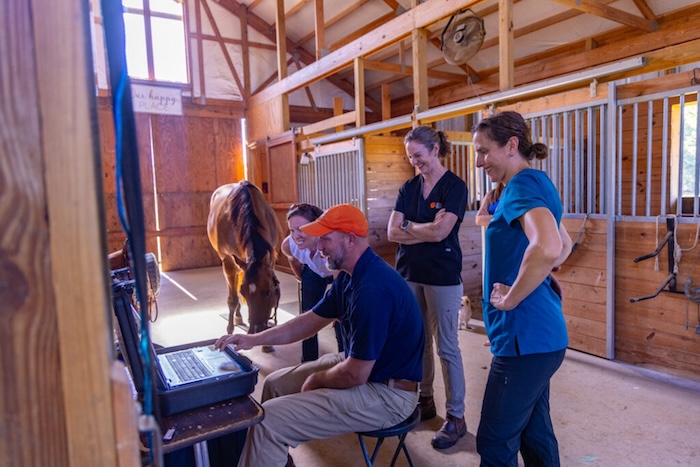
For help with Rags’ exam, Dr. Wise worked with Clemson University’s Dr. Callie Fogle and Dr. Shawn Williamson to give an objective overview of the horse’s health.
“Buying or leasing a horse isn’t just a financial decision,” said Wise. “It’s a commitment to stewardship and partnership. With careful preparation, sound veterinary advice and a strong support network, you’ll be ready to build a safe, healthy and rewarding relationship with your new companion.”
Dr. Wise recently decided to lease Rags, a 14-year-old Quarter Horse gelding for her family.
“Once we knew that Rags’ experience, riding style and personality were a fit for us, the next step was to have him undergo a thorough pre-purchase exam,” she says.
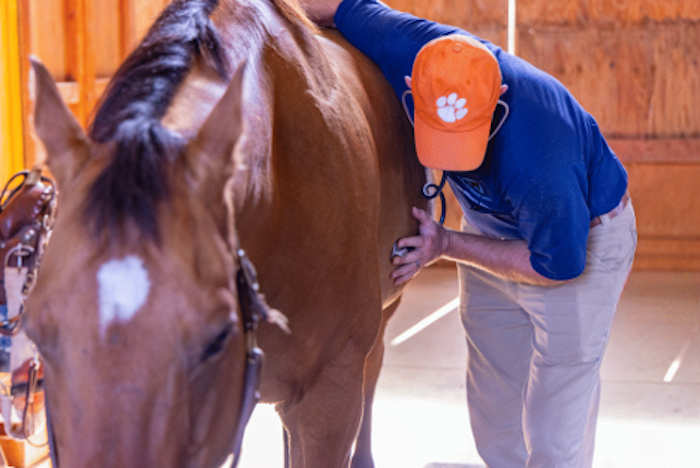
The buyer should be clear with the veterinarian and farrier about their specific goals for this horse.
A pre-purchase exam, conducted by an equine veterinarian, offers an objective assessment of the horse’s current health, soundness and long-term potential. Typically, the future owner (buyer) is responsible for organizing the exam. If possible, it is ideal for both the current and future owner to be present during the exam.
The pre-purchase veterinarian may recommend that a farrier examine the horse to ensure there is a plan for ongoing hoof care.
Depending on the client’s goals and the individual horse, the veterinarian may recommend a:
- Review of previous medical records
- Full physical examination
- Lameness evaluation
- Blood work
- Diagnostic imaging (radiographs, ultrasound, endoscopy) if indicated
- Additionally, the pre-purchase veterinarian may recommend that a farrier examine the horse to ensure there is a plan for ongoing hoof care
“When purchasing a horse, the exam results allow the new owner to be fully informed about any ongoing or potential future health concerns the horse may have..” says Wise. “For leases, the exam ensures both parties are clear about the horse’s current condition, allowing for management considerations to be included in the lease agreement.”
Late-Breaking News & Views
Full-time farriers work with average of 301 horses per year, according to the 2025 American Farriers Journal’s Business Practices Survey … With President Trump slapping costly tariffs last year on products moving between the U.S. and Canada, Glencoe, Ontario, farrier Doug Clark lost a 50-head Thoroughbred barn account last spring due to the uncertainty of U.S. regulations ... Next year (January 26-29, 2027), the International Hoof-Care Summit is heading back to Covington, Ky., Kentucky, the site of the 23rd annual event … Full-time farriers charge $57.80 to trim 4 feet based on data from the 2025 American Farriers Journal’s Business Practices Study.
How to Collect Money Clients Owe You
By Esco Buff, PhD, APF-1, CF
From the American Farriers Journal Archives (Aug. 1, 2014)
Clients failing to pay for hoof-care services is a problem every farrier will experience at some point ji n his career. There are a variety of reasons as to why clients don’t pay their farriers.
By understanding the United States government’s definitions of non-payments and reviewing the basics for collecting, you can make sure more of the money you earn gets to your bank account.
Unpaid Invoices
Each day, millions of small businesses are getting stiffed or are not paid on time. In fact, according to the National Federation of Independent Businesses, slow or late payments are the most significant issue businesses encounter when it comes to getting the money they’re rightfully owed.
Like most small business owners, dealing with late payments from clients is not your specialty. Yet constantly letting late payments slide makes you look bad, is unprofessional and financially hurts you and your family.
There are three ways to demand payment on unpaid invoices or bills:
- Send a collection letter to the offender requesting payment on the unpaid invoice. Sample collection letters can be easily found on the internet, as well as in many business supply stores.
- You can collect debts by hiring an attorney or by using a collection agency.
- Sue the offender in your state’s small claims court. Follow the ensuing procedure discussed in the bad check collection section of this article.
The latter two, especially the second, have costs associated with them, so make sure the probable sum you expect to recover exceeds the time and finances you are willing to invest in the collection.
Stop Payment Checks
A bad check is a check that you can’t cash. The two types of bad checks are stop payment (SP) and non-sufficient funds (NSF) or bounced checks.
An SP check occurs when the owner of the check requests that the bank stop payment. Sometimes there are valid reasons for stopping payment on a check, such as the goods or service paid for that were never delivered or were defective. This is known as a “good faith dispute.”
State SP check regulations vary. In some states, SPs can’t be done on any service checks, while being allowed in other states only for “good faith” reasons.
Usually, if a check you cashed was returned because a stop payment was placed on it, you may take legal action. For your lawsuit to be successful, you must show that the person who issued the SP acted in bad faith. In most states, you can sue for the amount of the check plus damages for up to three times the amount of the check.
Another interesting fact is a bank may cash a check even if the writer of the check had put a stop payment on it. If the SP was done orally, such as by phone, the stop payment is only valid for 14 days. If the SP was done in writing, it is valid for 6 months. The owner of the check can renew stop payments.
Non-Sufficient Funds Checks
An NSF check occurs when the owner of the check didn’t have enough money in his or her bank account to cover the check. NSF or bounced checks can be an expensive hassle. They occur more frequently today because of electronic check cashing, which means banks don’t have to actually process your physical check.
Digital substitute checks can be presented instead. That means checks can clear within a few hours instead of a few days. However, there are several ways to collect on NSF checks.
How To Collect Bad Checks
First and foremost, you should post your returned check policy and the fee that you charge somewhere on your footcare invoice, as well as on an easily seen area of your farrier vehicle.
Secondly, and especially for newer customers, make sure you record the client’s phone number and driver’s license number on the check, if permitted by your state’s laws. This can be most helpful in contacting the check writer if the check comes back as NSF.
State laws address the penalties for writing bad checks. There are generally two types of penalties for NSF checks: civil and criminal.
If a check was returned because of a stop payment, you may take legal action.
Civil penalties address how much the recipient can collect after receiving a bad check. In some states, this can be much more than the amount of the bad check, and may include double or triple the amount of the check plus attorney fees and damages.
In criminal penalties, the bad check writer can be prosecuted and even arrested. NSF checks typically become criminal matters when there is an intent to defraud on the part of the check writer. The majority of bounced check cases do not involve criminal penalties, as most people cover a bad check as soon as possible.
Here are steps for collecting on your SP and NSF checks:
- Contact the check writer as soon as you know about a bad check. Ask them to make good on the bad check or pay you in cash. Be careful about when you call the customer and how often. Laws in several states limit what you can do to collect debts.
- To avoid problems, call only between 8 a.m. and 9 p.m. Maintain politeness in your request for payment. Keep a record of the date and time you contacted the check writer. Give the check writer a deadline of 1-2 weeks to make good on the check. I advise accepting a postal money order, bank check or cash from the check writer to avoid a second returned check.
- If the check writer does not make good on the bad check within the time period, send them a certified letter. Include a return receipt, with the demand for payment on the bounced check. In your letter, demand to be paid within 30 days and include the following amounts: the amount of the check, the cost of certified mail and the service fee charged by your bank.
Some 35 states have bad check laws that are particularly favorable to businesses. In such states, if you send a written demand for payment, you may be able to collect extra damages in court. - After a few days, ask the client’s bank whether the check is good, as the customer may have deposited sufficient funds after the bounced check was returned. You can check the status of an account by calling the bank and saying you are holding a check for a certain dollar amount and asking whether there is enough in the account to cover it. If so, take the returned check to their bank and cash it.
- Another option is asking the customer’s bank for enforced collection. If the bank offers this service, the bad check will be held in a special category. The next money deposited in the client’s account will go to you.
If you aren’t paid within 30 days from the date of the certified letter, you can sue in small claims court. The SP or NSF must be less than the maximum amount you can sue for in your state’s small claims court. Most states have limits of $2,000 to $5,000. If you’ve followed the bad check procedures in your state, you may be entitled to two or three times the amount of the check as damages, as well as your court filing and service of process costs.
Small claims court is particularly well-suited to collecting small debts because it’s inexpensive, fairly quick and you don’t need a lawyer. If you file a suit in small claims court and your customer doesn’t show up when they are supposed to, you’ll win the case by default.
A substantial percentage of customers don’t contest claims for unpaid fees in court because they know that they owe the money and can’t win.
If you file a Small Claims Court claim, you must produce a copy of your written demand and a signed, certified mail receipt showing its delivery, or attempted delivery if refused, to the owner’s address.
Another option is to subscribe to a check recovery service to handle collections on bad checks. Their fees are a legitimate business expense and they take the hassle and embarrassment of dealing with bad check writers out of your hands.
You can set up these services so bad checks go directly from your bank to the check recovery service. They will begin electronic collection of the bad check and send you a report.
Related Content: Establish Terms and Payment Plans to Recover Missed Payments
Esco Buff is a Clearwater, Fla., farrier and a member of the International Horseshoeing Hall of Fame. He has a PhD in business administration.