For more than two decades, the bright yellow “Briefings” page that regularly appeared in American Farriers Journal was among the publication’s most popular features. Now, we’re bringing back this valuable content that offers 4-5 quick-to-read items on the AFJ web site. “Hoof-Care Briefings” will be coming your way on the last Monday of each month, and highlight farrier tips, industry news, maybe a bit of shoeing history from time-to-time and insights of special interest to footcare professionals.
— Frank Lessiter, AFJ Editorial Director
Takeaways
- Obtaining better data accelerates racing surface improvements.
- Concerns over white vs. black hooves is an old wives’ tale.
- Rocker shoe usage has expanded in refining laminitis treatment strategies.
- The latest technology aimed at helping dairymen deal with serious lameness issues could be adopted for more effective quine footcare.
Racetrack Surface Testing Makes Strides
Anytime a catastrophic injury occurs at the racetrack, the first topic is often the safety of the racing surface.
Writing in a 2024 Bloodhorse article, Lenny Shulman says some of the most efficient work and quickest improvements in equine safety have taken place with surface testing and consistency.
Progress on improving racing surfaces is due in large part to the Racing Surface Testing Laboratory (RSTL). The mastermind behind this effort to make racetracks safer for 1,200-pound equine athletes carrying riders at 40 mph was Dr. Mick Peterson.
Peterson developed the Orono Biomechanical Surface Tester to reproduce the speed and loads of a horse’s front limb at the gallop in an effort to evaluate the track. To do this, he developed a three-prong approach to maintaining a quality surface: design, pre-meet inspection and daily testing on race days.
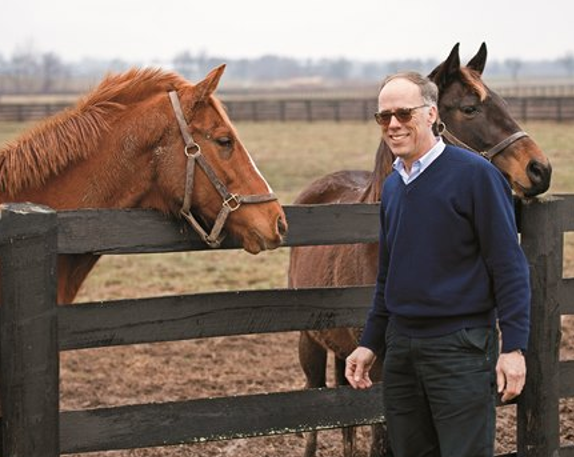
Dr. Mick Peterson of the Racing Surface Testing Laboratory. This project tests synthetic, grass and dirt surfaces to collect valuable data over a wider range of courses.
The passage of legislation in 2022 that put the Horseracing Integrity and Safety Authority in charge of overseeing racetrack safety protocols was a game changer.
“Essentially, those three phases are now requirements under HISA racetrack regulations,” Peterson noted. “In 2021, we did pre-meet inspections at 20 racetracks. In 2023, we did 70 visits to more than 50 racetracks.”
Through financial support from The Jockey Club, HISA covers the costs of pre-meet inspections. If major tracks such as Keeneland, the New York Racing Association tracks, or Del Mar want more done, they pay for any additional work.
In addition to the on-location inspections, material from each racetrack is sent back to the labs, where additional testing is performed
RSTL tests synthetic, grass ad dirt surfaces o collect valuable data over a wider range of courses. The relationship with HISA has significantly added to the available information used to identify potential problems and craft solutions.
“Different locations may have slightly different atmospheric factors, but there should not be any light that separates, for example, Del Mar and Santa Anita,” maintained Peterson. “Slightly different climate, but basically the same materials. And it should be as simple as buying the same sand to put on their tracks. Yet It’s ridiculously difficult to find consistent sand sources.
A big issue is figuring out how to run more races on the turf...
Tracks under HISA in 2023 reported the lowest rate of breakdowns, 1.23 per 1,000 starts, for any North American season in the past 15 years. Tracks not under HISA oversight saw a 32.5% higher rate of these incidents in 2023.
Almost Never Just One Thing
While Peterson feels pre-meet inspections are valuable in identifying potential problems, he identifies a few areas that will further improve safety heading. One area is where track grading is a major issue.
“What I want is real-time monitoring equipment, which a couple of entities are working on independently,” he said. “We need to be able to measure moisture and cushion depths in real time.
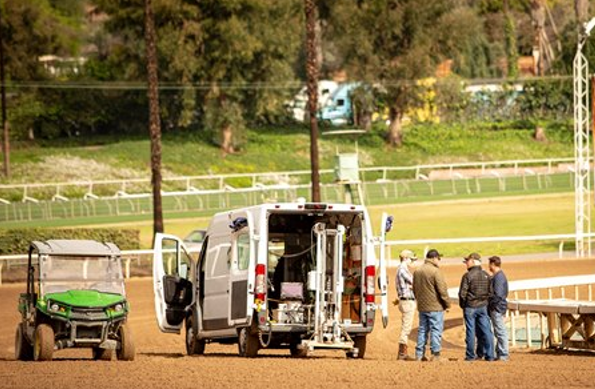
The Orono Biomechanical Surface Tester shown here being used at Santa Anita Park follows a three-prong approach to maintaining a quality track surface that encompasses design, pre-meet inspection and daily testing on race days.
“At Woodbine, they had $25,000 claimers setting track records because the racetrack material was wearing down,” he said. “That’s not good. But that’s where real-time monitoring of the track condition will pay off.”
Turf Concerns
“The other big issue is figuring out how to run more races on the turf,” he added. “Turf racing is a bright spot. It is where the handle is, the interest is, and the field size is. We’re putting a lot of research into that. We’re looking at modifying divot mix. We have a PhD dissertation looking into that.”
Forget Concerns About Hoof Color!
An August 14, 2014 “Blast from the Past” … by Frank Lessiter, American Farriers Journal Editorial Director…
Years ago after California Chrome won the Kentucky Derby and Preakness, members of the general media jumped on the idea that the horse’s white hooves might be a detriment to his racing career. For many decades, some folks in the equine industry have maintained unpigmented hooves are more prone to cracking, tender footedness and weakness.
Reading about California Chrome’s white hooves got me to take a look back at articles published on the topic over the years in American Farriers Journal. In looking through the AFJ article index, I spotted several articles on the legitimacy of claims about white hooves.
White hooves are as strong in the rugged outback as darker colored hooves...
An article in the September 1981 American Farriers Journal issue by deceased researcher Doug Leach pointed out that hoof color has been implicated as an important factor in the durability and strength of hooves. This belief goes as far back as John Dollar’s The Handbook of Horse-Shoeing in 1898.
However, Leach found later research determined there is no difference in water content, chemical composition, hardness or compressive strength between white and black hooves.
Leach wrote that only the outer two-thirds of the hoof wall contains pigment while the inner 1/3 adjacent to the lamellae is unpigmented. If there was a difference between these parts of the hoof wall, a shear force would be produced that would lead to a breakdown if the white hoof were weaker. And he pointed out that such breakdowns do not occur.
In an article in the May/June 1993 issue of AFJ, Jamie Jackson agreed that the white-colored hoof has been a so-called concern in the horse world for more than a century. Now living in California, Jackson offered further evidence in regard to the controversy based on his research with wild and free-roaming horses in the Great Basin area.
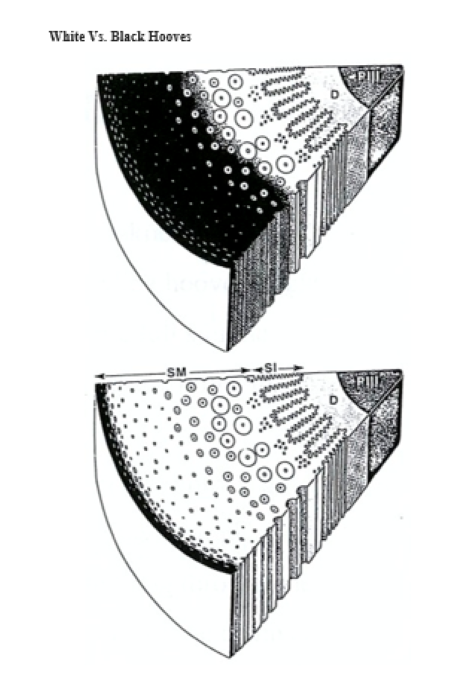
These hoof wall sections show a fully pigmented hoof (above) and a partially pigmented hoof (below). While the inner third of the wall is unpigmented, both hooves would look completely black from the outside.
Color Differences Don’t Matter
When it comes down to whether white hooves are inferior to black ones, Jackson pointed out that the notion that white hooves are prone to tender footedness and weakness did not hold up in the research he conducted with wild horses in the rugged outback. His observations were based on 500 hooves that he personally examined at the Bureau of Land Management holding centers.
When he placed these hooves into black (70%), mixed color (17%) and white (13%) categories, white hooves had the same measurement averages as the entire sample of horses. He found white hooves are as strong in the rugged outback as darker colored hooves.
Jackson concluded that pigmentation or a lack of pigmentation contributed nothing more than what can be deduced with the naked eye — hoof color and pattern. In fact, he determined that unpigmented horn could contribute to abrasion resistance, which is the opposite of what the industry has been led to believe for hundreds of years.
Jackson’s conclusion? The concern over white hooves is an old wives’ tale.Using Rocker Shoes for Managing Laminitis
Laminitis remains among the most challenging and painful conditions affecting horses. When inflammation or metabolic disturbances weaken the lamellae—the structures that suspend the coffin bone (third or distal phalanx, or P3) within the hoof capsule—that bone can rotate or sink, leading to pain, instability and long-term damage.
Alongside medical treatment, proper hoof care and mechanical support help stabilize the foot and support recovery, writes Haylie Pfeffer in The Horse.
During a presentation at the 2025 American Association of Equine Practitioners Convention, equine veterinarian Ramon Batalla, with Podología Equina in Costa Rica, described how rocker shoes can improve hoof biomechanics and help reduce mechanical stress in laminitic hooves.
Mechanical Support for Laminitic Horses
Once lamellar support is compromised, he says the coffin bone can shift within the capsule, creating instability and abnormal force distribution during the stride cycle. These altered mechanics increase strain on already compromised tissues.
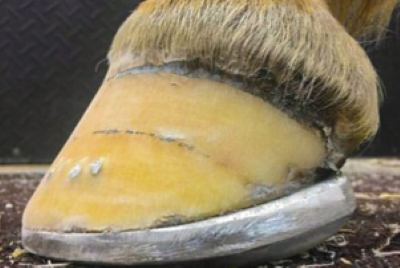
With a curved ground surface that allows the hoof to roll smoothly during movement, rocker shoes might help stabilize laminitic feet by improving breakover, reducing tendon tension and redistributing weight to support healing and hoof growth.Source: Raul Brass
Successful farriery focuses on stabilizing the distal phalanx, reducing pain, and redistributing load toward structures better able to tolerate weight-bearing. By improving how forces are shared within the foot, mechanical support can reduce stress on the damaged lamellae and guide more uniform hoof growth during recovery, said Batalla.
Rocker Shoes and Hoof Mechanics
Rocker shoes have a curved ground surface that allows the hoof to roll smoothly during movement. Unlike traditional flat shoes with a rolled or beveled toe, rocker shoes have continuous curvature along the ground surface of the shoe.
This design effectively shortens the lever arm at the toe and allows breakover to occur earlier and with less resistance, reducing the mechanical load applied to the dorsal (front) lamellae. By decreasing the effort needed to lift the heels during breakover, rocker shoes can reduce tension in the deep digital flexor tendon (DDFT), which runs down the back of the limb and inserts into the bottom of the coffin bone.
In laminitic horses, limiting excessive flexor tension and toe leverage becomes particularly important because these forces further contribute to coffin bone displacement. Rocker shoes allow the foot to transition more smoothly through the stance phase, Batalla added.
Unlike traditional flat shoes with a rolled or beveled toe, rocker shoes have continuous curvature along the ground surface of the shoe...
Proper Trimming and Radiographs
Applying rocker shoes correctly requires careful trimming and radiographic guidance. In many cases the farrier trims back the heels to the widest part of the frog to help realign the hoof capsule relative to its internal structures and improve weight distribution across the foot, Batalla said.
Because trimming the heels can influence palmar angle (the angle of the coffin bone relative to the ground), farriers could use wedge pads with rocker shoes to maintain appropriate alignment and provide additional structural support, said Batalla.
Improving load distribution across the sole might help restore healthier perfusion (oxygenated blood delivery) within the foot. “When P3 rotates, pressure beneath the bone’s apex can compromise circulation to the solar corium (the sensitive living tissue between P3 and the insensitive sole),” said Batalla. “Corrective shoeing that redistributes load away from overloaded areas may help restore perfusion and support more uniform hoof growth.”
Take-Home Message
Although rocker shoes are not a new concept, equine veterinary podiatrists and farriers have expanded their use as they refine laminitis treatment strategies. The technique demands skill and careful application, but it can provide meaningful biomechanical advantages in certain cases.
Because laminitis varies widely in severity and underlying cause, no single treatment approach works for every horse. However, when applied appropriately, rocker shoes can help improve comfort, reduce damaging forces within the hoof, and support long-term recovery.
Late-Breaking News & Views…
Hoof knife misuse is among the leading causes of equine lameness, says Bob Smith, owner of the Pacific Coast Horseshoeing School in Sacramento, Calif. … If you were charging $36.80 for a trim in 2024, your price today should be $70, based on American Farriers Journal Benchmark Survey data … Remember that farriers see horses every 6-8 weeks while veterinarians only see most horses 1-2 times a year, says Ingrid Wolff … 30% of British horse owners are looking at extending the interval between farrier visits, according to a survey from the United Kingdom’s Equine Welfare Council.
Can New Technology Dealing with Hoof Concerns in Cattle Work With Horses?
As a dairy cow named Pearl stood patiently, Catie McVey ran an iPhone around each of her hooves for a few seconds. Pictures of Pearl’s feet zipped online into the cloud, where computer vision algorithms stitched them together into three-dimensional models.
In moments, McVey got back an analysis of the cow’s hooves, quantifying size, toe angle and claw curvature. These are key traits for avoiding lameness, which can reduce milk production, harm animal welfare and eventually lead to a farmer euthanizing a cow.
“Dairy farmers were into big data way before it was cool,” McVey said, citing the literature she relied on while earning her doctorate in animal biology at the University of California, Davis.
“Maybe the latest cattle lameness technology can be adopted for quine hoof-care…”
Dairy producers first used technology to improve easy-to-measure quantitative traits, such as like milk yield. But the rapid progress they achieved outpaced improvements to foundational traits like bone structure and hoof size.
This leads to what McVey calls, “Ferrari genetics with flat tires.” Those larger, more efficient cattle started to suffer higher levels of lameness.
McVey is part of a growing movement to help develop even more effective technology. Camera systems such as PediVue and CattleEye are helping farmers catch and correct hoof issues before they cause real harm.
McVey’s own Graham, N.C.-based startup OsRostrum has been developing an iPhone app, BoviPhIT, to give dairy farmers the same easy, precise measurements for hoof traits that they’ve long had for weight and milk production.
“Being able to look at a cow and pick her apart and make breeding decisions at the farm level is always going to be the cornerstone of any breeding program,” says McVey. “But being able to take some of that time-tested knowledge on what makes a strong, structurally correct cow and quantify it and put it into national-level genetic evaluations — that’s the missing link to make some truly spectacular cows.”