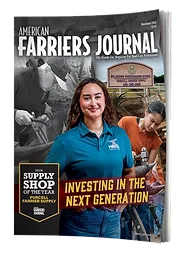
With Thanksgiving upon us and the holiday season knocking at the door, it’s important to take a step back and reflect on the year, our lives and what we’re thankful for. Family, friends, a roof over your head and food on your table may come to mind immediately. For many farriers and equine enthusiasts alike, the intangible and tangible value we place on our lives may be tied to the horse.
Besides the monetary benefits and the security that comes with a steady income, have you ever been introduced to a new friend by someone you met at a clinic? Did you meet your spouse at a barn or a contest? Did the International Hoof-Care Summit ever connect you with a mentor?
It’s impossible to acknowledge every moment, decision and coincidence that’s led to today. We’d be going around the dinner table for the rest of our lives. What we can acknowledge is that our lives are shaped by what we choose to do each day. A farrier’s life is shaped by the horse.
In turn, the horse’s life is shaped by us. Humans have spent thousands of years entwined with horses, driving innovation and society forward. For the last 5,500 years, horses have been used for farming, transportation, work, sports and pleasure. Horseshoers have been around for at least 2,000 of those years, the oldest horseshoes dating back to the fourth century B.C.E. Though older shoes likely existed, any leather options have been lost to time, and metal was probably recycled after the horse no longer needed it.
Prior to domestication, horses were hunted as food.
The family Equidae is one of the most thoroughly researched groups in history, its lineage being roughly traced back 55 million years. In a recent paper, published in Nature Ecology & Evolution, researchers from the Senckenberg Centre for Human Evolution and Palaeoenvironment at the University of Tübingen reconstructed the genome of Equus mosbachensis, an extinct horse that lived 300,000 years ago. A miraculous find in and of itself, the findings help close a gap in the evolution of modern-day horses.
“With our study, we were able to fill a temporal and geographic gap in the study of horse evolution,” says Professor Cosimo Posth of the Senckenberg Centre and an author of the research paper. “For a long time, genetic research focused primarily on changes caused by the domestication of horses in the recent past. But to understand the evolution of the horse, you also have to examine their earlier history. Archeological finds, for example, show that horses already played a central role for early human species, particularly as a source of food.”
According to Equine Science Update, fossil remains of at least 20 hunted horses were found next to 300,000-year-old wooden spears, the oldest complete hunting weapons in the world. Early humans evolved alongside early horses, permanently weaving our stories together.
Today, our relationship with horses is much different. We keep them as pets and compete with them in high-level sports, all of which require precision in hoof care. We have more technology at our disposal than ever before, more knowledge-sharing than 50 years ago and more community than we did yesterday.
Farriery is an ancient trade that’s evolving for a modern world and shows no signs of giving out any time soon. So keep passing the torch that was lit over 300,000 years ago. Learn from your colleagues, and invest in the next generation. Bring your kids to a contest. Maybe they’ll meet a lifelong friend.
Give yourself the opportunity to be thankful tomorrow by being open to possibilities today.