Takeaways
- Build a network of mentors and peers to lean on. Resisting isolation is a key to growth.
- Get involved in local and national organizations and attend clinics, contests and certifications to continue to learn and improve as a farrier.
- Stay self-motivated and passionate, and say yes to any opportunity that presents itself.
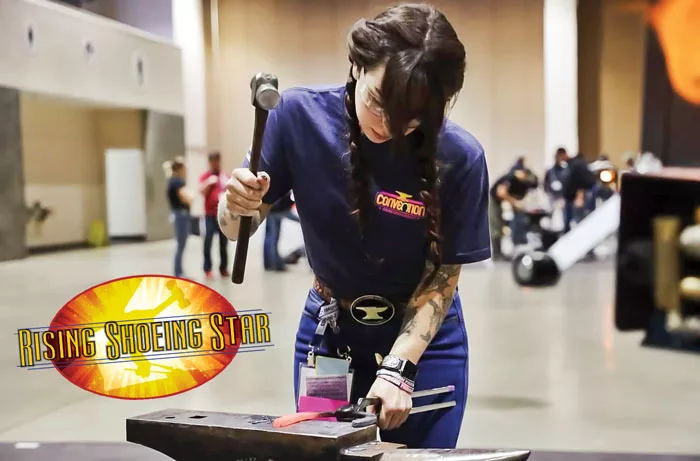
There is a seemingly insurmountable mountain of knowledge to absorb or implement when starting your practice. For 2024 Rising Shoeing Star Amanda Smith, the key is to keep moving forward and say yes to every opportunity.
Smith was honored as a Rising Shoeing Star at the International Hoof-Care Summit in Kansas City, Mo. The program — sponsored by Pyranha Animal Health, Victory Racing Plate Co., and American Farriers Journal — recognizes farriers making incredible progress in their first 3 years after farrier school. In partnership with industry suppliers, the program highlights the importance of education and motivates new farriers to succeed.
Born in Costa Rica and raised in Switzerland, the California farrier knows what it means to make big changes and roll with the punches. Though she makes it seem easy, the Rising Shoeing Star award celebrates the hard work and dedication of young farriers.
Smith grew up around horses. Her parents were involved in the breeding scene in Switzerland, so it wasn’t difficult to transition to equine behavior specialist for a large horse rescue in the Mojave Desert. It was a position that facilitated her earning the Certified Equine Behavior Management Specialist designation through the Animal Behavior Institute.
“I was helping with the training and behavioral correction of horses that were going through their first trimmings and shoeing in years since getting to the rescue,” she says. “So, I was working with their local farrier who introduced me to it all.”
Smith started her career as a means of independence from a bad situation. Needing to support herself financially, she attended Pacific Coast Horseshoeing School in Plymouth, Calif., because it was the closest and most affordable.
Since then, she’s earned her Certified Farrier designation through the American Farrier’s Association (AFA) and Accredited Professional Farrier III designation through the International Association of Professional Farriers (IAPF). She is the secretary for the Western States Farrier Association — which involves organizing contests, clinics and other events — and wrote the Equine Behavior Manual for the IAPF. She is a lead instructor at Pacific Coast and heavily involved in furthering the education program there and online for the benefit of farriers around the world. At the same time, she keeps 100-head of horses on her personal books, which she tends to after hours and on weekends.
Smith’s career thus far could only be achieved through the support and guidance of others — namely Bob Smith, owner of Pacific Coast, and a local farrier Raleigh Desiato — along with her own positive attitude toward new challenges.
It Takes a Village
She learned valuable lessons from Desiato and Smith, including determination and perseverance in the face of adversity.
“Raleigh was the first farrier who let me into her truck,” says Smith. “She taught me how to take criticism. You’re going to do something wrong a million times, and you have to keep going until you get it right. You can’t take it personally. It’s either well done or it’s not. I rode with Raleigh for a short 6 months, but almost every day when I’m shoeing a horse, I can hear her in my head.”
This standard of excellence is something Smith carries with her. Each shoe she fits or foot she trims acts as her business card, she says. No matter if it’s a performance horse or pasture pet, each horse receives the same level of care.
“I am letting people know who I am as a farrier every time I set a foot on the ground,” she says.
From Bob Smith, she learned to be self-reliant, to not let others’ opinions get in the way of her goals and to be professional and positive, regardless of the situation.
“You have to get out of your comfort zone…”
“Bob pushed me to pursue certain things and get involved with different associations like the IAPF, which had me write the Equine Behavior Manual for them. That connection came through Bob. It was the same with the AFA and the Western States Farriers Association. Bob was heavily involved with them. I would not have known how to handle the pressure of working with so many people without some guidance from him,” she says.
Building this network of mentors and peers to lean on helped her significantly when she experienced a health scare that left her unable to work for several months. The village she built for herself stepped up and tended to all her horses when she couldn’t. That’s when Smith offered her a more prominent position at Pacific Coast, where she learned she has a passion for teaching.
“I work 7 days a week,” Smith says. “I’m 5 days a week at the horseshoeing school, and then I work my personal clients either in the morning before I start teaching or in the evenings after I’m done for the day and then on weekends.”
To manage the 100 horses she has on her books, Smith has a few local farriers ride along with her to help out.
“That village comes in and allows me to make all of this work,” she says. “No one can achieve this kind of success in the farrier industry on their own.”
Learning & Growing
Reflecting on her journey, Smith says she would have done a few things differently if she could.
“I haven’t had the chance to do a lot of ride-alongs,” she says. “I just chased clinics and events all across the country. The entire time, I was already running a full-time business, so I couldn’t promise multiple days out of the week to someone.”
She views apprenticeships and shoeing schools as necessary steps to operating a successful business for the foundational skills they teach.
“I am where I am in spite of the fact that I started a practice right away rather than thanks to it,” she says. “When I first started, I was in such an isolated area. I had nobody to ride with, and I needed to survive. So, I just went out and worked.
“It wasn’t until later when I started riding with Raleigh and when I started coming to the school more to practice for my Certified Farrier and later work toward my Journeyman that I realized I missed out on a lot because I was in this mentality that I just needed to work. I needed to survive.”
“I am letting people know who I am as a farrier every time I set a foot on the ground…”
She emphasizes that hindsight is 20/20 and recommends others attend a school, then ride with another farrier while making time for contests and clinics. Once a farrier starts shoeing full-time, it can be difficult to make room for continuing education activities.
However, sometimes sacrifices may be necessary. When Smith was riding with Desiato, she had to let go of a few clients and give up personal time on the weekends to learn from her. Concessions should also be made in the way of comfort.
“To prepare, get better and show up at events, you have to get out of your comfort zone,” she says.
Failure is part of the learning process, but resilience is key. Though it’s also important to know when something isn’t going to work out. When Smith was an equine behavior specialist for a large rescue operation, she dealt with many animal abuse cases. For Smith, she knew to back out when it started affecting the horse.
“If it’s affecting me and my mental health, that’s a choice I’m making every day, so I need to take responsibility for that,” she says. “But if it starts affecting the animals that you’re working with — where you’re unable to give 100%, and you start giving up because you’ve already seen a hundred cases like this, and you had no success — that’s when you have to get out. I will change things as soon as I realize that it’s not benefiting me or the animals that I’m working with. Because the priority is the animal.”
Defining Success
A good indicator of success for Smith is self-motivation and the drive to continually improve. One way she does this for herself is through certifications.
“It’s a way to keep myself accountable in my continued education,” she says. “I think it’s good to bring your work in front of other people and have it picked apart because you can’t improve until you see a different perspective. The AFA certification specifically forces you to get out of your comfort zone. It forces you to practice things that you will not do in your everyday practice. It gives you a goal.
“I need to have that goalpost in front of me and plan on how I’m gonna reach it. Certification gives me that. It’s not about the letters. It’s just about personal pride and wanting to be better than you were yesterday.”
At the end of the day, being a successful farrier is less about the certifications behind her name and more about being proud of herself and her work.
“It’s really important for me that when the day’s over, I had fun. I had good laughs with the people around me. I know I did the best job that I could do with every animal that I encountered and know that tomorrow I’m going to try to do better than that,” she says.
In her work, she also prioritizes giving back to the farrier community and helping those who helped her. At Pacific Coast, she and Smith set students up to be involved in the AFA and IAPF after graduation. Students attend pre-certification and certification events, with entry and membership fees covered by the school. This helps new farriers avoid falling into the trap of isolation, she says, and then they have a clear path forward after graduation.
Smith’s advice for new farriers is to simply get involved with everything you can. It’s the best way to build community, learn and grow as a person.
“When somebody asked me to become involved or help with something, I always said yes. Or I was the person who walked up to somebody and said, ‘What can I do to help?’ And there’s always something.
“Look up any local or national associations and just become a member and show up. That’s the best thing you can do. Just keep showing up. Because you’re doing it for yourself and the horses that you work on every day.”