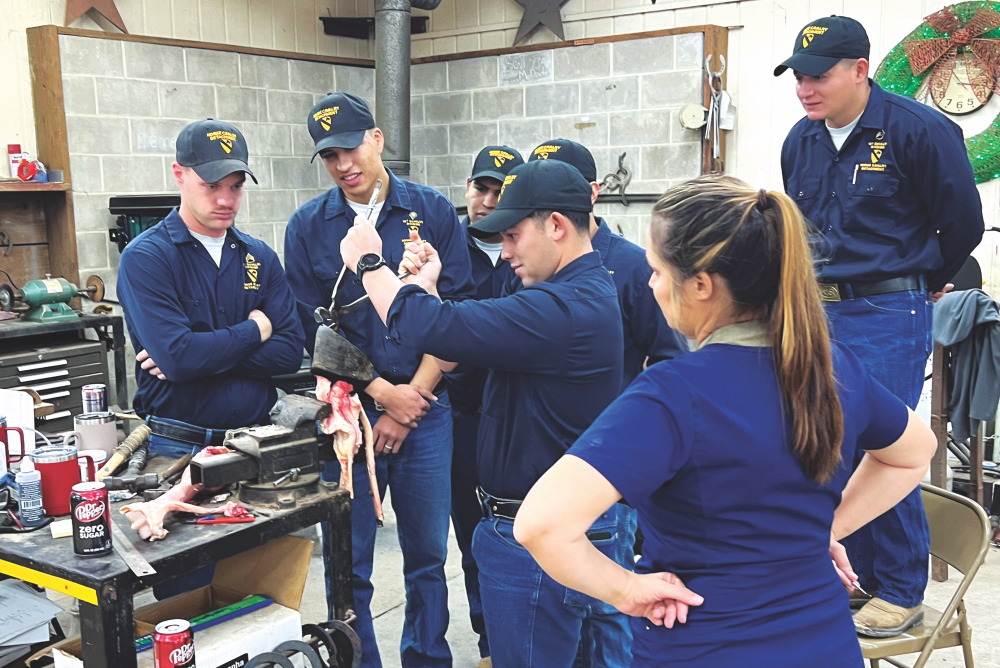
Members of the First Cavalry Horse Detachment at Fort Hood, Texas, dissect a cadaver limb. Source: Chris Gregory
Farriers and horses are deeply woven into the fabric of U.S. military history, serving significant roles in every major war since 1775, including the invasion of Afghanistan in 2001. After 250 years, the sun is setting on their roles of defending the constitutional republic.
The U.S. Army is ending its Military Working Equid (MWE) Program at five installations in a cost-cutting move. The programs will cease at Fort Hood, Texas; Fort Huachuca, Ariz.; Fort Irwin, Calif.; Fort Riley, Kan.; and Fort Sill, Okla., according to the Army. Fort Carson, Colo., is also among the programs closing, according to the Army Times.
The Army will cease “ownership, operation and material support” this month. Programs will continue with The Old Guard caisson units at Arlington National Cemetery, Virginia, and Joint Base San Antonio, Texas.
The Army estimates the move will save $2 million annually. The 141 horses on the bases will be adopted over the next 12 months to “vetted owners according to federal law.” None will be sold, says Steve Warren, Army spokesman.
“[The horses] are part of the Army family,” he says. “We’re going to treat them with compassion.”
Losing History
Although modern warfare no longer requires horses, International Horseshoeing Hall of Famer Chris Gregory laments discarding the noble steed from the Army’s ranks. The owner of Heartland Horseshoeing School in Lamar, Mo., has worked with military horses and conducted educational sessions at Fort Hood and Fort Carson.
“This is a tragedy,” Gregory says. “We don’t want to lose our cavalry and our horses. For what they bring as far as recruitment, heritage, culture and putting the American stamp on it, they need to stay.”
Joshua Baker, an active-duty service member, farrier and owner of Black Iron Equine, agrees.
“Removing the programs takes away a part of history,” the Kentucky native says. “There are still monuments, machines, etc., that represent history on display and in museums at many installations. What better way to have your community become interested in history than to have re-enactments, parades and funeral ceremonies live and in action right in front of you.”
The Army’s MWE Program played a major role in recruiting Baker to enlist.
“I grew up around horses all my life,” he says. “My dad was a farrier for over 20 years. When I saw the Army had horses, it was one of my driving factors to join.”
However, Baker would have to wait. A horse detachment is an interviewed position. To improve his chances, he completed his hoof-care education at Casey and Son Horseshoeing School in LaFayette, Ga. Baker reupped his commitment with the hope of securing an interview at Fort Riley. The closures could have negative long-term ramifications.
“This decision to close the detachments can directly affect service members who are in the farrier industry because it stops their professional growth,” he says. “Some service members rely on the farrier skills they have attained for their job after the Army. Taking away this opportunity hinders their efforts to better themselves professionally and personally.”
Learn More
Gain more insight into the military history of horses with this exclusive content.
U.S. Army Honors its Horse Tradition: Chris Gregory explains the importance of hoof-care education for military horse detachments.
For the Want of a Farrier, Independence Might Have Been Lost: The fabled crossing of the Delaware River by Gen. George Washington is immortalized in paintings, history books and film. Yet, the struggles endured by the Continental Army during that fateful night might have impressed upon our first commander-in-chief the importance of farriers.
Nation’s Farrier: Pete Cote shoes the horses that pull the full-honor funeral caissons at Arlington Cemetery, is the official farrier for presidential inaugurations and shoes the only horses owned and maintained by the federal government.
Farewell to the Nation’s Farrier: Pete Cote steps down after 35 years of service helping “The Old Guard” keep Arlington’s traditions.
Horses Add to the Solemnity of Arlington National Cemetery: I remember the sound of the hooves meeting the ground clearly. And I remember standing in awe.
A Farrier’s Well-Kept Promise … 5 Years Later: Frank Lessiter recalls how he acquired a horseshoe from the caisson from President Reagan’s funeral.