
For farriers just starting their careers, it can be difficult to assess whether you’re charging appropriately, operating your business in the most efficient way and setting yourself up for future success. Horseshoeing can be an isolating trade, so it’s important to have a baseline knowledge of how your peers and those more experienced than you are running their businesses.
Each year, American Farriers Journal publishes the Farrier Business Practices Survey Report. The survey — made possible by Anvil Brand, Vetericyn, Hoof MD and Glue-U — is sent to farriers across the United States, and the resulting data helps farriers evaluate their businesses.
Establishing Pricing
Many young farriers undercharge for hoof-care services because they’re less experienced than their older counterparts, feel they’re not worth as much or do not have enough horses on their books to pick and choose their client base. While increased skill, business acumen and client relationships do come with time and experience, it’s important to still charge a living wage. This means evaluating your overhead costs and factoring living expenses in to your charges (Read “A Healthy Business Requires Sound Financial Planning” on Page 43 to learn more about ensuring your business is profitable).
Data from the Farrier Business Practices Survey supports the idea that younger farriers charge less. For those under 25, the average annual income for full-time farriers is $80,000. By the time farriers enter the 30-39 age bracket, this has increased to an average of $150,657. After the age of 40, full-time farrier income declines. However, it isn’t until 69 and older that farriers report making less than those 25-29.
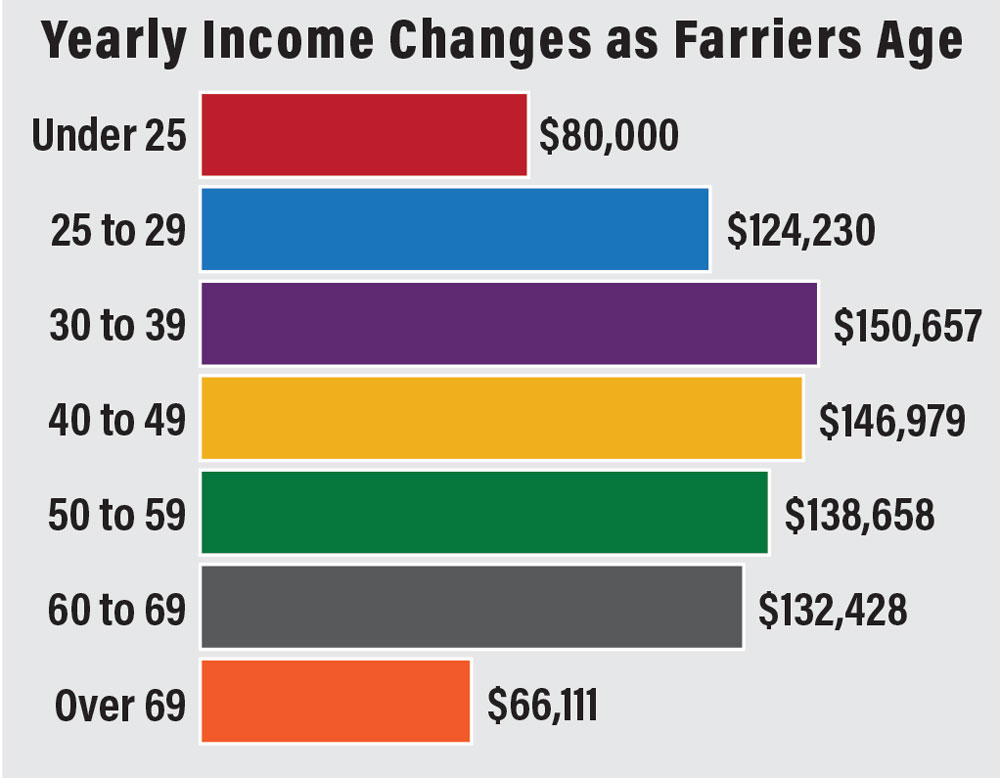
The average full-time farrier spends $23,170 each year on products and supplies. This means at the end of the year, those under 25 will take home an average of $57,000. Where you live, is this enough to pay your bills and live comfortably? Do you have money to spend on continuing education, such as contests, clinics or conferences? Is there enough left over to save or invest? If the answer is no, consider raising your prices.
Where & When to Adjust
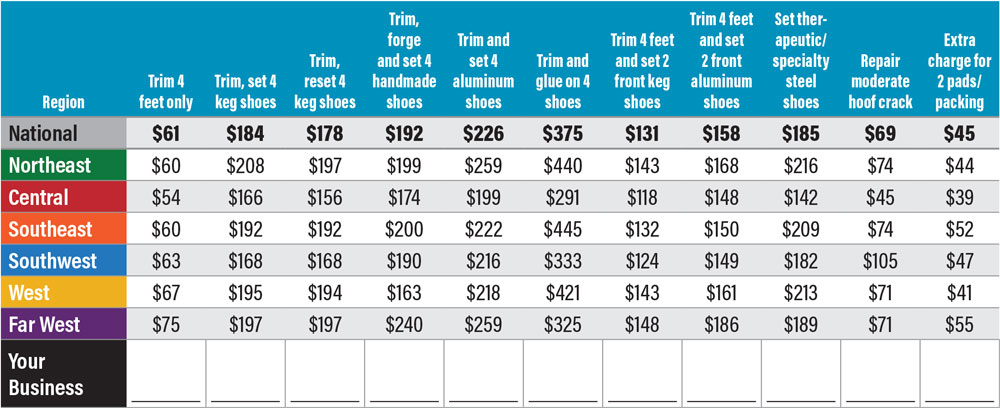
Depending on where in the country you live, farriers are likely charging differently for different services. For example, the average farrier is charging $166 for a set of keg shoes in the Central region of the U.S., while a farrier in the Northeast is charging $208. Regional charges can be impacted by climate and hoof quality, the types of horses worked on as well as the ratio of horses to farriers for any given state. Knowing the demographics of your area can help you establish a reasonable pricing structure (Read “Protect Your Profit Margin” to learn the value of saving money through efficiency and charging appropriately).
Another factor to consider when adjusting charges is your education and experience. Though farriers raise their rates with age, the level of experience at which this occurs is often undefined. What counts as “enough” knowledge or continuing education to justify a price hike? Often, imposter syndrome plays a role. Data from the Farrier Business Practices Survey may be able to shed some light on the subject.
According to survey respondents, those who owned or were in a multi-farrier practice made $167,619 per year, $31,883 more than the national full-time average of $135,736. Farriers who served as an apprentice for any length of time reported making $144,508 per year, and those who served for 2 or more years made $146,439. If you invested any money at all in continuing education — such as textbooks, podcasts, contests or clinics — you would be making $147,815 on average. Full-time farriers who are current members of either the American Farrier’s Association, the International Association of Professional Farriers or a local farrier group make an average of $151,500 per year. Farriers who attended either local clinics, national conventions or contests made an average of $153,843. In addition, each year, farriers report planning to raise their prices an average of 3.5-4% to account for inflation.
It pays to continue your education past horseshoeing school.