Takeaways
- Scheduling clients based on their location can save time, minimize wear on your vehicle and save on gas money, protecting your profit margin.
- Raising prices improves profit margin and incurs fewer expenses than adding horses, which reduces your business’ efficiency.
- Charging appropriately and raising prices at regular intervals is crucial to maintaining a healthy profit margin.
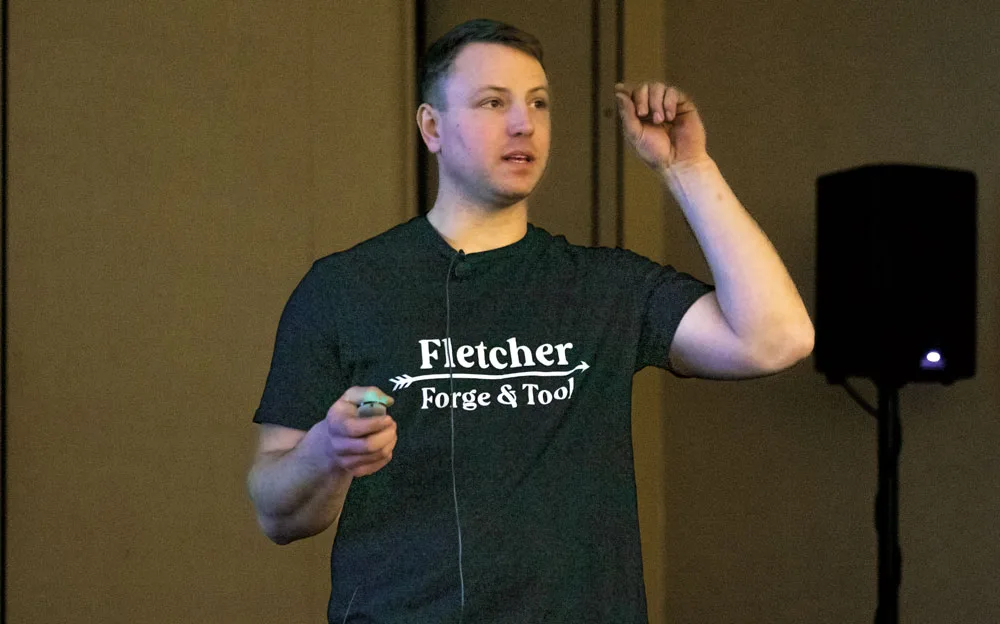
There is more to operating a successful farrier business than shoeing horses. Maintaining a healthy profit margin is key to ensuring farriers can continue to do what they love. At the 2026 International Hoof-Care Summit, Paris, Ontario, farrier Andrew DeVisser explains this means controlling expenses, scheduling efficiently and raising prices appropriately.
“For some of us, it’s easy to be busy shoeing horses while the barbecue fire that is the financial side of our business rages vaguely in the background,” he says.
Without proper management, taking an “out of sight, out of mind” approach to finances can lead to spiraling debt and undue stress. Profit margin is a measure of expenses vs. income, the “margin” being how much profit you gain after all expenses are taken into account. It’s an effective way to measure the health of a business. DeVisser does not include retirement savings, other wages and personal expenses in business expenses. Those items would be pulled from the profit margin final number. Taking the time to keep up with inflation, evaluate where expenses can be cut and raise prices as needed ensures your profit margin stays in the black annually.
The Butler Professional Farrier School graduate says it simply: “You either make more money or you spend less.”
Efficient Scheduling Saves Money
DeVisser acknowledges that people often prefer to discuss increasing their income when it may be more effective and realistic to control expenses.
“In a lot of situations, you can affect your expenses a lot more than you can affect your ability to make more money if you’re already maxing out there,” DeVisser says.
Expenses can be controlled in many ways, including purchasing smarter. Farriers can invest in a more fuel-efficient vehicle, spend some time finding the best deals for needed expenses and avoid eating fast food on the road. On the job, scheduling clients efficiently can save time and money.
“Many of our expenses are up 50% or more…”
“Instead of driving past a client you saw yesterday to go to a client today and then driving past them again on the way home, if you schedule better, sometimes you realize you can be driving 30-50% less,” DeVisser says. “If your clients can be flexible, you can say, ‘I’m going to schedule a string or a line of people, and I’m going to cover all those people in one day.’ ”
Creating a route that avoids doubling back while keeping the day’s clients within a reasonable area saves valuable driving time that could be used to add clients, pursue personal projects or practice in the shop. It also reduces unnecessary tire wear, minimizes the mileage added daily to your vehicle and saves gas money, which can add up quickly depending on what you drive and fuel prices.
Raising Prices vs. Adding Horses
In addition to looking for pathways out of expenses, DeVisser suggests expanding profit margin by weighing the value of increasing prices against adding more horses to your books.
“For example, a guy shoes 10 horses in a day at $360 per horse. His total income is $3,600. A gal shoes 20 horses at $180 each. The total is the same, $3,600. Now, who made more money?” DeVisser asks.
The guy made a greater profit than the gal because he incurred fewer expenses by using fewer products and putting less wear on his vehicle.
“If you take on more horses, your overall income may go up, but your business does not become more efficient,” he says.
Education Saves Money
Ontario farrier Andrew DeVisser notes that taking time to learn new skills is an investment in your future.
“How many of you have heard the phrase, ‘I would rather just shoe one more horse and buy the tool?’” he says. “That’s fine, but becoming skillful makes your time more valuable. If you become more skillful at shoeing horses, you can charge more.
“For example, it takes about $3 of steel, $1 of propane and two heats to make a fore punch,” he continues. “If you really knock them out, you can make a batch of five serviceable fore punches in an hour. Now, do the math on what your last fore punches cost you to buy.”
Instead, raising prices for existing clients eliminates the extra expenses of taking on more horses — including the cost of extra shoes, rasps and other frequently replenished inventory — which increases efficiency.
“If you raise prices, your income per horse increases. As you raise your income — barring the long-term effects of inflation — your expenses remain the same,” DeVisser says, which ultimately improves profit margin.
By increasing prices per horse, farriers minimize their workload while increasing profit. It also works to improve the customer service side of a farrier’s business, he says, by allowing more time to accommodate client schedules, including last-minute emergencies.
“Raising prices instead of adding horses means less time spent shoeing, less scheduling, significantly less in expenses — like fuel, shoes, nails, rasps — and fewer emergencies,” DeVisser says. “The more horses you have on your books, the more time is spent on emergencies.”
Charging Appropriately
DeVisser suggests that farriers set their product price point according to their expenses, rather than basing it on the farrier next door. The cost of running a farrier business includes more expenses than just tools and shoes. Time spent on your business, not underneath the horse, should still be accounted for.
“There are a lot of expenses that we don’t usually think about,” he says. “Have you factored in the insurance for your van? Have you factored in bookkeeping costs? Because there is a per-horse cost that can be factored into your pricing. It doesn’t feel like a shoeing expense, but it is a necessary expense.”
DeVisser’s equation for determining appropriate charges uses the cost of materials as a farrier’s baseline, then adds the cost of labor and skills as well as a premium on top.
“It’s going to vary,” he says. “If you’re in an affluent area, you can afford to upcharge a little bit more for your skill. Whereas if you’re in a more depressed area, the market just won’t bear an additional premium.”
DeVisser adds that the market can handle increased prices more than one might think, but pay attention to what you charge in less affluent areas.
“There’s an area that I started working in, about an hour west of my house, and I do probably half my work there now,” DeVisser says. “Before another farrier and I started shoeing in that area, other shoers thought that half price was what the market could bear. Now, not every person with a horse in that area is willing to pay my premium, but I don’t need all the horses. You only need the ones who are willing to pay your premium.”
He adds that farriers may need to sell themselves to new clientele by explaining their work experience and continuing education to ensure a better reaction to higher pricing. Keeping prices too low to appease clients only hurts themselves, he says.
“There are a lot of expenses that we don’t usually think about…”
“Either they’re doing work without being properly insured and without proper tools, or they’re losing money, and neither of those is what you want to do,” he says. “Talk to people who are charging good money. Get in and work with them. You have to associate yourself with a premium brand. Maybe you can’t charge $350 in your area, but maybe you can charge enough to make a living there.”
DeVisser adds that premium charges should reflect the economy and account for inflation.
“Between 2018 and the current year, many of our expenses are up 50% or more,” he says. “A lot of older farriers have been hit hard. For us, we had to increase our prices 30% just to stay level, and a lot of those guys didn’t. They were charging great money 9 years ago, and now they’re having trouble.”
Farriers need to be strategic about how they raise prices, notes DeVisser. Timing is one factor to consider.
“A guy that I work for would raise his prices not in January when everybody’s broke right after Christmas, but in June when everyone’s busy going to shows. He says clients hardly even notice,” DeVisser says.
Another strategy is to implement an incremental price increase. This means farriers raise the price of a different product or service annually. This minimizes sticker shock for clients while allowing farriers to keep up with inflation and the cost of living.
“Instead of going up $5 a trim every year, you go up $10 every 2 years,” he says.
Using his own business as an example of good profit margin, he says that, on average, another farrier in his area would have needed to shoe seven more horses per week and significantly increase their average prices to have made the same profit.
“At the end of it, you’re left with what feels like just a wee little bit,” DeVisser says. “That wee little bit is how you get ahead in life. That is the difference between horseshoers who are 70 years old and completely broken and still working because they have to and ones who don’t have to do that.
“There’s a reason that a lot of us aren’t accountants,” he continues. “We don’t want to spend all day behind a desk, but this is a part of our trade. Pricing has a long-term bearing on you, your families and your clients. We can’t guarantee that we’re going to make it to 65, so it’s more important for us to be thinking about the business side of shoeing horses than perhaps people in other industries.”