
For more than two decades, the bright yellow “Briefing” page that appeared in American Farriers Journal issues was among its most popular features. Now, we’re bringing back this valuable content that offers a few quick-to-read items on the AFJ web site. “Hoof-Care Briefings” comes your way near at the end of each month, highlighting farrier tips, industry news, maybe a bit of shoeing history and valuable insights of interest to footcare professionals.
— Frank Lessiter, AFJ Editorial Director
Takeaways
- The earliest signs of rainrot is warmth in the affected area and hairs standing slightly on end.
- Know what your per-hour rate is for handling footcare work.
- Adding water to feed did not impact amount of water drank by the horse.
- Experience comes earning from an accumulation of mistakes — hoping you don’t make the same ones again.
Moisture Is a Major Concern with a Horse’s Skin
Moisture concerns was the number one concern in a recent Equus magazine article that discussed the three worst threats to a horse’s skin. The other two were sunlight and insects.
Since moisture is also a major threat to footcare, here’s what the article stated about moisture and why a horse’s coat can only look its best when the skin beneath it is healthy. The article pointed out this is why an essential part of any grooming routine is to stay alert to conditions that can compromise dermatological health.
Here is the article’s advice for dealing with scratches and rainrot that you can share with your hoof-care clients.
Rainrot and Moisture Concerns
For starters, be on watch for rainrot, the crusty, painful skin infection that thrives in damp weather. The bacteria responsible, dermatophilus congolensis, normally reside on a horse’s skin without consequence. But wet weather — particularly following a long dry spell — allows them to flourish. This overgrowth triggers an inflammatory response in the top layers of the skin and hair follicle.
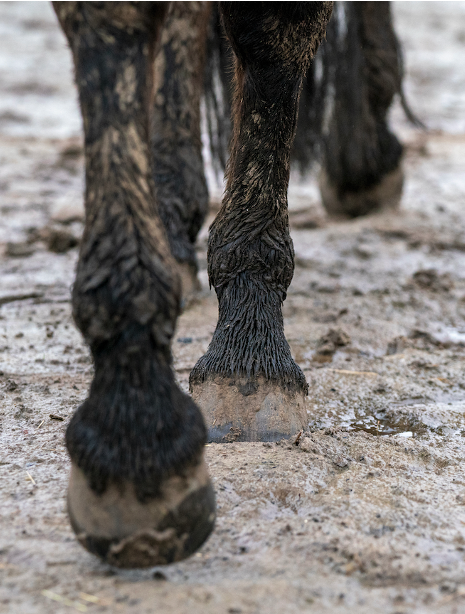
The wet/dry cycles common in milder climates can lead to scratches, a painful bacterial infection of the skin just behind the fetlock. (Adobe Stock)
The earliest signs of rainrot is warmth in the affected area and hairs that stand slightly on end. Within a few days scabs begin to form at the base of the hairs. As these scabs proliferate, they develop a tight, painful crust that follows the runoff pattern of rain across a horse’s back and rump.
Most cases of rainrot can be treated with medicated shampoos — usually containing Betadine or chlorhexidine — or topical other treatments specifically formulated to kill bacteria. In severe cases, your veterinarian may recommend systemic antibiotics. Otherwise, the treatment protocol focuses on removing the scabs to kill the bacteria beneath them.
Scratches and Moisture Concerns
The wet/dry cycles common in milder climates can also lead to scratches, a painful bacterial infection of the skin behind the fetlocks. Scratches begins when repeated exposure to moisture followed by drying causes the skin in this area to chap and crack. Bacteria invade these small openings, and once infection takes hold, the affected skin begins to ooze and crust over, forming hard, painful scabs. Cases can range from mild — easily overlooked during routine grooming — to severe enough to cause lameness.
When treating scratches, resist the urge to pick at the scabs. Pulling them off is extremely painful for the horse and could put you at risk of being kicked.
Instead, gently trim the pastern hair and wash the area with an antiseptic shampoo. Afterward, dry the skin thoroughly — using a hair dryer if needed. Finish by applying an antibiotic ointment followed by a thick layer of an emollient cream, such as one used to treat diaper rash. Repeat this process every other day, and the scabs will eventually loosen and fall off on their own.
Wet weather allows the bacteria involved with rainrot to flourish…
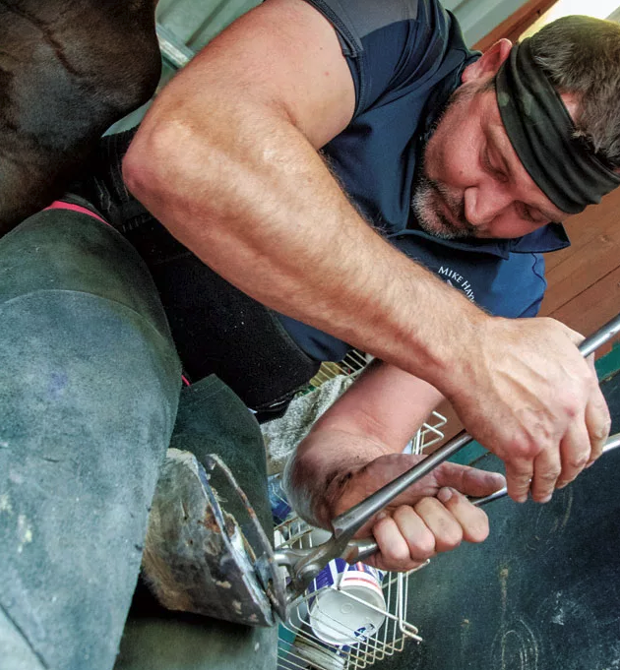
San Fransico Bay farrier Mike Hayward raises trimming and shoeing prices each year on the 4th of July.
Scheduling, Servicing & Communicating with Clients
Most of Mike Hayward’s clients are on a 5- to 6-week schedule, which makes work life easier.
“The feet are nicer because they don’t get too long,” says the San Fransico Bay farrier who was featured in a 2025 American Farriers Journal “Shoeing for a Living” article. “They’re easy to maintain. Since the feet are so dry, they stay together much better. We’re not chasing feet; we’re maintaining them. We also reset more often. We make more money when we’re resetting shoes.”
The shorter cycle also changes the clientele dynamic.
“There are fewer clients, although not necessarily fewer horses,” Hayward says. “Fewer clients means fewer problems.”
Although most are on a shorter cycle, there are a few mavericks.
“Anything over 6 weeks is pretty much a trim,” he says. “We don’t have a great deal of trims. I push the longer scheduled ones out, or I’ll have my team — Esteban Narez or Fernando Roman — do them because they really mess with my schedule. Everything just bunches up. I’m pretty happy when everything is on a 5- to 6-week schedule.”
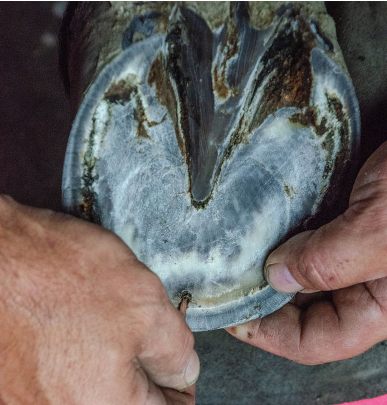
Mike Hayward investigates a seedy toe insult to determine its severity.
While Hayward’s schedule is relatively smooth, it wasn’t always that way.
“When I started, I’d work until 9 or 10 at night just to get things done,” he recalls. “Setting boundaries and expectations with my clients are the best things I ever did. I have a son, Jonny, and Esteban has a wife and kids, so I have to be done at 5 p.m. My clients know that I have Jonny every weekend, and I don’t work. If you lose a shoe on Friday, it might be Monday before I get there.”
Hayward takes scheduling seriously. Each client receives the next appointment time and date on his business card before he leaves the property.
The number 1 reason for switching farriers is because they don’t show up on time…
“My schedule is the most important thing for me,” he says. “I need to know where I’m going to be 5 weeks from now. I need a schedule. I hate being behind. I want to be there when I say I’m going to be there because nobody else does that — shows up or shows up on time.”
It’s the No. 1 reason horse owners say they switch farriers. According to an American Farriers Journal survey, 32% fired their hoof-care provider for failure to keep appointments. Another 24% say the farrier did not return phone calls, texts or social media messages, while 12% say they showed up 2 or more hours late.
Hayward also incorporates interesting scheduling choices.
“Normally, I take Flag Day off,” he says. “When I came to the U.S., I looked at my calendar and saw that it’s Flag Day. I take it off like it’s a holiday. My first wife asked, ‘Why are you still at home?’ Well, it’s Flag Day. She’s like, ‘What?!’ Yes, it’s a holiday. It’s in my Apple calendar and everything. I’m like, ’Merica. Since then, I’ve always taken it off.”
Hayward targets another holiday for his annual rate increase. While many farriers implement hikes on New Year’s Day, he takes a more revolutionary approach.
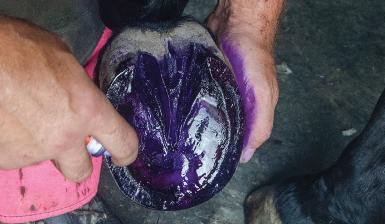
Hayward applies Groom’s Hand to Cookie’s sole to combat seedy toe.
“Prices go up every year on July 4,” Hayward says, chuckling.
Why?
“Because I’m British, and it’s Independence Day,” he says with a smile. “Happy Treason Day, peasants. My prices just went up. It seems to work out pretty well.”
Client Communication
Hayward pulls his Chevy 2500 HD pickup into Jaclyn Pepper Dressage, a training and boarding facility in Cotati, just west of Sonoma. Pepper is an FEI rider, competitor and trainer who was a U.S. Dressage Federation (USDF) silver medalist at the tender age of 15. She earned gold earlier this year. Pepper has also won multiple Horse of the Year awards and scores well over 75%.
She cut her training teeth under Allison Mathy, a fellow USDF gold medalist who is a Grand Prix Dressage rider, trainer and instructor at Lyric Dressage in Rhinebeck, N.Y.
“Jaclyn is such a wonderful trainer to work for,” Hayward says. “When we arrive at the barn, we talk about all the horses. She has a really good feel. Our communication is awesome. I can’t change anything unless you tell me.”
Managing a Horse’s Salt and Water Intake
A report from Kentucky Equine Research to share with your footcare clients.
If we devour a favorite salty snack — potato chips, mixed nuts, pepperoni pizza — our thirst response kicks in quickly. Why?
Excess salt increases the concentration of sodium in our blood, prompting us to seek water to dilute it, which helps maintain osmotic balance and protect cells from dehydration. This process is governed by the brain, which triggers thirst when sodium levels rise.
Does the same hold true for horses?
Sure! Drinking boosts body-wide hydration but also supports normal kidney function, reduces the risk of impaction colic and sustains other important physiological functions.
Water intake may decrease at certain times, such as during cold weather or transport. To boost intake, some horse owners add water to the feed or provide salt to their horses, either in the feed or as salt licks.
Nutrient Requirements of Horses, published by The National Research Council, suggests horses at a maintenance level should receive 25-30 grams of salt per day, depending on the sodium content of the feed, the amount of sweat produced due to exercise, weather and lactation status.
Scientists at Kentucky Equine Research wanted to know if adding water to the feed or adding water and salt to the feed would affect water consumption by horses. They used eight unexercised, mature geldings in a study in which each horse received each treatment. Horses were fed two meals of the same time each day, with water only or water plus salt added to create four treatments.
The four treatments included:
- 500 grams (1.1 lb.) of dry feed at each meal (DRY)
- 500 grams of dry feed plus 1.2 L of water added at each meal (WET)
- 500 grams of dry feed plus 1.2 L of water at each meal and 28 g of salt fed in the morning meal only (SALT-AM)
- 500 grams of dry feed plus 1.2 L of water and 14 g of salt fed at each meal (28 g salt per day; SALT-AM&PM)
Water intake was measured for 90 minutes immediately following each meal, and total daily water intake was also recorded.
Key points from the study
- Adding only water to the feed did not affect the total amount of water ingested by the horse, as horses reduced voluntary water intake when water was added to their feed.
- Adding salt to wet feed increased the amount of water ingested, with horses drinking more water after a meal if more salt was added to that meal.
- For horses that have decreased their voluntary water intake, adding salt and water to the feed is the best way to get them to drink more water.
- Adding water to the feed without adding salt will not reduce the total amount of water ingested by the horse, and may be a good way to set water into the horse it may not be drinking for other reasons, such as cold weather or travel.
Adding salt to wet feed led horses to drink more water……
Quick Tips for Improving Your Bottom Line
David Nicholls clearly understands the need for farriers to operate their businesses as businesses. The West Sussex, England, farrier has keen insight not only from being a practitioner for more than 45 years, but from his overall business experience. He’s worked outside of farriery in varied capacities and within farriery, he’s worked in both single- and multi-farrier practices. But for him, there is one reason why he was qualified to lecture other farriers on the subject of business at the 2015 International Hoof-Care Summit.

At the 2015 International Hoof-Care Summit, David Nicholls told farriers to never take a phone call when talking with a client.
“I’ve made many mistakes,” he says. “When someone asks me what is experience, I reply that it is learning from an accumulation of mistakes — hoping you don’t make the same ones again.”
A Balanced Life
Nicholls believes many farriers fail to manage their businesses simply because they are too busy to do so. It is the nature of the business. For example, Nicholls points to the mindset that if a farrier is in financial difficulty, the attitude is that shoeing more horses is the way out of that difficulty.
“This stops us from managing our businesses properly,” he says. “The secret to business success and personal happiness is to first organize your business. This removes the pressure on you. You know what you’re doing every day and how much money comes in and goes out with bills.” Pre-booking clients in advance, Nicholls adds, is one of the best ways to become organized.
Another key is becoming detail oriented. Oftentimes, that requires understanding the impact of actions.
“Paying attention to detail is with your manner and time keeping,” he says. “If you are going to be late — even 10 minutes — let them know. Many of my clients work and they take time off to be at the appointment with me. They won’t be happy if you don’t show up.”
A third component is delegation. Nicholls points out that very few farriers are good at every facet of their practice. By identifying shortcomings, you may find an opportunity to delegate a responsibility to someone else.
“I’m not good at accounting,” admits Nicholls. “It is actually cheaper for me to hire someone to manage accounts.”
“The secret to both business and happiness is to organize your footcare business……”
Understanding Clients
Nicholls says research finds that 50% of small businesses can’t identify who their best clients are. Nicholls says a mistake he made was to think that the clients who turn over the most money are the best ones. Until you identify who your best clients are, you won’t fully recognize your profit margins.
“When you start breaking down accounts and looking at the profit margin on clients,” he says, “sometimes you’ll find someone with a small backyard pony makes you more money. They don’t mind when you come and are often honored that you’re lending your expertise to their old pony. You may find that the net profit is higher per horse than a large barn that is demanding.”
Dollars And Cents
Nicholls says it is crucial to understand the finances of a business. For this, he uses a simple equation to assist.
“First, determine all of your consumable and vehicle expenses, plus all other business expenses and then wages,” he says. “This splits perfectly into three. This seems to work with many other businesses, not just farriery.”
Nicholls likes to determine an hourly rate at 40 hours per week. He admits that very few farriers limit work to 40 hours a week. At 48 weeks per year, that total equates to 1,920 hours. Dividing expenses into the hours provides the hourly rate.
“If you determine that you need to raise your hourly rate by $10 and you’re already $20 higher than everyone else, that is a $30 increase in the minds of some clients,” he warns. “Market forces may prevent you from earning what you should on an hourly rate.”
Embrace New Technology
Nicholls is from the pen and paper era. Although he uses a smartphone, tablet and laptop for his practice, he admits he’s needed considerable assistance to move into the digital world. Still, he finds it important to modernize in business management, especially when keeping client records.
The most unenthusiastic task for Nicholls is entering client data into his software program — especially for that initial inputting of every current client.
“The smart money is getting clients to do this,” he says.
Upon reviewing client records, Nicholls was amazed at how much detail was out of date, especially cellular numbers. He approached every client, letting them know he wanted to update their information.
“I would give them the laptop and most of them would enter the data,” he says. “Now when I turn up and they have a new horse, they want to enter the information themselves.”
Monitor Communication
With today’s technology, smartphones have revolutionized how we communicate. The British farrier advises monitoring and using these various channels properly.
Answering/returning phone calls. Nicholls says to never answer your phone or make a call if a client is engaging you. “There will be time afterward to make that call — don’t be rude,” he says.
Texting. This can be useful, but you have to establish boundaries with clients early. Otherwise, they might exploit it.
Social media. “You need to segregate your personal life from your business life on Facebook,” he says. “You can do things on your personal page that your clients don’t want to see on your professional page. You put so much work into promotion, but it can be one small mistake that brings you down. So be careful what you post to social media.”
Inventory Management
One way to control costs is by understanding what inventory is necessary to carry. If something has been on your rig for more than a year, Nicholls says to take it off. Maybe you won’t need a large truck and can downsize. To demonstrate this point, Nicholls showed a 1-ton shoeing van he used to drive. By taking out unneeded inventory, he was able to downsize to a 3/4-ton van. Beyond the annual fuel savings, the cost savings from this purchase exceeded the van payments in a 3-year period with the smaller van.