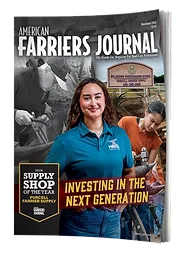
For more than two decades, the bright yellow “Briefings” page that regularly appeared in American Farriers Journal was among the publication’s most popular features. Now, we’re bringing back this valuable content that offers 4-5 quick-to-read items on the AFJ web site. “Hoof-Care Briefings” will be coming your way on the last Monday of each month, and highlight farrier tips, industry news, maybe a bit of shoeing history from time-to-time and insights of special interest to footcare professionals.
— Frank Lessiter, AFJ Editorial Director
Consider Every Horse You Work With As ‘Claustrophobic’
Blaine Chapman maintains farrier need to learn to communicate differently with each horse they shoe, which means knowing where every horse is in its stage of life and its level of training to make the horse comfortable during footcare work
“Horses are claustrophobic,” says the Lubbock Texas, farrier who learned the trade from his father Burney, a world-renown shoer. “Horses are already a prey animal to us. If we don’t look at each animal that way, it’s easy to misconstrue the actions of the horse based on your own actions.”
In a recent Working Ranch magazine article, Chapman said it’s important to pay attention to what you are telling the horse and what the horse is telling you. “Try to come up with some understanding where we can both get along and get the job done together,” he suggests.
Traveling 10,607 Miles to Shoe in War-Torn Ukraine
In the middle of the war in Ukraine, New Zealand farrier Trevor Sutherland volunteered to handle shoeing work at the Dergachiv Children’s and Youth Equestrian Sports School to educate the students on foot care and shoe their horses. When the school had to relocate after being caught in the middle of the Russia-Ukraine war. Sutherland made the lengthy trip to the Ukraine when their farrier was called to military duty.
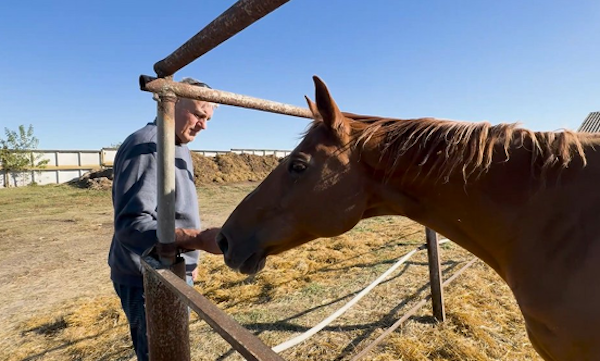
Trevor Sutherland with a horse. Source: Public Chernihiv

Dreaming About the Honor & Nobility of Farrier Work
10 years ago at the International Hoof-Care Summit, Kerry Haugh mentioned to Editor Jeff Cota that his career dream was to sometime be featured in American Farriers Journal’s “Shoeing for a Living” a regular magazine feature that got its start back in 1993. That comment came from an experienced, accomplished hoof-care professional who at the time was president of the Equine Lameness Prevention Organization.
Late-Breaking News & Views
Now in its 23rd year and featuring the largest farrier supplier trade show in the world, the first International Hoof-Care Summit in January of 2004 attracted farriers and equine vets from 40 states and eight foreign countries…Equi Management magazine reports the typical equine veterinarian sees 22 patients per week while a companion animal vet (dogs, cats, etc.) sees 20-30 patients per day…Data from the 2023 American Horse Counceil equine economic impact survey estimates the U.S. horse population at 6.7 million horses, down from 7.2 million in 2017...More than 20,000 employees left the U.S. Department of Agriculture from January to May of 2025, representing 20% of the federal agency’s total workers.
When it comes to maintaining a quality racetrack surface, Univ. of Maine beseecher Mick Peterson says it requires a three-prong approach that includes proper track surface design, pre-meet inspection and testing the surface on each race day…At a hearing on potentially outlawing traction devices on road horse in Amish country, Ohio’s Lafayette County Plan Commission relied on the 16-page “Shoeing the Road Horse” report from the December 2025 issue of American Farriers Journal as an educational tool… A photo taken by AFJ Editor Jeff Cota was recently named as the winner of the Livestock Publications Council People’s Choice award. It was taken by during a “Shoeing for a Living” ride along with Jason Critton’s farrier crew in Colorado.
A ‘Wow’ Factor from the 1st International Hoof-Care Summit
During that first Summit in 2004, Scottish farrier Jim Ferrie outlined five reasons for using bar shoes:
- To stabilize the hoof capsule
- To provide mediolateral support
- To establish anterior/posterior balance
- To create a larger ground-bearing surface
- To offer frog support
After 2 Hours, Horses (& Farriers) Lose Their Patience
“A horse has a 2-hour patience level and after that, farriers really have to work with the horse,” says Lonnie Falk. The instructor at the Wyoming School of Horseshoeing says being a successful farrier requires developing a one-on-one relationship with every horse when it comes to footcare.
Looking Back at a ‘Shoeing For Elvis’ Memory
Each month in Hoof-Care Briefings, we’ll provide a “Shoeing for a Living” memory from this on-going series that has appeared for more than 30 years in American Farriers Journal.
This month’s trip down memory lane features now-deceased Mississippi farrier Lim Couch shoeing the Elvis Presley horses at Graceland in Memphis, Tenn., back in June of 2014. Couch spent nearly 30 years shoeing horses for the “King of Rock 'n Roll.”