
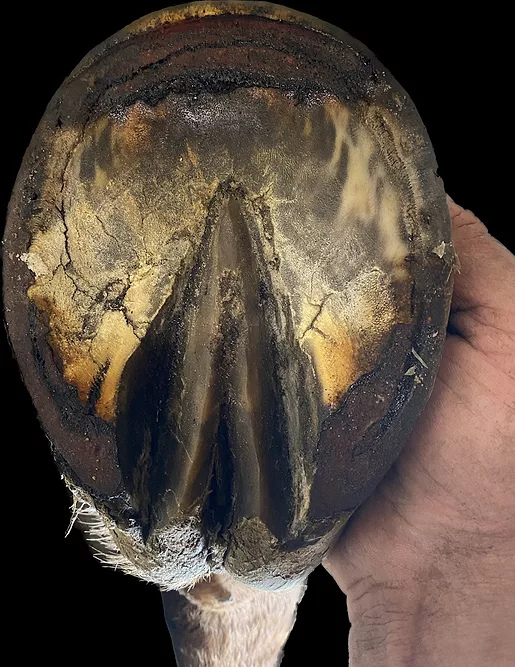
Thrush is a common bacterial infection that can cause headaches for horse owners and farriers alike.
Caused by an anaerobic bacterium, thrush normally affects the foot’s central sulcus or the collateral sulci.
“The bacteria that are most often found in thrush samples are fusobacterium necrophorum,” David Hallock, lead farrier instructor of Michigan State University’s Farrier Program, says in the American Farriers Journal Online Hoof-Care Classroom, “Thrush in the Modern Horse,” presented by Absorbine. “It functions by producing toxins, inflammation and tissue necrosis. It is quite often paired with a keratolytic bacterium that breaks down the keratin of the horn tubules and consumes the horn tubules of the frog. But it varies as to which one of those is present.”
There are several causes, including horses living in a wet environment, poof hoof conformation and neglect. However, unhygienic conditions and poor stable management are preventable.
“The environment they live in plays a huge role in being able to manage hoof ailments,” Hallock says. “Unhygienic conditions like standing in mud and manure go along with poor stable management.”
Regularly picking out the feet and maintaining a consistent hoof-care cycle are beneficial.
“If the feet aren’t being cleaned out and they’re not being trimmed or shod on a regular cycle, they tend to be more susceptible to thrush,” he says. “When a horse has a deep central sulcus and commissures on either side, that lends to trapping bacteria. If your clients aren’t cleaning them out regularly, then the only time the feet are picked out is when we trim them. You have to get it cleaned out and get as much of the bacteria out as you possibly can during your visitations.”
When that occurs, a tough conversation might be in order.
“Nobody wants to be told they’re not doing enough for their animals,” Hallock says. “If you’re going to have that conversation, it really has to be about, ‘I know how much you love Fluffy. I know we want to do the best we possibly can for her, but she’s standing in 6 inches of mud for 23 hours a day.’”
Hallock advises a straightforward approach.
“You have to be honest with them, but you can only soften the blow so much,” he says. “At some point, you need to say, ‘Look, we’re never going to get rid of it the way it is right now. With the living conditions we have, we’re never going to improve any of these feet.’”
Learn More ...
Watch the American Farriers Journal Online Hoof-Care Classroom, “Thrush in the Modern Horse,” presented by Absorbine.