 Premium content is for our Digital-only and Premium subscribers. A Print-only subscription doesn't qualify. Please
American Farriers Journal
American Farriers Journal is the “hands-on” magazine for professional farriers, equine veterinarians and horse care product and service buyers.
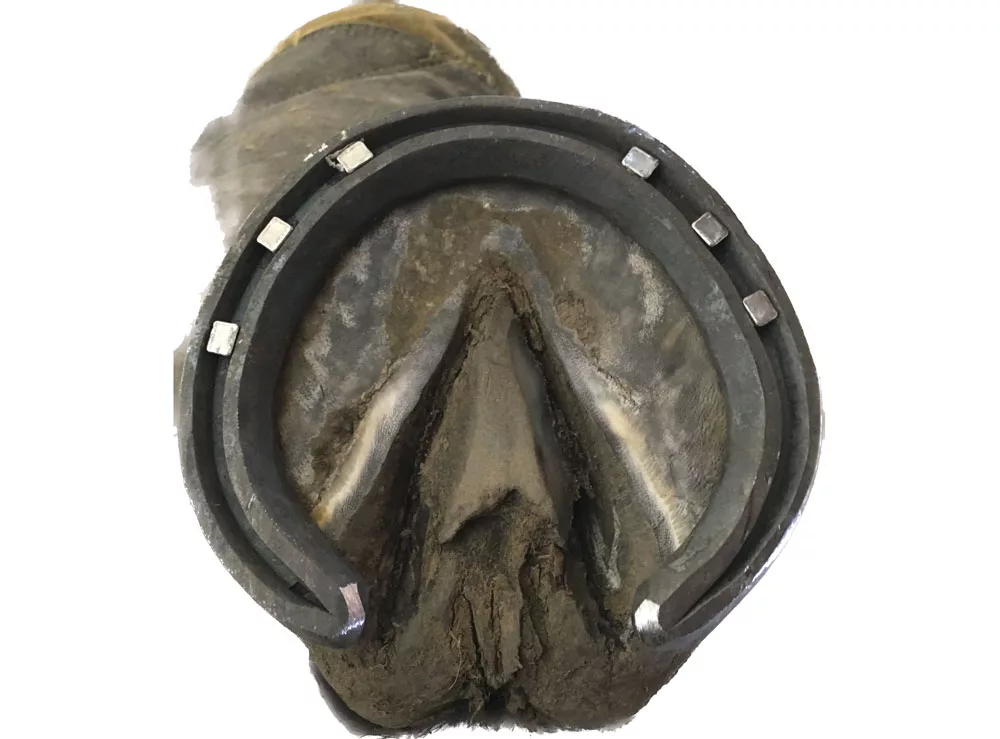
Thrush is an anaerobic bacteria that’s easily treated yet is often persistent under lax hoof care.
David Hallock is well acquainted with thrush while providing hoof care in the damp Michigan climate. Although wet conditions contribute to thrush, several factors lead to the buildup of anaerobic bacteria in the frog region.
In a recent webinar, presented by Absorbine, Hallock stresses the importance of farriers understanding the signs, symptoms, treatment options and anticipated outcomes of thrush.
Thrush is an anaerobic gram-negative, non-spore forming bacteria that produces toxins, inflammation and tissue necrosis.
“It’s quite often paired with a keratinolytic bacteria that breaks down the keratin of the horn tubules and consumes the horn tubules of the frog,” he explains. “The signs and symptoms include a thick, typically black substance that has a distinctive and offensive odor.”
Thrush can impact the frog’s numerous functions, including grip, traction, protection for the underlying structures like the digital cushion, collateral cartilages, the navicular bursa and the deep digital flexor tendon.
“You can wind up with the dermal or sensitive structures involved because as it dissolves the keratinized tissue and necrosis starts to set in, it eats its way back into the sensitive structures,”…

American Farriers Journal is the “hands-on” magazine for professional farriers, equine veterinarians and horse care product and service buyers.

American Farriers Journal is the “hands-on” magazine for professional farriers, equine veterinarians and horse care product and service buyers.
Download these helpful knowledge building tools


We are here to support you.
We stock a wide range of high-quality products from trusted brands to ensure durability, performance, and reliability in every job you undertake. Our extensive inventory of horseshoe products and farrier tools means you can find everything you need in one place, saving you time and effort. Your satisfaction is our top priority. We are committed to providing excellent customer service, prompt shipping, and hassle-free returns.
