
Hidden deep within the equine hoof lies one of the horse’s most misunderstood — and overlooked — structures: the digital cushion.
Years of working on horses with collapsing heels and narrowing heel bulbs set Dansville, Mich., farrier David Hallock on the path to study the digital cushion. This left him searching for answers that traditional methods couldn’t solve.
“We’ve all seen horses where the back half of the foot is failing,” Hallock says at the 2024 International Hoof-Care Summit. “You wedge them up, you try to give them support, and the heel bulbs collapse more. But the problem wasn’t just mechanical — it was anatomical.”
What started as frustration in the field soon turned into a research pursuit through the Royal Veterinary College’s Graduate Diploma in Equine Locomotor Research.
“It’s fascinating that the largest structure in the hoof is one we know the least about,” he says. “I told Dr. Renate Weller, who was then the professor of Comparative Imaging and Biomechanics at the Royal Veterinary College, that I wanted to figure out how to rehabilitate a weak digital cushion.”
Traditionally, farriers and veterinarians assume the digital cushion’s primary job is to absorb concussion. However, Hallock questioned how well it does this — especially in feet, where the structure appears to collapse. He found the literature on this theory thin and conflicting.
With limited funding, he turned to cadaver limbs instead. Each foot was measured using digital calipers for hoof width, buttress width and heel angles before the cushions were dissected for microscopic analysis. He carefully dissected each specimen to study how the digital cushion’s structure varied by location within the hoof.
“We know they load separately, so I split each cushion in half and compared them,” he says. “Each section was photographed and examined under magnification in six different locations to assess variations in tissue makeup.”
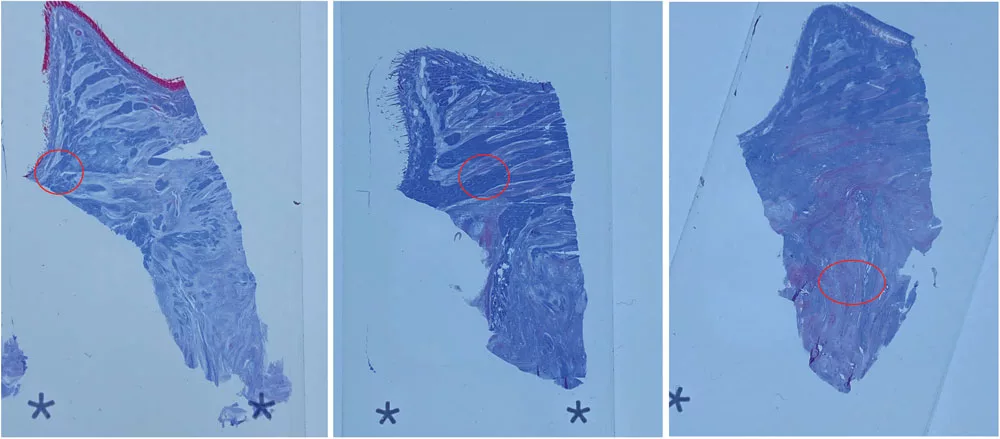
The samples were then stained to make the tissues visible (Figures 3a-3c).
FIGURES 3a, 3b, 3c: Each digital cushion section was photographed and examined under magnification in six different locations to assess variations in tissue makeup. The samples were stained. Collagen fibers stain blue, keratinized tissue is red and fat is clear.David Hallock
“The collagen fibers stain blue, the keratinized tissue stains red and the fat shows up clear,” Hallock says.
By analyzing each tissue type, Hallock confirmed these differences were consistent across specimens.
“The lower parts of the cushion contained more collagen, while higher areas had more keratinized tissue,” he explains. “That tells me different regions of the cushion probably have different jobs — they work together, but they’re not designed the same.”
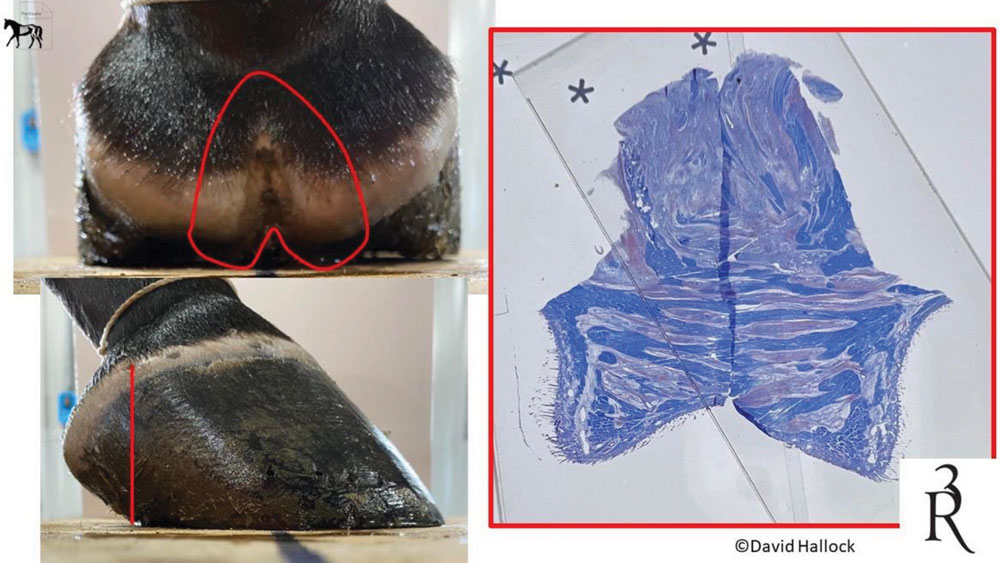
A weak digital cushion has about the same amount of collagen and fat as a strong one — the difference is in how those tissues are organized. Hallock found that structure, not quantity, determines the strength of a digital cushion.
“It’s not about what’s in the cushion — it’s about how it’s organized (Figures 4a-4c),” he says. “When you look at an unorganized cushion under the microscope, the colors blend together — there’s no structure to it. The highly organized ones showed clear collagen bands stretching between the collateral cartilages — almost like rubber bands or slings — adding stability to the back of the foot.”
Hallock’s findings show that external hoof measurements can also reveal valuable clues about the internal structure of the digital cushion.
“Hoof width, buttress width and heel bulb depth all correlate with collagen content and organization,” he explains. “Those are measurements we can take right in the barn aisle.”
The wider the foot and buttress and the deeper the heel bulb, the more collagen fibers are present in the digital cushion, Hallock says.
His research also suggests heel angle influences tissue structure, with lower-heeled feet showing greater organization than those with an upright heel. Additionally, while more collagen may signal strength, Hallock cautions that balance matters.
“It makes me wonder where the line is between healthy load and going too far,” Hallock says. “When does it get so rigid that it stops working as a cushion?”
He hopes future studies explore how movement, nutrition and conformation affect the digital cushion’s ability to rebuild.
Gain more insights from David Hallock by reading "Understanding the Equine Digital Cushion" in the December 2025 issue of American Farriers Journal.