“The basics are most important in competitions, certification, but most of all, in daily work,” American Farrier’s Association president Hank Chisholm told attendees during a clinic at 3B Farrier Supply in Valley, Neb. Farrier Product Distribution sponsored the clinic.
Over the course of the day, Chisholm shares several forging tips that will benefit anyone, regardless of experience.
Swinging a hammer. It’s common for many farriers to tighten up their hands while swinging a hammer, which can lead to significant elbow pain. It boils down to confidence for Chisholm.
“The reason I use wraps on my hammer handles is because I have the same problem, especially with draft shoes because you’re coming with it, then you have no elbow left,” he says. “The wraps allow me to hold it like I’m trying not to squeeze toothpaste out of the tube. You basically throw a hammer. The tighter you grip, the more it becomes a push. I’ve never tightened up on the handle with the wraps. They give me the confidence to let it go.”
When Chisholm was struggling with tightening his hand during blows, Daniel Jones, CJF, of Fairhope, Ala., had him place a 2x4 on the anvil and strike it with a hammer.
“Every time you hit it, switch faces on the backswing,” he says. “You’ll learn real fast to get it flat because it will break your arm. This drill teaches you to let go of the hammer, especially when your elbows are hurting from over-gripping. When you let go of the hammer at the top of the swing to switch faces, you don’t have time to regrip the handle. It will become more work with less energy.”
Modifying keg shoes. Forging is an integral part of many farriers’ work, including Chisholm. While some forge every shoe that they nail on, it’s not practical for his hoof-care business.
“Most of everything I do is with keg shoes because the daily world pays the bills,” Chisholm says. “It’s a simple deal. It saves me money by keeping my inventory down.”
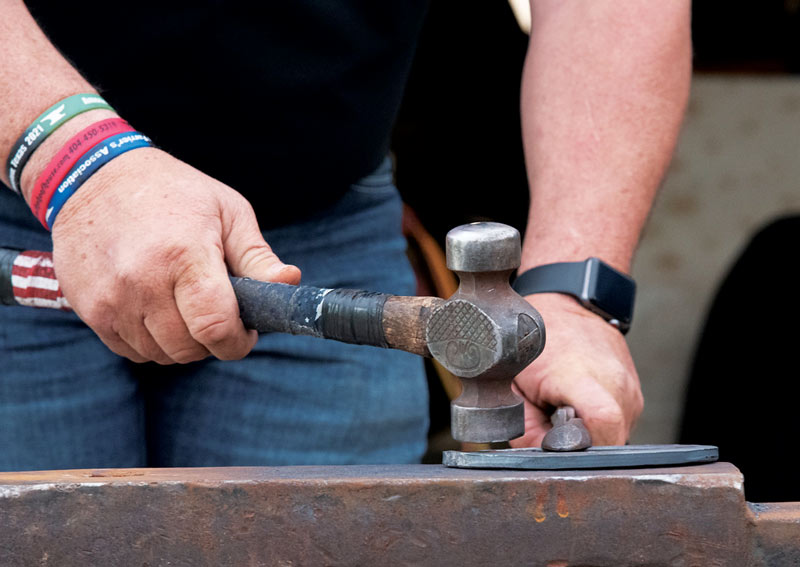
When flattening and leveling a shoe, start overlapping hammer blows just past center, Hank Chisholm says. Do not hit the shoe hard and don’t skip hammer blows.
Flattening and leveling shoes. To determine whether a shoe is flat and level, look at it from at least two angles — mediolaterally and from the heel.
“Most people, including myself, have a habit of missing a spot,” he says. “Start just past center. Do not hit it hard. Every blow touches the next one. It shouldn’t have to be hit a bunch to make it nice and flat and level. When it’s fullered, favor the outside of the web. Do not skip hammer blows because you’ll put waves in the shoe. It’s muscle memory hammer blows. It’s not that difficult to replicate once you get used to that system.”
Farriers tend to label themselves with the disciplines of the horses that they shoe. While it’s beneficial to have a firm grasp on the horses’ hoof-care needs, Chisholm urges caution about identifying too closely with labels.
“I do all kinds of horses from $1 million show hunters to those that aren’t $1 million show hunters,” he says. “I do a lot of barrel horses. Some of them are not great, but they stand still and pay. Some of them are world-class. Parrish, Fla., farrier Robbie Hunziker said it best when someone asked him, ‘What kind of horses do you shoe?’ He said, ‘Mostly brown ones.’ It doesn’t matter. Shoeing is shoeing.”
Yet, Chisholm also urges farriers to remain focused on the importance of the job.
“We owe everything we do to the horse,” he says. “Someone asked me, ‘What’s the most important horse you ever shod?’ I said, ‘The one I’m working on now.’"
Gain more insight by reading “Reliance on the Basics Benefits the Horse and Farrier."