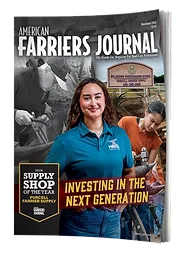
This special publication is published once per year by American Farriers Journal. The career guide delivers advice from farriers on how to establish and operate a successful equine footcare practice.
Equine hoof care is a close-knit industry. When a group of farriers get together, the conversation generally focuses on sharing knowledge about the foot — lamenesses, shoes, tools, etc.
The passion to improve footcare results in a stronger, more knowledgeable trade. While the practical aspect of farriery grows, there’s another that doesn’t get enough attention — farriery is a business.
I have taught horseshoeing for 40 years to more students than anybody else ever has. Most of my graduates went on to shoe horses professionally and made a living for themselves and their families. There are a number of ideas and philosophies about what’s important when learning about horseshoeing. The following are my ideas of what you should learn at shoeing school.
It’s important for the farrier school graduate and the mentor to understand the definition of the word “apprentice” before either individual enters into a working relationship.
Attrition rate is a business management term that’s used to describe the loss of business, product or employees. Companies do not want to see a high attrition rate.
I believe it's a tragedy if farriers don't continue to learn. I am grateful that I have recognized that one's skill level can and must continually improve — especially when I look back over my own experience.
After graduating from a farrier school, you will be faced with challenging situations that don’t always involve easy solutions. Former students often seek my advice on how to handle various scenarios.
Building relationships with clients and knowing when to let them go may sound as easy as saying hello and goodbye, but there are a few things farriers should keep in mind when developing and ending client relationships that can make everything go a little more smoothly.
While a new farrier’s top priority is the care of hooves, you’ve got to be equally concerned with earning a living and dealing with the numerous business aspects of the profession. This means knowing what it really costs you to trim and shoe horses.
People start businesses for many reasons — freedom, unlimited earnings and many others. They frequently overlook the real responsibilities they will have, including their financial future, both their own and that of the business.
A farrier practice is a business — that is no surprise. As professionals, practitioners have a responsibility to maintain accurate records, schedule properly, bill and receive payment promptly and track performance. At the same time, farriers also should keep records on clients and the type of work conducted on their horses, including photographs of the feet or radiographs shared by veterinarians.
What’s a better way to celebrate the dawn of your farrier career than tool shopping?
There’s no doubt that the temptation runs high to grab the top-of-the-line pair of nippers that are polished so brightly that a pair of sunglasses should come standard with them. While the feel and performance of a high-quality tool often are worth the price, many young farriers have a steep financial mountain to climb when starting out.
Clients who fail to pay for hoof-care services are a problem that every farrier experiences at some point in his or her career. There are a variety of cases and reasons as to why clients don’t pay their farriers. By understanding the United States government’s definitions of non-payments and reviewing the basics for collecting, you can be better prepared for making sure more of the money you earn gets to your pocket.
Pulling into a farrier clinic is an impressive sight.
A variety of bright, shiny aluminum farrier rigs line the parking lot — truck bodies, drop-ins, caps and trailers — and they don’t come cheap. Aside from your vehicle, your rig will be the most expensive tool that you’ll buy.
As you embark on this remarkable career, it is likely you will shoe horses commonly referred to as “backyard horses.” Some will say this with disdain, but in reality, this segment of the horse population may be the very best kind of horses to be shod — especially in this economy.
There is no argument that farriery is a male dominated industry. Being female is part of my experience as a farrier. To give you a bit of context, in Australia we have trimming schools filled with female recruits. In our farrier schools, of which there are only six, we have a total of four female apprentices over the entire 4 years of study for the country. So in Australia, as a female farrier, I’m rare.
There are few professions tougher mentally or physically than being a professional farrier. I believe the only job remotely close would be that of a professional athlete. The daily repetitive nature of the job and an awkward working posture definitely take their toll on the farrier’s and athlete’s body.
Finishing farrier school means a significant jump — from student to full-time professional and, most often, small business owner.
Farriers with a few years of experience achieving the success they worked hard for know the challenges this brings and their accompanying struggles well — and how to deal with them.
Oleo Acres Farrier and Blacksmith Supply owner Rob Michel walks viewers through the Littleton, Colo., warehouse. Inventory is organized with the customer in mind. If the product is in stock and easy to find, farriers can spend more time under a horse, which Michel says is more money in your pocket.
At Doc Foal's, we manufacture The Black Pads and The Black Pads PLUS (featuring embedded magnets and copper). Our hybrid pads work seamlessly with your choice of conventional horseshoe, combining metal for structure with polyurethane for exceptional comfort and shock absorption.
Designed as a...
We stock a wide range of high-quality products from trusted brands to ensure durability, performance, and reliability in every job you undertake. Our extensive inventory of horseshoe products and farrier tools means you can find everything you need in one place, saving you time and effort. Your satisfaction is our top priority. We are committed to providing excellent customer service, prompt shipping, and hassle-free returns.
Equilox International Inc. specializes in equine horse hoof adhesives. Developed in 1988 after many trials and extensive research at leading universities and equine centers throughout the U.S., the Equilox Adhesive Hoof Repair System was originally used to treat competitive horses. Now, Equilox Adhesive is used by farriers, equine centers, and horse owners — as well as various zoo and wildlife centers — throughout the world.