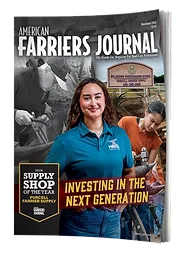
Each year, American Farriers Journal publishes the Farrier Business Practices Survey Report to help you assess the state of your business compared with the rest of the country. Read the 2025 report here. We gather data from a diverse range of farriers from all 50 states to give you the best picture of the current state of the farrier industry. While the report is published in the July/August issue of American Farriers Journal — and mailed out at the end of June — there are a few trends that stood out to me that I want to share with you.
- Compared with last year, more farriers feel they’re able to charge more because of their certifications. They’ve gained more respect from customers, and certifications have opened doors professionally — for example, being a clinician or brand ambassador. Most importantly, almost 50% of respondents said earning certifications has increased their confidence in their farriery work.
- Farriers are attending more clinics than last year, up from 2 per year to 4 per year.
- For almost two-thirds of respondents, their primary sources of hoof-care information are clinics and conventions.
When much of your hoof-care education is coming from in-person events, it’s important that those events contain valuable information. We at American Farriers Journal attend several clinics and conventions throughout the year, compiling the best tips and tricks for you to use in your own business. Here, I’ve collected a few to demonstrate the value of getting out to your local clinic or contest.
A Safe Place for a Hot Horseshoe
When attending farrier clinics, sometimes the best ideas you leave with come from fellow attendees you talk with. Warrenton, Va., farrier Marc van der Rest shared a tip at a clinic that he attended about 10 years ago.
The other farrier explained how he attached a plate to his Hoofjack to rest a hot shoe while under the horse.
“So many barns have rubber flooring or rubber mats, and the clients don’t want you to put the shoe down on those,” van der Rest says. “This is an easy way to keep the shoe from burning marks on the floor and keep nearby.”
For his modification of this idea, van der Rest uses a piece from an aluminum diamond plate mud flap. He cut the piece to the necessary dimensions, drilled several anchor holes in the plate and cleaned before adhering to the stand with an ounce of leftover Equilox I. A decade later, the plate remains attached to the Hoofjack.
How To Check The Palmar Angle Of P3 Without Radiographs
Do you find that you’re curious about the palmar angle of the third phalanx, but radiographs aren’t available?
Bow, Wash., farrier Shane Westman offers a tip that he learned at a clinic conducted by Hall Of Fame equine veterinarian Ric Redden of Versaille, Ky.
“The central sulcus of the frog is a pretty good indicator of the palmar angle of P3,” Westman says. “When I lay a straight edge down the central sulcus of the frog (Figure 1), that gives me a fairly decent indicator that we have some trouble in that foot. It’s a very helpful tool if it’s an otherwise good-looking foot.”
Adds Redden, “This works pretty well when the central sulcus is deep within the frog.”
Although the straight edge is a good indicator, you shouldn’t rely on it. Yet, this tip might prove more valuable for demonstrating to horse owners that radiographs are necessary.
There is yet another external landmark that could prove valuable.
“Another very good reference is to sight an imaginary line through the little protruded bump that is at the skin/frog junction to the apex of the frog,” Redden explains. “This line is parallel to the palmar rim of the coffin bone wings. When vets are taking lateral views for farriers, a dot of radiopaque paste on this spot and one on the apex of the frog helps all concerned to train the eye for useful landmarks. However, farrier friendly radiographs hold a world of information other than just the palmar angle for farriers.”
Be sure to involve a veterinarian and have radiographs taken if you suspect problems inside a foot.
Tool Tips From A Tool Master
If Drummond, Wis., farrier Roy Bloom is at a clinic, it’s a good bet that tools are going to come up. After all, the Hall Of Fame farrier and American Association of Professional Farriers/Canadian Association of Professional Farriers treasurer has built a reputation as a superior toolmaker.
At the March 20 clinic at the Duggan Farrier Supplies/Minnesota Horseshoeing School in Ramsey, Minn., the owner of Bloom Forge Tools shared some quick tool tips with those in the audience.
Sharpening Your Nippers
Nippers are some of the most misunderstood tools in your shoeing box because of how they should work, according to Bloom.
“It’s extremely important that when holding nippers up toward light, you should see a slight gap between the two blades because there are two angles. They don’t match when they come together.”
For clear evidence that your nippers are working properly, Bloom says to use a business card. Place the card between the blades by a corner, holding the nippers vertically. Close the nippers so that the card stands vertically as well. After squeezing the reins, the card should jump straight up after the cut, indicating the nippers’ cutting edges match.
However, if the card leans one way or the other, then you need to adjust them.
“Use a diamond hone that has two different grits,” he says. “You can find these at Cabela’s. Place the nippers in your vise and match your angles. Very carefully work that angle. Then do it to the other side.
Bloom says if the card leans to one side, then you know the side opposite of that direction is higher than the other.
Over time, as you sharpen the blades eventually the gap will get wider. For that, Bloom says to take a triangular file to remove just a slight amount off each stop.
“Keep your nippers nice and sharp, like your hoof knife,” he says. “You want it to pass through that hoof quickly. Keep it clean by wire brushing it occasionally and apply some oil to maintain it. This tool costs a lot of money, so you want it to last a few years. All tools wear out — that’s guaranteed — but by maintaining them the best you can, they will last longer.”