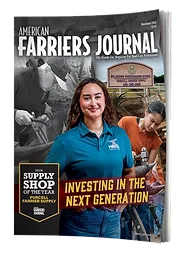
Back in January 2013, Delaware, Ohio, farrier Dean Moshier was invited to be on an online radio show Stable Scoop on Horse Radio Network. In it, he discussed a top 10 list of what most farriers wanted their clients to know. Over the last 3 years, these questions and answers have evolved, mainly influenced by client interactions within Moshier’s practice. He recently delivered this at the Midwest Horse Fair, which draws tens of thousands of equine enthusiasts to south-central Wisconsin every year.
Lameness Occurs The Most Of All Equine Medical Problems
According to federal researchers, lameness has the highest annual incident density of all medical problems in horses, DVM360 Magazine reports. Half of all horse operations with five or more horses have one or more cases of lameness annually. Another federal report estimates lameness incidence at 7.5% to 13.7% annually.
Progress continues in our work to define the professionalization of farriers. A few of us met and discussed many of the processes and permutations of the “Initiative to Professionalize the Practice of Equine Footcare and Farriery” in early March. We’ll meet in late summer, when progress can be assessed and new assignments undertaken.
Research indicates that the positive effects of particular shoe selection for Western Pleasure horses are guided by the perceptions of judges and trainers rather than reality
Many trainers and owners often try to convince a farrier to adopt a certain style of trimming or shoeing based on a myriad of factors. Sometimes the motivation comes from a belief that a particular change will improve the horse’s overall performance, resulting in better scores from judges.
Tim Shannon has some succinct advice for farriers who deal with quarter cracks. “I’d suggest whoever wants to get into it to find somebody who knows a lot about [handling quarter cracks] to walk you through it,” advises the San Moreno, Calif., farrier. “There is a lot to crack repair.”
Toe cracks come in different forms, but none of them look good. Some cracks are small, others are long up the wall. Some are deep and others are superficial. All of us have heard, “Can you fix that crack?” Some can be corrected, but others will die with the horse. The biggest thing we must learn is what causes the crack in the first place. It’s just as important to know where it comes from as to where it’s going.
Growing up in Ontario, Ian McKinlay learned crack repair from his father J.C., a pioneer in the practice. J.C. McKinlay started repairing cracks in Ontario in the 1960s, primarily with Standardbreds at Toronto’s Greenwood Mohawk Racetrack and his farm. The younger McKinlay told attendees of the March Razerhorse clinic in Denton, Texas, that his late father would be amazed at how farriers have adapted his work in lacing and patching cracks.
The life of one of the most promising racehorses of our time was cut short in 2006 after a long struggle to recover from a shattered fetlock. Barbaro’s injury at the Preakness Stakes and the New Bolton Center's heroic attempts to save him drew a lot of attention to the question of why so many young performance horses suffer from broken bones and ruptured tendons. Are these kinds of injuries inevitable? Should we give up trying to solve this problem?
Scheduling clients is as high on the priority list only because it enables farriers to do what they really want to do — trim and shoe horses, not to mention make money.
A: The first question I ask is “Why?” Why affix a pad to the horse’s hoof? Is it necessary? What is my objective? Is it beneficial to the horse during the shoeing cycle? Will it aid in protection and relief? Is it needed for environmental reasons, such as rocky terrain? Or is there a therapeutic need for it — sole protection, pathology, ligament/tendon issues?
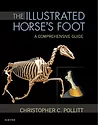
The Illustrated Horse’s Foot (A Comprehensive Guide) is the latest book by veterinary surgeon and researcher Christopher C. Pollitt. Released in December 2015 by Elsevier as a follow-up to Pollit’s renowned book, Color Atlas of the Horse’s Foot, which is no longer in print. This 272-page book is a must-have for all equine practitioners specifically all farriers and equine veterinarians.
It’s all about the trim.
It’s a common refrain among farriers, but is the practice receiving its due diligence or is it merely lip service?
In Fabio Gnoatto’s Wellington, Fla., practice, trimming is the mainstay.
Farriers work hard year-round to provide quality hoof care for horses worldwide. Although we hope appreciation is shown all year long, each year we set aside a week dedicated to honoring your work. The 18th annual National Farriers Week, sponsored by American Farriers Journal, will take place from July 10-16, 2016.
While non-metal horseshoes may never make up a huge share of the overall market, they have carved out a well-established niche that is substantial enough that it makes sense for farriers to know how and when to use them.
Aluminum stock remains a popular choice for a variety of horses, primarily due to its lighter weight. Another advantage is that aluminum can be shaped hot or cold. While the typical thinking might be that racing plates and lighter shoes will be shaped cold, and heavier aluminum shoes like those used for hunters and jumpers will be put in the forge, that also proves to be a matter of personal preference.
If you’re handy and looking to save money on a farrier rig, a do-it-yourself project might be the way to go.
Both handy and looking to save money, Sam Fabila had big plans for a small U-Haul 3x5 box trailer that he converted into a rig.
The information, ideas and opinions expressed are those of the author and do not necessarily represent those of the United States Department of Agriculture.
Joint Injections Compared Joint injections using corticosteroids, hyaluronic acid (HA) or a combination of the two are commonly used to treat synovitis and arthritis in performance horses. In this study, researchers compared the efficacy of one type of corticosteroid (triamcinolone acetate, TA) with and without HA for the treatment of lameness, localized to one limb only that responded to a diagnostic joint block. Eighty horses of various breeds were enrolled in the study with follow-up at 3 weeks by re-examining the horses and 3 months by an owner questionnaire. No other medications were permitted during the first 3 weeks of follow-up.
Research indicates that the positive effects of particular shoe selection for Western Pleasure horses are guided by the perceptions of judges and trainers rather than reality
Many trainers and owners often try to convince a farrier to adopt a certain style of trimming or shoeing based on a myriad of factors. Sometimes the motivation comes from a belief that a particular change will improve the horse’s overall performance, resulting in better scores from judges.
Aluminum stock remains a popular choice for a variety of horses, primarily due to its lighter weight. Another advantage is that aluminum can be shaped hot or cold. While the typical thinking might be that racing plates and lighter shoes will be shaped cold, and heavier aluminum shoes like those used for hunters and jumpers will be put in the forge, that also proves to be a matter of personal preference.
The life of one of the most promising racehorses of our time was cut short in 2006 after a long struggle to recover from a shattered fetlock. Barbaro’s injury at the Preakness Stakes and the New Bolton Center's heroic attempts to save him drew a lot of attention to the question of why so many young performance horses suffer from broken bones and ruptured tendons. Are these kinds of injuries inevitable? Should we give up trying to solve this problem?
Now view magazine-like digital flipbooks on your desktop and tablet. Starting in 2015 issues, included for FREE with your Digital or Premium subscription, view the magazine on your laptop, tablet, and mobile device. You need to be logged in to view.
Oleo Acres Farrier and Blacksmith Supply owner Rob Michel walks viewers through the Littleton, Colo., warehouse. Inventory is organized with the customer in mind. If the product is in stock and easy to find, farriers can spend more time under a horse, which Michel says is more money in your pocket.
Equine Cushing’s and Insulin Resistance (ECIR) Group Inc. is hosting a webinar titled "PPID and the Seasonal Rise" at 5 p.m. ET on Wednesday, Sept. 2, 2026. Dr. Eleanor M. Kellon and Dr. Kathleen M. Gustafson are the clinicians.
At Doc Foal's, we manufacture The Black Pads and The Black Pads PLUS (featuring embedded magnets and copper). Our hybrid pads work seamlessly with your choice of conventional horseshoe, combining metal for structure with polyurethane for exceptional comfort and shock absorption.
Designed as a...
We stock a wide range of high-quality products from trusted brands to ensure durability, performance, and reliability in every job you undertake. Our extensive inventory of horseshoe products and farrier tools means you can find everything you need in one place, saving you time and effort. Your satisfaction is our top priority. We are committed to providing excellent customer service, prompt shipping, and hassle-free returns.
Equilox International Inc. specializes in equine horse hoof adhesives. Developed in 1988 after many trials and extensive research at leading universities and equine centers throughout the U.S., the Equilox Adhesive Hoof Repair System was originally used to treat competitive horses. Now, Equilox Adhesive is used by farriers, equine centers, and horse owners — as well as various zoo and wildlife centers — throughout the world.