On the early morning of July 4, 2025, the National Weather Service Austin/San Antonio issued a warning on X of a flash flood emergency in Kerr County, Texas. This is an extremely rare alert, sent out only in times of “severe threat to human life” and imminent “catastrophic damage,” according to the National Weather Service.
Intense rainfall caused the Guadalupe River to rise 26 feet in 45 minutes, according to the Associated Press. This is about as tall as a 2-story building. The death toll has risen to 134 as of July 21, and 3 people remain missing.
As soon as Evan Campbell, membership director of the Texas Professional Farrier’s Association (TPFA), heard that a trail riding group from East Texas was in the area to help with search and rescue efforts, he knew they’d need farriers.
Campbell wasn’t the first farrier to arrive on the scene by July 7, but the task of managing a volunteer crew of farriers quickly fell onto his lap.
“Some of the local guys had already taken it upon themselves to find where search and rescuers were and get there,” he says. “But everyone knows me. I’m the membership director, and I have everybody’s phone number. So, it was time to direct this membership.”

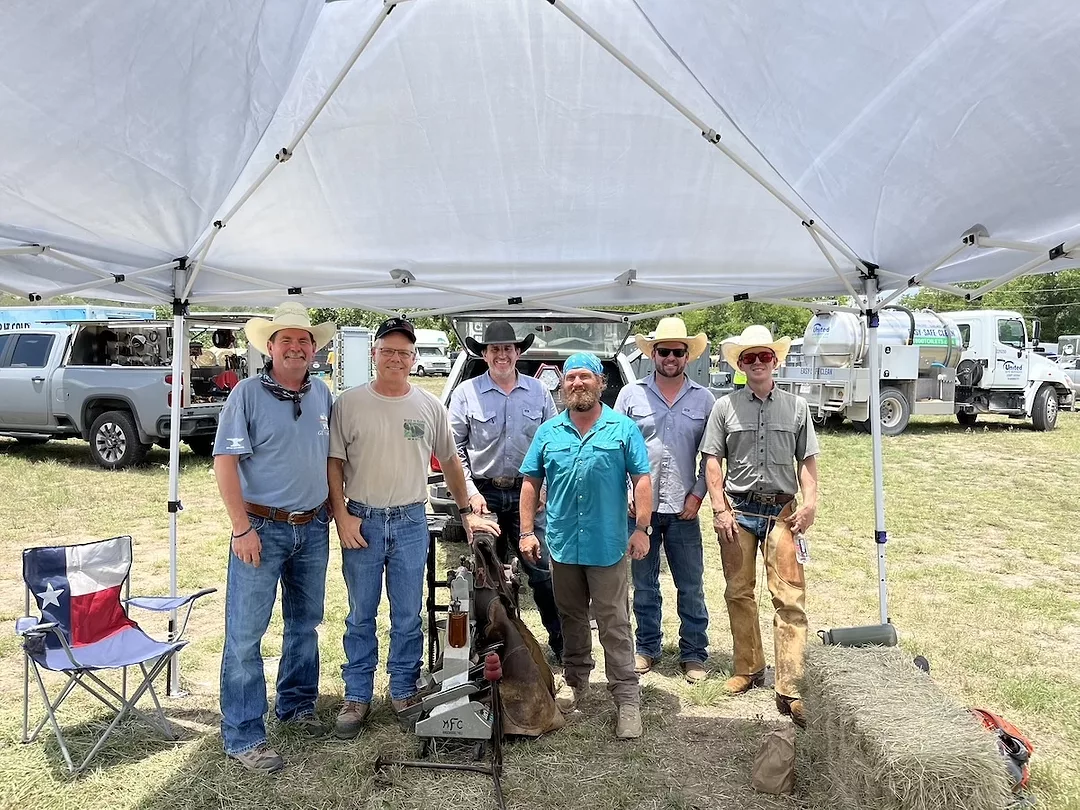
Texas farriers traveled from across the state to help keep equine search and rescue teams in the field. Evan Campbell
Coordinating Relief
Campbell hit the ground running. He made phone calls and sent out the “bat signal” on the TPFA Facebook group with a heartfelt call to action. The response was “incredible.”
“It was like a World Championship Blacksmiths competition,” he says.
On July 8, nine farriers with seven rigs shod upwards of 27 horses. Over 100 horses are now searching Ingram and Hunt — about 10 miles upriver from Kerrville and the same distance downriver from Camp Mystic. EquuSearch, a Texas equine search and rescue nonprofit, has brought closure to over 40 families in Kerr County so far. Around 31 farriers have cycled in and out of the disaster zone, tending to these horses. Two of Campbell’s mentors, Texas farriers Brandon Rogers and Todd Haenel, were in the mix.
“Brandon has a foot in his lap, getting ready to trim, taking measurements,” he says. “He calls the measurements out to Todd, who’s at the anvil making the shoe. He brings the shoe to Brandon, who burns it on and says it’s good. Todd quenches the shoe, brings it back, and Brandon nails it on without the foot ever touching the ground. And as soon as that foot touches the ground, another farrier is picking up the next foot.”
So far, these efforts have totaled more than 250 hours, and farriers are on standby days in advance.
“I’m trying to keep guys down to 2 days at a time out there unless they want to be there longer,” he says. “If you can give me 2 days, I’ll make sure you’re well-fed, supplied and have everything you need. But it’s a camping expedition, just so you know.”
As the de facto relief effort coordinator, he’s also gotten calls from other search and rescue groups miles away. One call came from Kerrville, where they were lacking electrolyte powder and snacks for the human volunteers. Others came from Leander, 2 hours away, where additional equine search and rescue operations are underway for a different flooding disaster.
TPFA Donations & Support
When Campbell first arrived in Kerr County, Texas Farrier Supply, Mustad and Well-Shod were already there handing out supplies.
“Todd Walker of Mustad left us with a bunch of shoes, rasps and nails,” he says. “The next day, Chuck Milne of Texas Farrier Supply drove all the way down from Kennedale to bring us some Sole Armor. That stuff was a game changer. Most of us aren’t used to a wet environment out here in South and West Texas. So we were sending horses out there with leather pads, and the water and silt were just sucking them right off. They were coming back barefoot an hour later.
“[Texas Farrier Supply’s] Sole Armor is a heavy-duty super glue that goes on a clean sole, even when the shoe is already on. You stick the horse’s foot in a bag of rubber sand, and it creates a rubber pad. Then you spray a setting spray on top. We have horses that have had that on their feet since last Monday [July 7].”
Many volunteer search and rescue teams were showing up barefoot, says Campbell, a bad idea in wet, debris-filled terrain. To help treat any injuries — thus far only minor abrasions, lacerations and punctures — Texas veterinarians have been closing their practices early to be there by 5 or 6 p.m. when the search and rescue crews return to camp. They came bearing first-aid materials like vet wrap, Silver Honey and Wonder Dust.
In addition to handing out supplies, Well-Shod has been collecting donations for the TPFA Relief Fund, which allows the TPFA to purchase much-needed shoes, nails, tools and other hoof-care materials while help is still needed in Kerr County. Campbell says Well-Shod has the staff, time and phones to coordinate donations while Texas farriers are on the ground.
“Initially, we were donating the supplies and shipping them to the farriers down there, but when word got out this was happening, our amazing community of people started calling in wanting to donate to the TPFA Relief Fund,” says Asya Newsom of Well-Shod. “Several shipments have been made, and we’re not sure how long it’ll be needed, but we will keep it going for as long as it takes to support the crews. There is no cost to the end user. We are only using the funds to cover the actual cost of supplies. Well-Shod is covering all shipping costs and a portion of the supplies. If there is a surplus in this account when the efforts are no longer necessary, we will be donating the remaining funds to the TPFA.”
To donate to the TPFA Relief Fund, call the Well-Shod office at 800-206-2181.
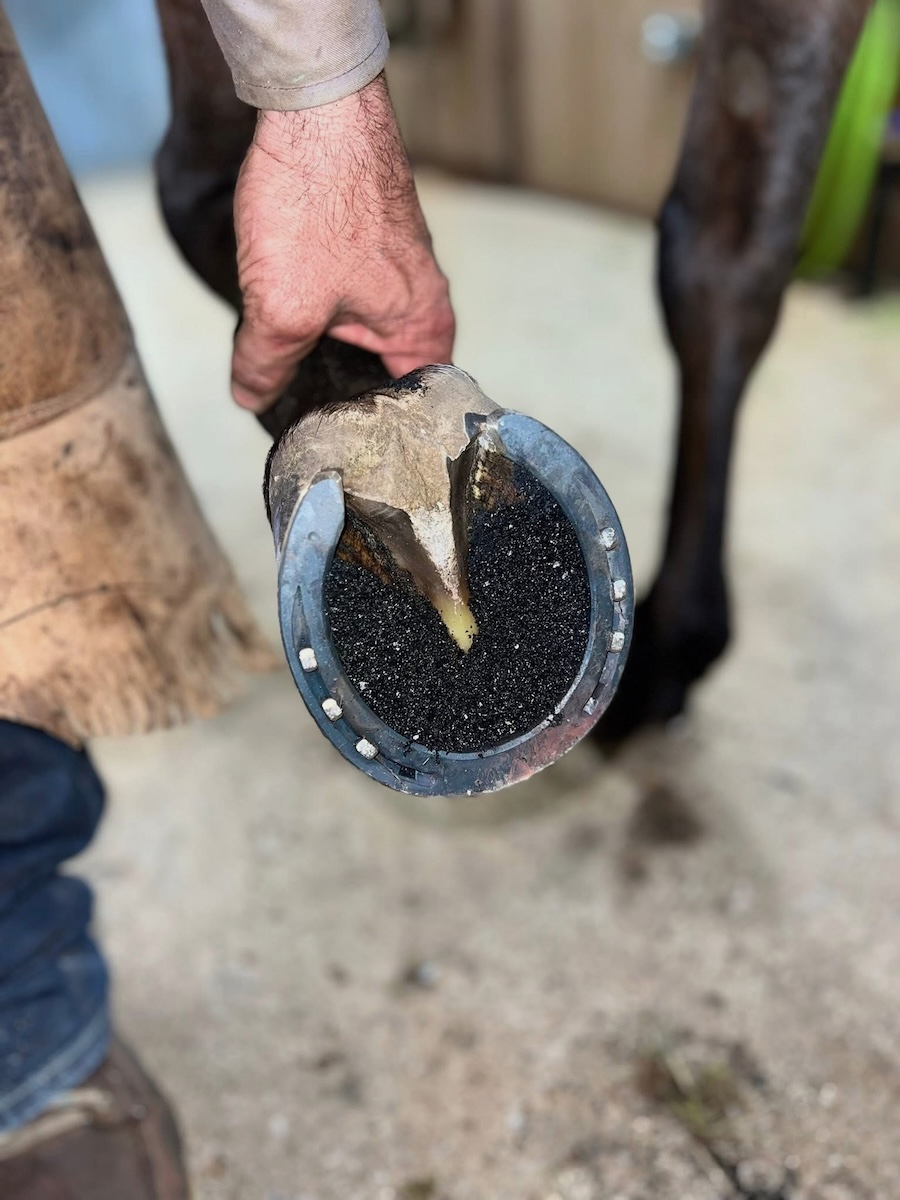
Texas Farrier Supply's Sole Armor helped protect horses' feet in wet and debris-filled conditions. Evan Campbell
Community Forged by Water
There’s still a long way to go with equine search and rescue efforts, which are all volunteer-based.
“Ingram and Hunt are at the top of where the destruction happened,” says Campbell. “We’ve only searched 15 miles of the Guadalupe River, but the last 2 or 3 days it’s been raining heavily again. The river came up 10 feet yesterday [July 15]. So, it’s completely changed the landscape again. We’re starting back from square one.”
The communities of Ingram and Hunt are small and tight-knit. Ingram’s population is less than 2,000, and Hunt is an unincorporated summer home to many tourists and campers, like those at Camp Mystic 6 miles away.
“It’s a small-town mayor and a small-town sheriff,” says Campbell. “The whole fire department is volunteer-run, and they’ve never dealt with anything like this before. They did the best they could to organize search and rescue efforts until they got support. Other counties and cities sent in heavy equipment to remove debris, so we could continue to search.
“The local community came together really fast, and anybody who had extras of anything was bringing it here,” he continues. “The feed store down the road had a couple pallets of grain and a bunch of round bales delivered. They just don’t have the infrastructure in place. The people who live here know that. So, when something happens, they know they can’t wait for the county or state to come help. They just pick themselves up by their bootstraps and get to work.”
Campbell says the water is the most powerful, destructive force he’s ever seen, rising 6 inches every 10 minutes. It turned a creek into a raging river. Cypress trees were torn down and piled up like nothing. Campbell was an Army medic and worked search and rescue after Hurricane Katrina. He knows how disaster can bring people together. Many of the volunteers didn’t know each other when they arrived, but they bonded quickly.
“We saw things you’re not supposed to see, things not meant for television,” he says. “It was hard on a lot of these folks, who had never done anything like this before. In the evenings, after everybody is back and getting settled, everyone is checking on each other. It’s a beautiful thing to see in such an awful time.”
Campbell lives on the Guadalupe River. He named his shoeing business “Bent River Forge & Farrier” for the way the river curves into a horseshoe near his home.
“That’s my river too,” he says. “You’re not going to be able to keep me away from this.”
If you’re interested in volunteering, please call Evan Campbell at 830-946-2331.