
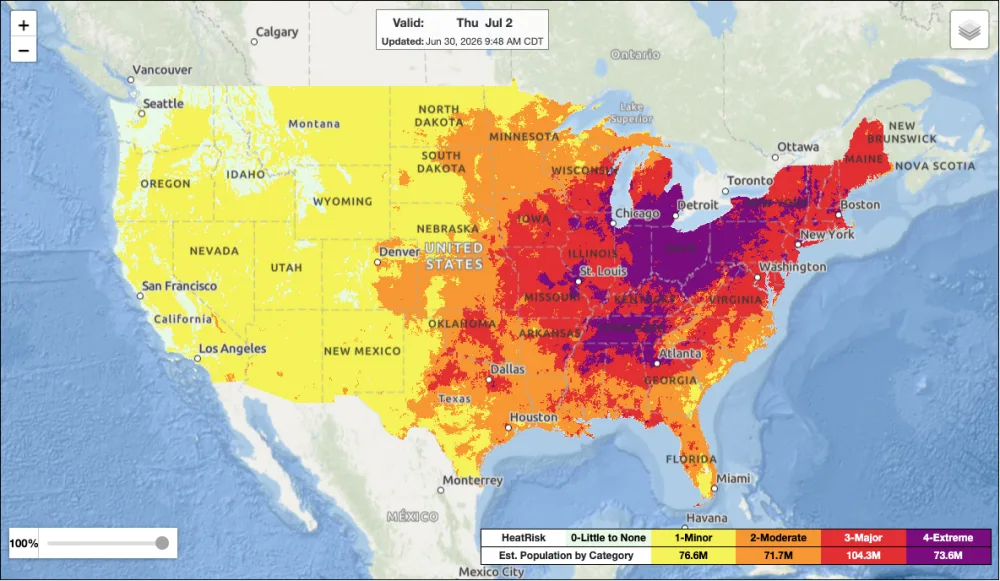
Stock up on water, electrolytes and fire up the fans. A heat wave stretching from the Midwest to the East Coast will subject half of the U.S. to “major” or “extreme” heat-related health issues, according to the National Weather Service.
“High temperatures in the 90s to low 100s, combined with high humidity, will lead to heat indices of 100-110 degrees, and locally as high as 115,” the NWS forecasts. “These levels of heat mean health impacts become more likely in general, and may occur in anyone without adequate hydration or cooling. Extreme heat could linger into next week across the central and eastern U.S., with some possible relief by July 7.”
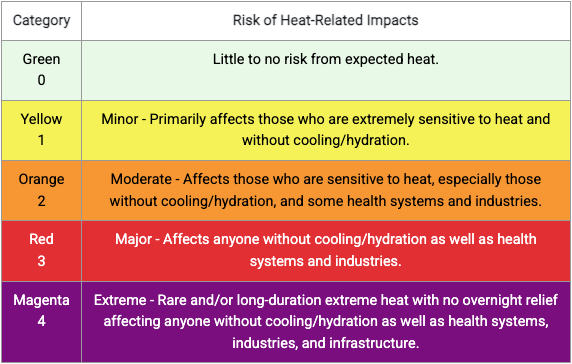
The heat index was developed to help determine the risk of heat-related illnesses for outdoor workers, what protective actions are needed and when they should be taken. The index combines air temperature and relative humidity to measure how hot the weather feels, according to the U.S. Department of Labor. It’s important to note that the heat index values were devised for shady and light wind conditions. Exposure to full sun can increase the index value as much as 15 degrees Fahrenheit.
Below is a summary of risk levels — Lower (less than 91 degrees), Moderate (91 to 103 degrees), High (103 to 115 degrees), Very High to Extreme (greater than 115 degrees) — and associated protective measures that are prescribed by the Occupational Safety and Health Administration (OSHA).

It’s important to recognize and act fast when experiencing symptoms of heat exhaustion and heat stroke.
“During extremely hot and humid weather, your body’s ability to cool itself is challenged,” according to the NWS. “When the body heats too rapidly to cool itself properly, or when too much fluid or salt is lost through dehydration or sweating, body temperature rises and you or someone you care about may experience a heat-related illness. It is important to know the symptoms of excessive heat exposure and the appropriate responses.”
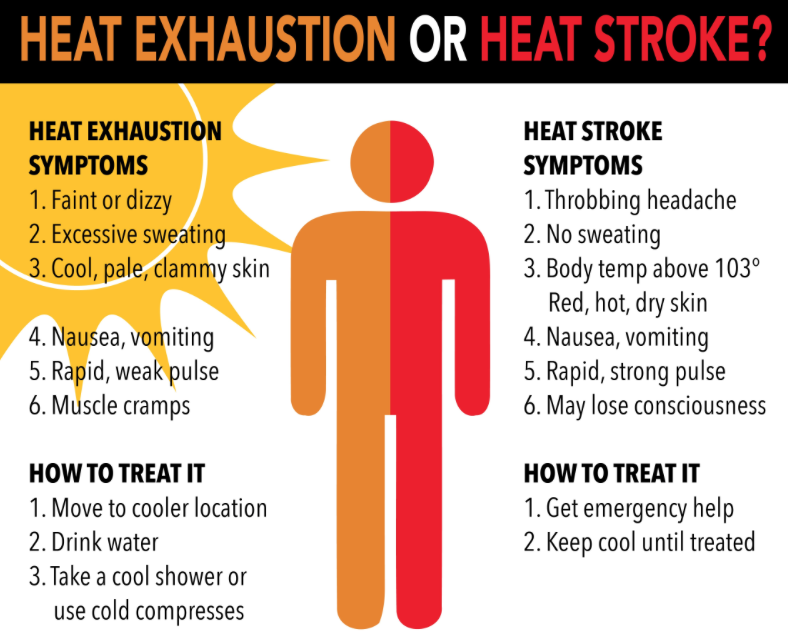
Below are warning signs and symptoms, as well as steps that should be followed, according to the Centers for Disease Control and Prevention (CDC).
Heat cramps: Often the first sign of heat-related illness and a precursor to heat exhaustion or stroke are cramping, according to the CDC. The symptoms are painful muscle cramps and spasms, usually in the legs and abdomen, and heavy sweating.
First aid that should be taken are “apply firm pressure on cramping muscles or gently massage to relieve spasm,” according to the CDC. “Give sips of water unless the person complains of nausea, then stop giving water.”
The CDC recommends seeking “immediate medical attention if cramps last longer than 1 hour.”
Heat exhaustion: Symptoms of heat exhaustion are heavy sweating, weakness or tiredness, cool, pale and clammy skin; fast, weak pulse, muscle cramps, dizziness, nausea or vomiting, headache and fainting.
When someone experiences heat exhaustion, they should be moved “to a cooler environment, preferably a well air-conditioned room. Loosen clothing. Apply cool, wet cloths or have person sit in a cool bath. Offer sips of water. … Seek immediate medical attention if the person vomits, symptoms worsen or last longer than 1 hour.”
Heat stroke: Symptoms are “throbbing headache, confusion, nausea, dizziness, body temperature above 103 degrees Fahrenheit, hot, red, dry or damp skin, rapid and strong pulse, fainting, loss of consciousness.
When heat stroke occurs, call 911 or get the person to a hospital immediately.
“Heat stroke is a severe medical emergency,” according to the CDC. “Delay can be fatal. Move the victim to a cooler, preferably air-conditioned, environment. Reduce body temperature with cool cloths or bath. Use a fan if heat index temperatures are below the high 90s. A fan can make you hotter at higher temperatures. Do not give fluids.”
It must be noted that a fan should not be used on a heat stroke victim during hotter temperatures.
“Using a fan to blow air in someone’s direction may actually make them hotter if heat index temperatures are above the 90s,” according to the CDC.
Preventing Heat Illnesses
OSHA recommends that outdoor workers acclimate — or gradually build up tolerance — for working in heat. This is particularly important for new workers, temporary workers and those returning to work after a week or more off.
“Workers new to the heat or those that have been away from work and are returning can be most vulnerable to heat stress and they must be acclimatized,” according to OSHA. “This is accomplished by ‘gradually increasing workload for new and returning workers and for everyone during a heat wave.’”
In addition, outdoor workers can take other measures to prevent heat-related illnesses, according to OSHA and the National Institute for Occupational Safety and Health (NIOSH).
Drink water every 15 minutes, even when you aren’t thirsty.
Rest in the shade to cool down.
Wear a hat and light-colored clothing.
Wear loose-fitting, breathable cotton clothing and avoid non-breathable synthetic clothing.
Scheduling heavy work during the coolest parts of the day.
Taking more breaks in extreme heat and humidity.
Avoiding alcohol and drinks with large amounts of caffeine or sugar.
Being aware that protective clothing or personal protective equipment may increase the risk of heat stress.