
Takeaways
- A successful hire often means hiring an employee who may be smarter than you.
- Being open to differing thoughts and viewpoints can lead to implementing new strategies and innovative technologies.
- Having a likeable and true to self personality will keep you in good standing with colleagues even through difficult times.
As a 25-year-old, I’ll admit that my generation may not be as familiar with Will Rogers as prior generations. Just a few days ago my dad, Mike Lessiter, passed me a new book to read on this American historical figure.
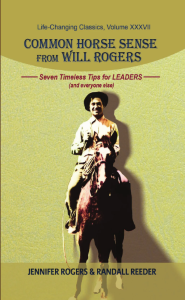
The just-released booklet was written by Jennifer Rogers (Will’s great-granddaughter) and Randall Reeder and titled Common Horse Sense from Will Rogers. Randall has been a friend of our company for over 4 decades and is an ag engineer who has spoken at our National No-Tillage Conference 19 times. Through Rogers’ and Reeder’s book, I learned more about the man who is celebrated with memorials in Oklahoma, California, Alaska, Texas and Colorado.
Will Rogers was a performer, actor and commentator from Oklahoma who was active from 1904 until his death in 1935. In the beginning of his career, he was a trick roper who performed live in circuses and fairs. As his reputation grew, he became a film star and, by 1933, was the nation’s highest-paid actor and biggest box office draw. Outside of films and performing, he also wrote a nationally syndicated column and was a sought-after social commentator.
7 Timeless Tips for Leaders
- Be a Thought Leader and an Influencer
- Listen and Admit When Wrong
- Persevere, Persist, Recover from Disappointments, Correct Mistakes, and Move On
- Utilize New Technologies
- Associate with Smarter People and Read
- Have Fun, Be Interesting, Likeable and Humble, and Stay Healthy
- Leaders are Comforters
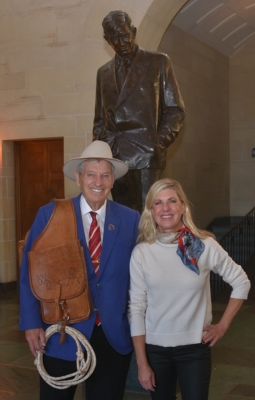 Authors Randall Reeder & Jennifer Rogers at the Will Rogers Memorial Museum in Claremore, Okla.
Even as a commentator who routinely focused on real events and people, Rogers’ likability was through the roof. He was respectful in his humor and wouldn’t push jokes on people who took offense. What little knowledge I had of him previously included his famous quote, “I never met a man I didn't like.”
He befriended politicians, businessmen, movie stars and pioneers in technology. There is a chapter in the book about Rogers’ strength in listening to people and his openness to admit to being wrong. This is a behavior that not only helps befriend people, but can also lead to learning about unfamiliar things.
Through his connections with these innovators, Rogers was, in fact, an early adopter of multiple new technologies. And it wasn’t just in film, although he appeared in 21 “talkies” in just 6 years after the integration of sound, and used new camera-cranking techniques to achieve a “slow-motion” on his early films.
He was syndicated nationally in multiple newspapers with daily columns for over a decade, which he would submit by telegraph. Rogers also appeared on the radio station KDKA-Pittsburgh (now considered the first commercially licensed radio station) within 2 years of its launch. Utilizing all of these technologies helped Rogers reach new audiences as he stayed ahead of the technological curve.
He was also an early advocate of planes and aviation. He was friends with General Billy Mitchell, who is well-known around these parts and the namesake of our Milwaukee airport. This passion for flight ultimately led to Rogers’ death in a crash, but he was friends with and respected by other famed aviators like Charles Lindbergh and Wiley Post.
Rogers' legacy and positive impacts don’t just come from his work but also with his humanitarian work. In the chapter, “Leaders are Comforters” there are records of 5 unique times where he made trips for different causes and wrote about them in his column. Those trips raised money and awareness for flooding in Mississippi, droughts in Texas, an earthquake in Nicaragua, a deadly theater fire in Ireland, and a visit to a sick child in New Mexico. He routinely performed in support of these causes to raise money and made large donations himself.
“'The most successful people hire people smarter than they are' ... While Rogers wasn’t a leader in the traditional sense, he believed in this maxim.”
In August 2025, we had a state of emergency in Southeastern Wisconsin due to flash floods, which caused a lot of damage. My residence was unaffected by the storms, and to be honest, I was largely unaware of its impact beyond the closing of the our State Fair on its final day. But through our office volunteering program, several of my coworkers and I worked on cleanup efforts, and witnessed the damage first-hand. This help was greatly appreciated, and I now see the importance of helping others in need, something that I learned that Will Rogers modeled himself.
With 90 years since Will Rogers’ passing, fewer people know about him and his character as one of America’s all-time greats of the 20th century. If you get a chance to pick up this 79-page book (and which will take you less than a coffee break to read), you’ll learn more about the man. And you’ll gain “food for thought” about being personable, bettering yourself through learning, embracing change and taking care of others who need your help and support.
The book’s authors regularly present at company gatherings and associations: Jennifer Rogers is a successful businesswoman and speaker while Randall Reeder has been speaking professionally as “Will Rogers” for more than 25 years. For more information about our speaking, or to order books, email willrogers@aol.com or visit www.WillRogersToday.com.