 RSS
RSS

Education

News & Notes
Equine Veterinarian Britt Conklin Joins Texas Tech
School of Veterinary Medicine taps alum as associate dean for clinical program
Read More
Friday’s Farrier Facts & Figures
Charging for Lameness Work | Farrier Work is No. 1 Income Source
Read MoreHoof Nutrition Intelligence
How can I eliminate the mold that’s showing up in a few of my bales of hay?
Read MoreWhite Paper Calls for Horse Racing Changes
Thoroughbred Idea Foundation spotlights the systematic issues of the sport
Read More
The Right Direction for Horse Transportation
What research studies say about best transportation practices for a horse’s well-being
Read More
Top Articles
Current Issue
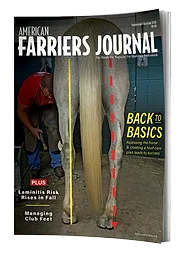
American Farriers Journal
American Farriers Journal is the “hands-on” magazine for professional farriers, equine veterinarians and horse care product and service buyers.
Thinking Beyond Breakover
Understanding Fall Equine Laminitis Risks
I Only Did What the Horse Owner Wanted: A Cautionary Tale
Current Issue

Special Report For Equine Veterinarians
American Farriers Journal is the “hands-on” magazine for professional farriers, equine veterinarians and horse care product and service buyers.
Must Read Free Eguides
Download these helpful knowledge building tools
- Spring Hoof Care
- Caring for Your Horse During a Pandemic
- CBD Products Have Promise for Farriers, but Buyer Beware
- Sharpening Knives with a Buffer
Videos

Organized & Efficient to Better Serve Farriers w/Oleo Acres: 2025 Supply Shop of the Year
Oleo Acres Farrier and Blacksmith Supply owner Rob Michel walks viewers through the Littleton, Colo., warehouse. Inventory is organized with the customer in mind. If the product is in stock and easy to find, farriers can spend more time under a horse, which Michel says is more money in your pocket.
Events
Foundations Clinic
Date: 10/23/26
Location: Fenwick, NS
View Event
Top Directory Listings
Doc Foal's | The Black Pads
At Doc Foal's, we manufacture The Black Pads and The Black Pads PLUS (featuring embedded magnets and copper). Our hybrid pads work seamlessly with your choice of conventional horseshoe, combining metal for structure with polyurethane for exceptional comfort and shock absorption.
Designed as a...

Sunrise Farrier Supply
We are here to support you.
We stock a wide range of high-quality products from trusted brands to ensure durability, performance, and reliability in every job you undertake. Our extensive inventory of horseshoe products and farrier tools means you can find everything you need in one place, saving you time and effort. Your satisfaction is our top priority. We are committed to providing excellent customer service, prompt shipping, and hassle-free returns.

Equilox International
Equilox International Inc. specializes in equine horse hoof adhesives. Developed in 1988 after many trials and extensive research at leading universities and equine centers throughout the U.S., the Equilox Adhesive Hoof Repair System was originally used to treat competitive horses. Now, Equilox Adhesive is used by farriers, equine centers, and horse owners — as well as various zoo and wildlife centers — throughout the world.