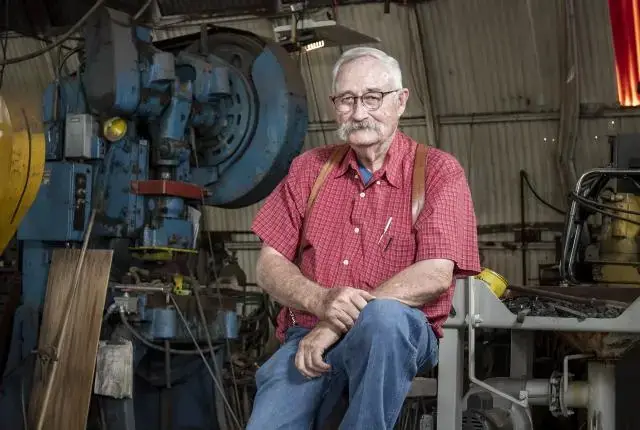
Jim Keith never intended to be a farrier, but he didn’t let that stop him from becoming one of the best to ever do it. The International Horseshoeing Hall of Famer passed away Sunday, Oct. 25, 2026.
Keith started shoeing out of necessity. Simply put, you had to shoe the horses you rode because there were so few farriers in eastern New Mexico. Barely 17 years old, he went to work on a ranch near Tucumcari. Shortly after, though, he landed the job he really wanted.
“The Bell Ranch sent word that they had a place for me,” he wrote. “The next year, I was admitted to Texas Tech, but the ranch manager offered me a small raise in pay if I would stay on.”
The offer was enough to persuade Keith to remain at the Bell Ranch and stoked his love for the rodeo.
“The rodeo bug got me good,” he wrote. “I started dozens of 3-year-old colts for the Bell Ranch, most of which would pitch, paw or otherwise fight back. I won the bronc riding at the first rodeo I entered and thus began my obsession for the next several years.”
If you spent any time discussing hoof care with Keith and you’ll quickly realize the gift he had for teaching. He earned his teaching certificate while working as an electrical lineman and shoeing part-time in a four-state area. Keith was instrumental in the creation of the Mesalands Community College Farrier Science Program, teaching future shoers for 14 years. During his tenure, the American Farrier’s Association recognized his contributions in hoof-care education with its inaugural Outstanding Educator Award. Keith went on to receive the award a second time.
“A great communicator, [Keith] could visit with a physics professor and then translate it to me and [Tim] Hooter [Hoover],” writes Craig Trnka, a fellow member of the International Horseshoeing Hall of Fame. “Educator, cowboy, servicemen — he was Tucumcari’s finest! He was a huge influence in all his genres of life! Some of the greatest life experiences he shared with so many!”
As much as Keith was known for his intellect and teaching, his love and mastery of the hammer only build on his legend.
“The hammer has gone through a tremendous evolution,” he told AFJ in 2016. “It probably started out as a flat rock. A stick with a knobby end on it was probably added eventually. Virtually any tool made by man can be used as a hammer. I know I use my computer mouse sometimes as a hammer when it doesn’t work right.”
Despite the simplicity of its design, Keith warned farriers to respect its complexity.
“I’ve always thought that you could probably teach a person to be proficient with the latest computer technology quicker than you can teach a person to be proficient with a hammer and anvil,” he said. “The subtle variations and combinations that you can get from the use of those two tools are tremendous. I haven’t been able to explore the depth of them, and I’ve been doing it for more than 70 years.”
Keith excelled as a competitor and judge in shoeing and blacksmithing contests around the world, including the Caribbean, Brazil and Japan. He finished in the top 10 in international competitions in 4 decades, including winning the 1991 World Blacksmith Championship in Calgary, Alberta.
“I was told a long time ago that you have to be good friends with your hammer,” he said. “The more natural a swing, the easier it is to make a better effect with how your work is progressing. If you have to think about your swing, then you’re neglecting what the swing is doing.”
A venture in manufacturing horseshoes sounded like a good idea, but it led to his real love — making tools with a hammer.
“[Manufacturing horseshoes] was a big headache for me,” Keith wrote. “All the employees got to do the hammering, and I had to be a businessman. I sold the horseshoe business and downsized to making hammers, tongs and a few other blacksmithing tools. I could do the hammering, and my wife Carole could be the businessman. I was much happier and it was much more successful. Sales of the products were worldwide.”
While the hammer and anvil were used to create tools, horseshoes and art, Keith was equally a hand with a pencil and paper, as well as the written word. He often immortalized people and experiences close to him, whether it was scenes from his days working the Bell Ranch or a family member. He was a contributor to hoof-care publications, including American Farriers Journal, and authored “I Never Called Myself a Cowboy” in 2019.
“How can we ever live without these icons of a generation?” says Nigel Fennell, a fellow Hall of Fame farrier and artist. “For those who paid attention and embraced the knowledge that he radiated in abundance to those who watched, listened, waited for the visual wisdom of this monumental artisan and human, it means he will forever be immortal in all of us.”
Keith was recognized for his immense contributions to the farrier industry when he was inducted into the International Horseshoeing Hall of Fame in 1994.
A memorial will be at 2 p.m. Mountain Time on Nov. 21, 2026, at the World Championship Blacksmiths’ National Smithy in Edgewood, N.M.