 Premium content is for our Digital-only and Premium subscribers. A Print-only subscription doesn't qualify. Please
American Farriers Journal
American Farriers Journal is the “hands-on” magazine for professional farriers, equine veterinarians and horse care product and service buyers.

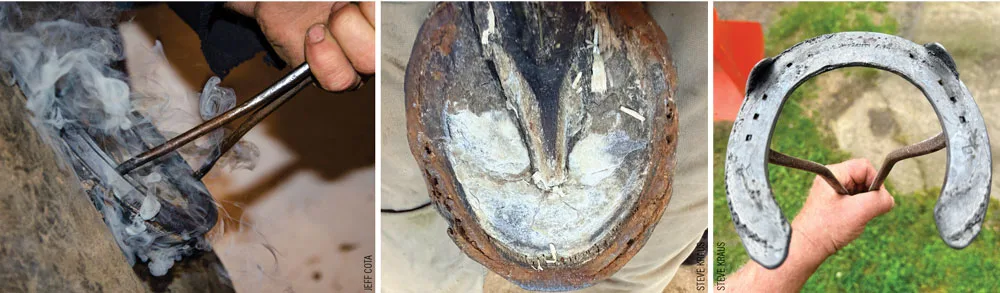
A 3-second even touch of a horseshoe that’s just losing its incandescent heat to the trimmed hoof ensures clips are properly seated into the hoof wall. In addition, high spots on the hoof surface will show scorch marks on the bottom of the hoof wall indicating whether the shoe fit is even. There will be burn marks transferred to the shoe that indicate whether the fit past the quarters is uniform, too tight or too full. Jeff Cota
In the previous installment, we discussed the initial steps in the thought process when shoeing a new horse — observation of stance, gait, conformation and any abnormal indicators. After acquiring the information about the horse’s job and any problems it might have, a plan is now in place to successfully shoe this horse. We must now decide what type of shoe is appropriate, any necessary modifications, as well as other extras, such as pads or studs, if desired.
Turnout conditions may alter what you consider an optimal plan. For instance, traction devices needed for rider safety may be dangerous to other horses in turnout. Wide, full-fitting shoes that provide flotation for a dressage horse will likely be lost in deep mud.
A basic plain horseshoe is just a starting point. A “rule of thumb” is that the width of the shoe should be twice the wall thickness. This puts the nail holes in the right…

American Farriers Journal is the “hands-on” magazine for professional farriers, equine veterinarians and horse care product and service buyers.

American Farriers Journal is the “hands-on” magazine for professional farriers, equine veterinarians and horse care product and service buyers.
Download these helpful knowledge building tools


We are here to support you.
We stock a wide range of high-quality products from trusted brands to ensure durability, performance, and reliability in every job you undertake. Our extensive inventory of horseshoe products and farrier tools means you can find everything you need in one place, saving you time and effort. Your satisfaction is our top priority. We are committed to providing excellent customer service, prompt shipping, and hassle-free returns.
