Conformation faults can create various hoof issues. In the case of a gelding used for pleasure riding, it promotes distorted hoof growth, prompting his farrier to bring his foot underneath him.
“His foot offsets to the outside,” explains Greg Martin, a Boerne, Texas, farrier. “He also breaks over toward that side, which isn’t all that uncommon. We’re not trying to fix him. We’re just trying to put that foot back underneath his leg where the weight is.”
Martin accomplishes this by focusing on Raven’s anatomy.
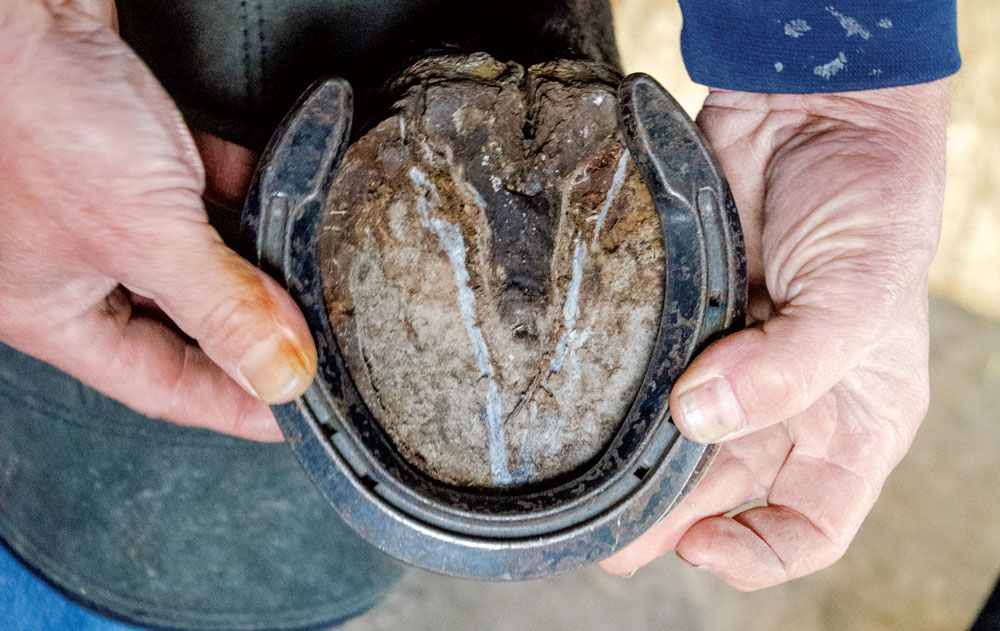
Martin moves Raven’s footprint to where it should be. “That’s how you achieve it over time. It’s not going to happen overnight. If you keep shoeing to the distortion, it’s just encouraging it to grow distorted.”
“You trust that the center of the coffin bone is in the center of the frog,” he says. “Move the shoe or footprint where it should be, making sure he’s not going to step on it. That’s how you achieve it over time. It’s not going to happen overnight. If you keep shoeing to the distortion, it’s just encouraging it to grow distorted.”
As Martin begins trimming the foot, he points out that it’s critical that the heels are level, especially with a distorted hoof like Raven’s. Then he turns his attention to the frog, which is rough.
“We don’t do a fancy frog trim,” Martin says. “We want to leave as much for him as we can, especially if it’s not diseased. Nowadays on Facebook, you see a lot of really nifty, manicured frogs. It looks pretty, but the frog is there for a reason.”
After completing the trim, Martin places the hoof on the floor. Seconds later, Raven is licking and chewing, indicating he’s happy with the results.
To learn more about Greg Martin’s straightforward farriership, read Jeff Cota’s article “Basic Farriery Keeps Horses Sound & Balanced” featured in the June/July issue of American Farriers Journal.