The farrier’s toolbox is critical to his or her livelihood. The quality of equipment you have will play an essential role in the quality of work you will deliver as a farrier. Equipment also will be one of your main investments when you are just starting out. Quality tools should be built to last, but there are some things that farriers can do to extend — or shorten — the life of their tools. Dan Bradley, International Horseshoeing Hall of Fame member and owner of Shadowfax Forge in Jefferson, Texas, offers common-sense tips that he has found helpful.
Keep Riveted Tools Lubricated
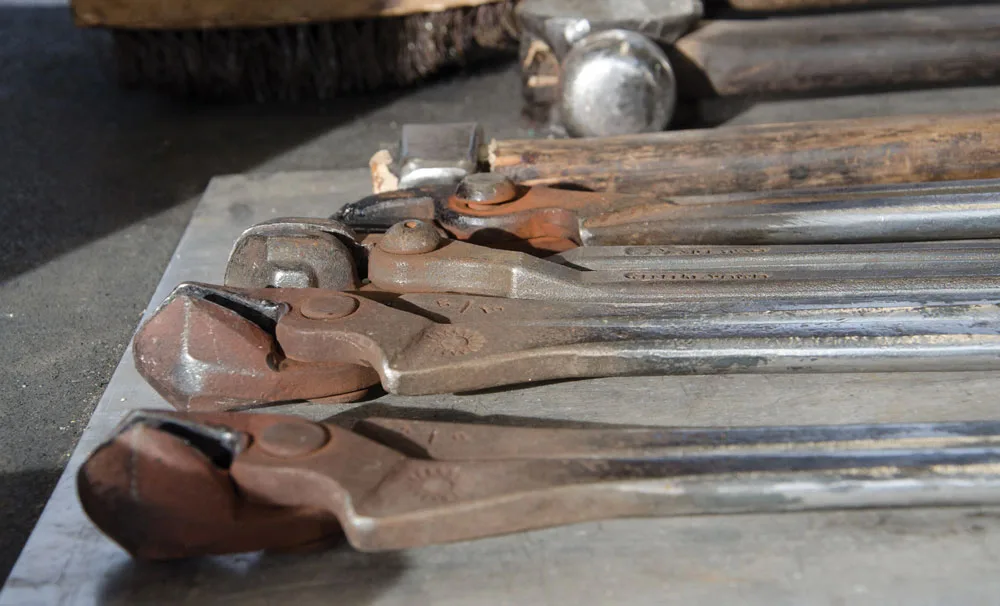
Any riveted tools, Bradley says, need to be kept lubricated. Based on shoeing five horses a day, 5 days a week, for 50 weeks a year, the number of times riveted tools will open and close over a 3-year period is significant. Hoof nippers will open and close approximately 195,000 times, clinchers 120,000; pull-offs 75,000 and crease nail pullers 20,000-90,000.
Extending the life of riveted tools is as simple as establishing a routine of regular cleaning with soap and water, and lubrication. A light coat of lubricant — 3-In-One Oil is Bradley’s go-to — is all that’s needed with most hand tools. Bradley cautions using too much can collect dirt.
Consult an Expert When Needed
Well-cared for tools make it easier for a farrier to make money. On the other hand, abusing tools can have costly consequences. Through normal use, tools wear down and become dull. When they need sharpening, Bradley advises getting educated or getting help. Many tools can be ruined by improper sharpening. A file, Bradley says, should not be used on tools in the same manner it is used to rasp a horse’s foot.
“Sharpening isn’t necessarily hard,” Bradley says, “but it is something people can screw up easily. You need to use finesse when tuning up your tools.”
“A farrier should always have at least 3-4 sets of nippers…”
Clinchers, for example, are often over sharpened, which can result in sheared nails. The mistake can be remedied by taking the triangle file used to sharpen the teeth and passing it over them once. The edges should look silver or have a shine, which indicates a slight dulling of the teeth.
For punches and fullers, Bradley recommends beveling the edges before they mushroom or else they can chip. When using a belt or sander, travel in the same direction as the grain, he says. The tool will stick if the grain is crossed. If any cracks are found, the tool should be discarded or it will eventually fail.
Have a Back Up
Besides normal wear and tear, tools often are dropped, lost and can get broken. For these reasons, having backup tools is a worthwhile practice. But Bradley notes having more than one of certain tools, and creating a life cycle-rotation, can also extend their longevity.
Nippers are one example.
“I think a farrier should always have at least 3-4 sets of nippers,” Bradley says. “If you rotate them, and have a rebuild, you always have a fresh tool.”
The sharpest, newest pair of nippers should be used in your day-to-day shoeing. When that pair gets worn down a little, it goes into the trimming box. The one that was in the trimming box then goes out to be rebuilt. The rebuilt nippers can go into the truck and serve as a backup. Bradley maintains a farrier should be able to get 9 years out of a nipper.
Ensure a Proper Fit
One-size tools do not fit all farriers. Tools that don’t slip improve efficiency. Ensuring that tools fit properly in a farrier’s hand will not only allow equipment to wear in the manner it was intended, but it can increase the farrier’s comfort, as well.
“Most tools can be modified to be more ergonomically feasible,” Bradley says. “Each person should have a sense of if something feels good or not. For example, is the hammer handle too fat or skinny? If it’s too flat or too round, you can shape the handle until it falls naturally in your hand.”
Tong reins and other riveted tools also can be adjusted so they are not causing unnecessary strain on a farrier’s wrists and hands.
The Right Tools to Get You Started
“Knowledge and education are the first tools for a farrier,” says Dan Bradley, a member of the International Horseshoeing Hall of Fame and owner of Shadowfax Forge in Jefferson, Texas.
As for hardware, Bradley says, “To go out and shoe a horse, you basically need an anvil, a rounding hammer, a knife, a nipper or some kind of cutting tool, rasp, some nails and a driving hammer. That’s what new farriers need,” he says. “They don’t need grinders and high-end equipment to start out with.”
Donald Jones, another member of the International Horseshoeing Hall of Fame and the long-time owner of NC Tool Co. in Pleasant Garden, N.C., offers a similar list for new farriers.
He recommends a hoof knife, nippers, rasp, clincher, driving hammer, rounding hammer, crease nail puller, clinch cutter, clinch block, pull-offs, a forge for modifying shoes, an anvil or a stall jack, an anvil stand with a spring vise and a hoof stand and cradle.
“If you’re going to shoe every day,” Jones says, “you need those tools to make the job easier.”
Needs vs. Wants
Bradley says new farriers need to determine a realistic budget and stay within it. Jones agrees, noting that some tools might be desirable but are not absolutely necessary while budgets are tight.
For example, Jones says, “You don’t have to have a clinch cutter, you can file the clinch off with a rasp, then pull the shoe. And you don’t need a clincher. You can clinch the nails with a hammer.
“You can just bend the nail over and flatten it against the hoof with a hammer, but that requires more skill than using a clincher. You’re hitting the side of the horse’s foot with a glancing blow, and you need to be really accurate.”
A new farrier can also do without a crease nail puller.
“You can take pull-offs, carefully work them under the shoe and raise the shoe a little bit,” Jones says. “That will pull the nail back out. Then you can pull it out with your shoe-puller. It takes a bit of skill to work the shoe up.”
An anvil is another item that isn’t truly necessary, according to Jones.
“You can use a stall jack,” he says. “The downside of that is you’re bent over, working low on a stall jack, as opposed to an anvil.”
Some farriers have both an anvil and a stall jack, which can be used to work around a horse while doing hoof work in a stall. “It has its place,” Jones says.
Although a hoof stand might not be necessary, Jones recommends them.
“I always used a hoof stand to set the front feet on. Some people just use their knee, but that takes a lot of skill and a lot of energy,” he says. “Now, there are hoof stands with cradles you can put on or take off. They’re nice to have; they can take some of the weight off you while you work.”
“For nippers that are too wide, you can open up the nipper, lay the outside edge on your anvil, go up approximately 1-inch from the split, use the rounding side of the hammer and give it a whack,” Bradley says. “This will bring a handle in. Do it the opposite way and it will open the handle.”
Another option, he says, is to hold that tool as you normally would, and use a marker to identify where the top of your bottom hand is. Then put that mark in the center of your horn, and use the hammer to strike to the end of the handle. The width at the top is the same width as where your bottom hand grips the tool, Bradley says.
For wooden handles, Bradley starts by using an old hoof rasp to get the initial shape. He then uses a belt sander and finally a torch to fine-tune the shape to fit his hand.
Consider Rebuilding
Rebuilding tools is another way to increase tool life. You know it’s time to rebuild a riveted tool when your hands start hitting each other and tool leverage has decreased.
Most riveted horseshoeing tools — with the exception of crease nail pullers — can be rebuilt. Bradley says a qualified tool rebuilder will rebuild a tool at roughly half the cost of replacing one.
“Safety should always be a priority…”
Tools tell the farrier when it is time for a rebuild. If nippers are tearing, rather than cutting through the hoof wall, or clinchers are sliding off the nail — these are signs that tools need to be rebuilt — or replaced.
Focus on Safety
Well-maintained tools will enable a farrier to be more efficient and do better work, but more importantly, they will make a farrier’s work environment a little safer. Some tools can become dangerous to both human and horse when not regularly maintained or replaced. Simply being aware of subtle changes in tool look and feel can help farriers stay safe and improve their efficiency.
“Any tool that is struck will start to mushroom,” Bradley says. “You need to keep an eye on that. Everything needs to be smooth or it will chip. Chipping off any tool struck can lead to a serious injury.”
Bradley also stresses wearing safety glasses whenever farriers are forging or grinding.
“Safety should always be a priority,” he says.