Takeaways
- Attendees agreed the tension that caused the coffin bone to sit in an articulated forward position was a muscle condition.
- Half of the attendees wanted to limit hoof capsule distortions by offsetting them mechanically with progressive horseshoeing strategies.
- As your skills and ability to communicate grow, your clientele will become more desirable.
- Once you get down to the nitty-gritty, everyone has to decide for themselves how much to charge.
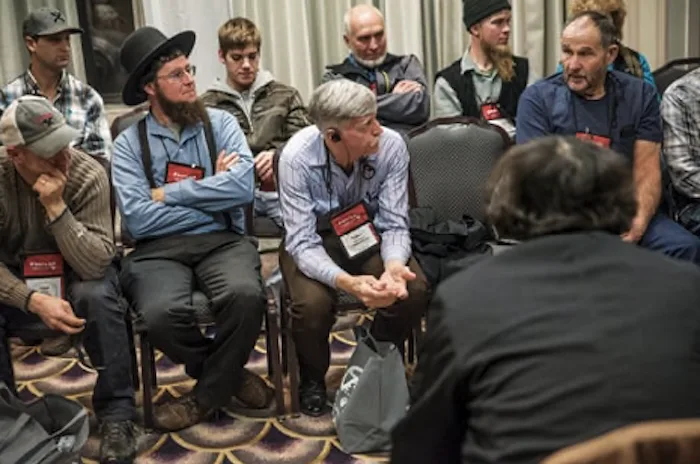
The Hoof-Care Roundtables are an important educational choice at each year’s International Hoof-Care Summit (IHCS). These sessions bring attendees together to discuss specific footcare topics that participants find challenging in their day-to-day work. Attendees walk away with ideas on how to more effectively solve a particular concern.
The moderators of these IHCS sessions shared some of the best ideas and tips that were made by attendees during their Roundtables. Here are two that might benefit your footcare practice today.
Addressing Clubfooted Horses, moderated by Stuart Muir, Rood & Riddle, Lexington, Ky.
It was widely agreed that there are numerous reasons for club foot syndrome. Among the factors included are nutrition, deep digital muscular retraction and a response to pain.
Nutrition. Poor nutrition can lead to rapid bone ossification in young horses. The clinical indication of this was presented as tight deep digital flexor tendons causing carpus instability.
Deep digital muscular retraction. Attendees agreed that the tension that caused the coffin bone to sit in an articulated forward position was a muscle condition. Most believe farrier work was helpful in lower grade cases, but veterinary intervention was necessary in higher-level cases to achieve results.
Response to pain. Attendees felt they had seen club feet develop from trauma to the affected limb. They referenced shoulder injury, hoof abscesses, foal delivery, infant grazing positions and internal hoof pathology as precursors to the condition.
"Half of the attendees preferred decreasing tension in the deep digital flexor network."
Attendees who spoke were interested in interpreting the hoof capsule to guide them on the right path. Among the considerations cited were growth rings, dorsal hoof wall flaring, heel growth and sole depth. Participants were reflective about the effect of their work on the internal structures within the capsule. Among their concerns were bone demineralization and solar corium pressure.
There were four distinctly different approaches to footcare of the clubfooted horse discussed — wedging the heel, roller motion mechanics, focused limb elevation and lowering the heel/toe extension.
Half of the attendees preferred decreasing tension in the deep digital flexor network. While numerous shoeing modalities were discussed, most Hoof-Care Roundtable participants thought the two best options were wedging the capsule or roller motion mechanics with sole support. Half of the attendees wanted to limit hoof capsule distortions by offsetting them mechanically with progressive horseshoeing strategies.
The other half of the attendees seemed to focus more on the antagonist approach of lowering the heels and bilateral hoof symmetry. This was discussed against more progressive methods, but the conversation quickly moved on to veterinary intervention with the cutting of the interior check ligament or a tenotomy of the deep digital flexor tendon.
For New Farriers (Apprentice to Third Year), moderated by Bob Smith, Pacific Coast Horseshoeing School, Plymouth, Calif.
The clients farriers get when starting out undoubtedly will be considered undesirable. However, depending on how hungry you are, new farriers typically take on almost every client you get a call from. As you develop and mature your practice, those clients go on an “undesirables list.”
As your skills and ability to communicate grow, your clientele will become more desirable. At some point, you will have a full book and the undesirables will be the first ones you can let go. Be sure to let them go for cause so the client knows the reason.
Some reasons for putting clients on the undesirable list could be unsuitable working conditions, ill-mannered horses, tracking down unpaid bills and refusing to remain on a consistent schedule.
People who return to their hometown after dedicating the time to learn new skills as a farrier often run into the struggle of not being taken seriously. Often this is a result of the anchoring principle. The trainer who you worked for previously will always see you as barn help. Your friends will see you as someone to get a “friend” deal.
“Take the option of relocating your beginning farrier practice away from home for a time……”
Take the option of relocating for a time. You will build your skillset, make mistakes, learn and grow away from those who see you as the newbie. Those people will see your decision as career focused. When you return to your home area, you will be seen as someone with something new to offer.
It is always good to find out what the going rate of established farriers is in your area. However, once you get down to the nitty-gritty, everyone has to decide for themselves how much they need to charge based on their business expenses and their desired profit margin that will afford them the lifestyle they want.
Don’t be afraid of digging into the numbers of your business. It will empower you to make well-informed monetary decisions. You need to know how much you have in business expenses. You also need to know how much you have in personal expenses.
The profit made from your business should cover your personal expenses, as well as leave a little more margin for business growth. If you notice your lifestyle expenses have increased, consider increasing your profit margin by cutting business expenses and/or increasing your prices.