
As the largest structure in the hoof, the digital cushion is a vital part of the equine foot, and its health should be accounted for when considering a shoeing package. Weak digital cushions are more likely to exist alongside long toes and low heels, which can be shod in a variety of ways to support healthy growth, including with frog support, pads and glue-on options.
“If we’re going to help the digital cushion, we need to know what it is, what job it has and what affects it,” says Minnesota farrier Roy Williams with Glue-U at the 2026 International Hoof-Care Summit.
What makes a healthy or an unhealthy digital cushion? Externally, palpating the heels can help get a feel for how the cushion is structured. If it has a firm texture and the frog is firm but elastic with good moisture content, it’s likely a healthy digital cushion, he says.
When assessing the cause of an unhealthy digital cushion, Williams looks to breed, environment, nutrition, exercise, grazing stance and the intervals and quality of hoof care. An off-the-track Thoroughbred might have a different conformation than a Morgan. A horse living on hardened desert won’t have the foot quality as one living in a wetter environment, and a horse receiving proper nutrition will have a better-formed digital cushion than one that isn’t being fed a rich diet.
“Is the horse stalled for 12 hours or 24 hours? Does it only come out to exercise? If the horse is in the stall for long periods of time, it leads to a poorly developed digital cushion. The same can be said if the exercise is too extreme,” Williams says.
The duration, frequency and intensity of exercise affect a horse’s nutritional needs. The Oklahoma State University Extension cites that energy needs increase about 20% beyond maintenance in each activity level category, ranging from moderate to very heavy exercise. Ensuring the level of exercise and the associated nutritional needs are in balance can help keep a digital cushion healthy.
“Another thing that affects the digital cushion is the horse’s grazing stance. If a horse has a short neck and long legs, it’s going to stand with one leg farther forward than the other. The foot that’s out in front is going to have low heels. The other foot will be steep, if not clubby,” he says.
“The sooner you address the hoof, the better off it’s going to be…”
Understanding how a low, weak heel develops is critical for proper treatment. Improper hoof care can even be a contributing factor.
“If you have a digital cushion that’s being compromised, time is not your friend,” he says. “You do not want to push those feet out 8 weeks. The sooner you address the hoof, the better off it’s going to be. A lot of times, when we see long toes, we only focus on the toe. You need to focus on the palmar aspect, the back half of the foot. If you don’t take care of that too, it’s not going to get better.”
When trimming the bars on a long-toe, low-heeled horse, Williams focuses on eliminating sole pressure. In his experience, flat heels cause the bars to fold over onto the sole, which can cause bruising and abscesses if untrimmed.
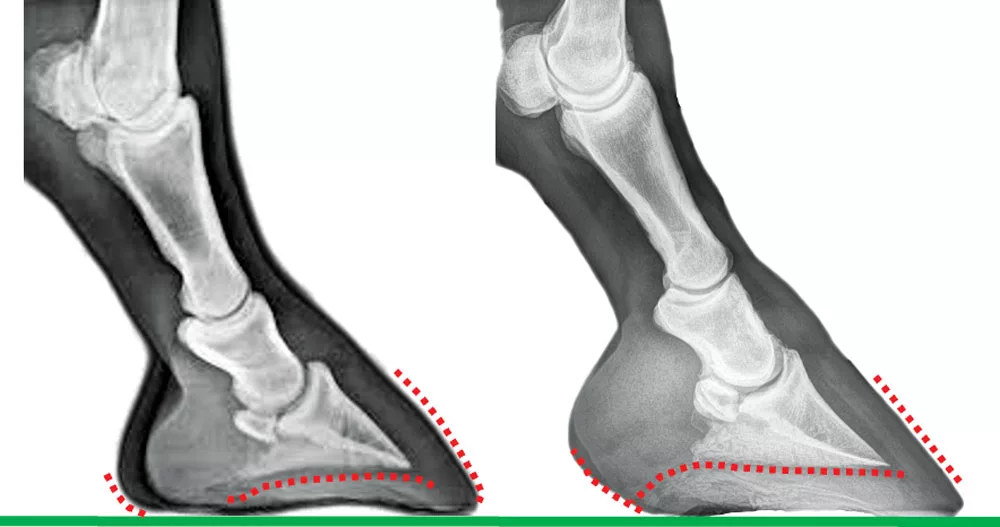
There is a connection between long toes, low heels and unhealthy digital cushions, he says, which, in addition to exterior appearance and feel, can be seen on a radiograph.
“A foot will have a less-than-ideal palmar angle, a broken back hoof-pastern axis and shallow sulci, which you can measure with a caliper,” Williams says. “You can also see it in X-rays. There’s a posterior pitch, which you see a lot with horses that have digital cushion issues (Figure 2a). There’s a shallow sulcus and a different distal border on P3. Figure 2b has more of a horizontal pitch, and the bone is in much better shape. It’s a little broken back but pretty good alignment.”
Gain more insight into supporting the digital cushion by reading "Supporting the Digital Cushion in a Long-Toe, Low-Heel Horse" in the May/June 2026 issue of American Farriers Journal.