 Premium content is for our Digital-only and Premium subscribers. A Print-only subscription doesn't qualify. Please
American Farriers Journal
American Farriers Journal is the “hands-on” magazine for professional farriers, equine veterinarians and horse care product and service buyers.

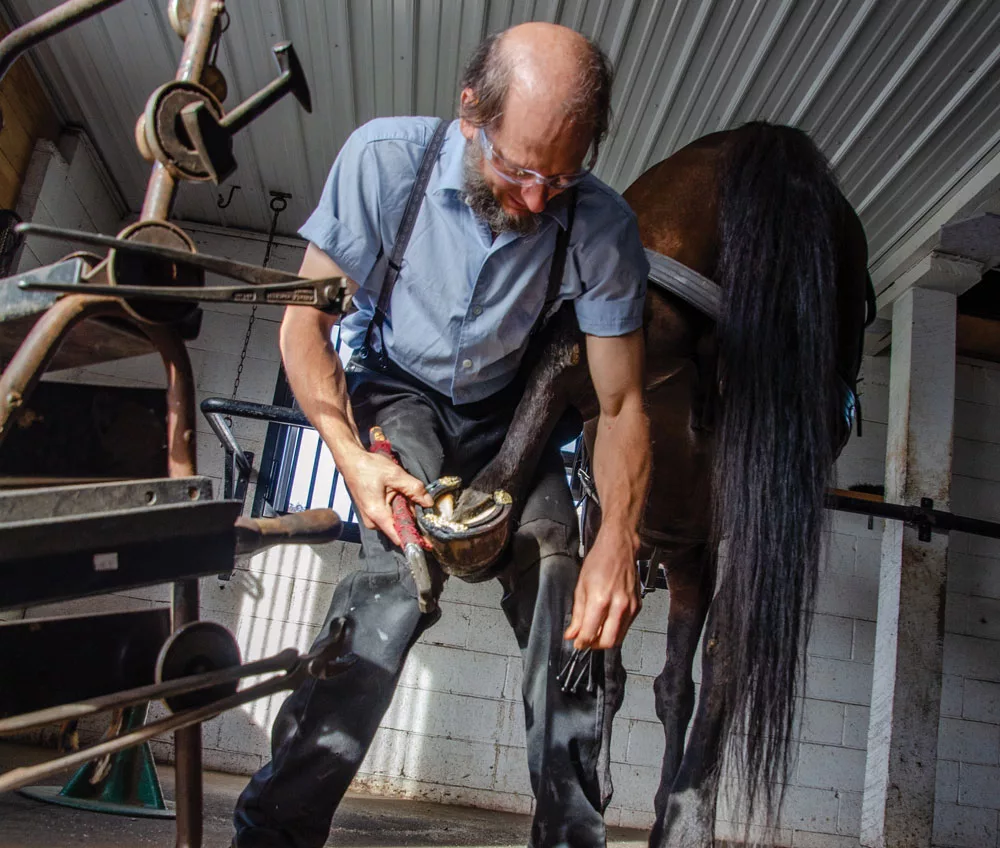
Stoltzfus prioritizes safety by wearing goggles while at the anvil, brazing or grinding. Efficiency is also important. In lieu of wearing an apron, he sewed a pocket in his work pants where he keeps a magnet. This allows him to have nails handy without looking away from the hoof. IMAGES: Maclaren Krueger
“What’s a sound horse?” asks Gordonville, Pa., farrier Elam Stoltzfus. “In my opinion, there is no sound horse.”
Stoltzfus operates a haul-in practice in Lancaster County, an area with one of the largest Amish family populations in the country. He shoes about 35 buggy horses per week, whose owners live in the surrounding 5-10 miles. In his experience, these horses are worked harder and longer than any other equine discipline. They often travel upwards of 15 miles in a day pulling a 1,000-pound buggy with passengers on unforgiving asphalt roads. So, many of the horses he shoes come to him a little sore, stiff or bruised.
Because of this, he often relies on the owner to tell him whether something is wrong and needs addressing. One of his biggest considerations is can the horse safely continue in work. If the answer is yes, then Stoltzfus’ job for the last 27 years has been to keep the horse comfortable and its feet well-maintained.
“In my opinion, there is no sound horse…”
“Anytime I shoe a horse, it’s therapeutic,” he adds. “I don’t fix any horses. I can shoe a horse and do what’s right for him today, but he’s not fixed. He has to come back again in 6 weeks. That’s how I look at therapeutic shoeing.”
Keeping a buggy horse in work most of its life requires comprehensive management. The first horse of the day is an older gelding that’s stiff in the hocks and stifles and…

American Farriers Journal is the “hands-on” magazine for professional farriers, equine veterinarians and horse care product and service buyers.

American Farriers Journal is the “hands-on” magazine for professional farriers, equine veterinarians and horse care product and service buyers.
Download these helpful knowledge building tools


We are here to support you.
We stock a wide range of high-quality products from trusted brands to ensure durability, performance, and reliability in every job you undertake. Our extensive inventory of horseshoe products and farrier tools means you can find everything you need in one place, saving you time and effort. Your satisfaction is our top priority. We are committed to providing excellent customer service, prompt shipping, and hassle-free returns.
