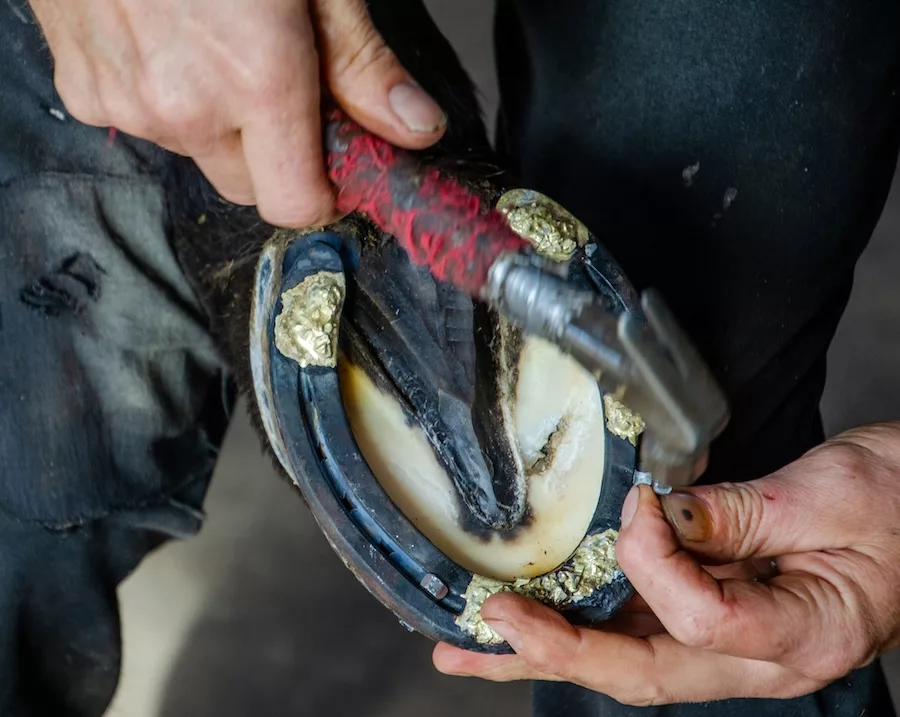
In Gordonville, Pa., farrier Elam Stoltzfus’ experience, buggy horses are worked harder and longer than any other equine discipline. They often travel upwards of 15 miles in a day pulling a 1,000-pound buggy and passengers on unforgiving asphalt roads. So, traction and shoe longevity are important. By adding more Drill Tek each cycle, he can get 3-5 resets out of a single set of shoes.
The placement and amount of that Drill Tek are equally important when considering traction and joint support. Too much Drill Tek or Drill Tek in the wrong places on the shoe can cause the foot to stick during landing. That arrested momentum sends shocks up the leg, straining joints, tendons and ligaments. Long-term stress can ultimately shorten the working lifespan of the horse. Too little Drill Tek and the foot slides on the road, causing the horse to compensate by overtaxing other muscles and joints. Stoltzfus favors something in between — enough slide to encourage fluid movement but not enough to destabilize the horse.
In the summer, this means a little less Drill Tek, as the road is hot and grabs easily. In the winter, it’s the opposite, which is why spring and fall are tricky. The needs of the horse may change from day to day or hour to hour, depending on the temperature. What Stoltzfus rarely does is add calks regardless of the weather.
“One small dot is going to penetrate the black top more than Drill Tek across the toe. If a horse is tight or has joint issues, I don’t want the grab to be extreme. Also, if I have two small calks and one falls off for some reason, we’re in trouble, especially in winter. With Drill Tek across the toe, I can lose a piece in the corner, and the horse will be OK,” he says.
One gelding tends to grow more lateral foot on the hinds, meaning that instead of landing squarely on the heels and breaking over squarely across the toe, it lands on the medial heel and loads laterally. This affects how Stoltzfus positions the Drill Tek on the shoe.
“I put Drill Tek on the medial toe but mostly the lateral,” he explains. “I look at the shoe and see which side is wearing the most. The horse wants to run out over the lateral side. I don’t want too much grab on that side, so I set the Drill Tek back and add borium to the lateral branch.”
He also applies Drill Tek to the heels to increase stability, adding more if it’s worn down between resets. For chronic clinch-pullers, Stoltzfus places the Drill Tek on the medial edge of the medial heel.
“It’s not uncommon for a buggy horse to stand in the stall and rub their back feet together. If I don’t adjust the placement of the Drill Tek, they’ll rub the clinches right off, and the hind shoe will not hold. The foot might also fall apart because it’s getting ground up by the Drill Tek,” he says.
Learn more from Stoltzfus in the January/February issue of American Farriers Journal.