Due to a recent outbreak of equine herpesvirus myeloencephalopathy (EHM), several organizations have shut down or postponed equine events. The outbreak originated at the Women’s Professional Rodeo Association World Finals and Elite Barrel Race event, November 5-9, 2025, in Waco, Texas, according to the Equine Disease Communications Center (EDCC). Since then, 13 horses have tested positive for EHM and two for EHV-1 across Texas, Oklahoma, Louisiana and Colorado as of November 20.
On November 18, the Barrel Futurities of America (BFA) announced that the first case of EHM in the state was confirmed by the Oklahoma state veterinarian. In response, it cancelled the remainder of its 40th anniversary world championship event, set to take place November 17-22, at the Lazy E Arena in Guthrie, Okla. Shortly after on November 19, the BFA also cancelled its barrel horse sale, set to take place on November 21.
“We would like to commend the teams at the Lazy E and the BFA for their swift, diligent and responsible response,” the BFA Barrel Horse Sale said on its Facebook page. “Their commitment to gathering accurate information and consulting with state veterinarians and officials before making decisions was evident.”
Though the statement indicated few sale horses had arrived on-site by the time the BFA event was cancelled, the sale was “set to be the largest BFA Select Barrel Horse Sale in our history, with an exceptional lineup of consignments.”
Following this announcement, the Prairie ProRodeo Circuit Finals were canceled, which was set to take place November 20-22 and included competitors from Kansas, Nebraska and Oklahoma. The San Antonio Stock Show & Rodeo also canceled its Uvalde Rodeo Qualifier, set to take place November 19-22.
In statements on their websites, the Professional Rodeo Cowboys Association and the Women's Professional Rodeo Association (WPRA) said they were following the recommendations of the Texas Animal Health Commission in their decisions to cancel upcoming events. The WPRA has canceled or postponed an additional 18 events in response to the outbreak. In addition, the National Barrel Horse Association (NBHA) issued a statement saying it is removing all NBHA sanctioning from events scheduled through December 1, 2025.
Farther away, the Billings, Mont., Livestock Horse Sale announced the cancellation of its November 22 horse sale. The World Equestrian Center Ocala also announced the cancellation of the Fiddler’s Turkey Run Barrel Racing event, set to take place November 26-29. The National Reining Horse Association (NRHA) opted to reschedule its North American Affiliate Championships and delay the start of the NRHA Futurity to November 27 while upping its biosecurity practices.
Meanwhile, the Ariat World Series of Team Roping (WSTR) Finale, set to take place December 5-14 in Las Vegas, Nev., is continuing as planned. According to The Team Roping Journal, the WSTR Finale is “the richest Western performance event in the industry that paid out some $19.6 million in 2024.”
“We are pleased to report that, as of now, officially there are no restrictions or additional protocols in place that prevent the Ariat World Series of Team Roping from holding its event,” WSTR said in a statement.
In anticipation of event season, Nevada updated its entry requirements to include entry permits through January 1, 2026, and a Certificate of Veterinary Inspection (CVI) stating, “No animals presented on this CVI have been on a premise with a confirmed case of EHV-1 within the last 21 days.”
The Oklahoma state veterinarian’s office and the Texas Animal Health Commission recommend a 14-day quarantine for any horse that attended the event in Waco, Texas.
“I’m asking every local horse rider, roper, trainer and breeder to do their part today,” says Texas Commissioner Sid Miller. “If we work together and take this seriously, we can get ahead of this outbreak and keep our horses and our state’s $12.3 billion equine industry safe.”
Cancellations and postponements of barrel racing, reining events and horse sales have a direct financial impact on the equine industry, making prevention and containment of an outbreak important for owners, equine organizations and other equine professionals, such as farriers.
What is EHM?
Equine herpesvirus myeloencephalopathy (EHM) is the neurologic form of EHV-1. Equine herpes virus is a family of viruses that includes EHV-1 through EHV-5. The most common are EHV-1 and -4, according to the EDCC. Usually, cases are limited to respiratory disease and include symptoms such as fever, nasal discharge, lethargy and abortion.
“EHV-1 causes inflammation of the blood vessels and triggers blood coagulation within the brain and spinal cord,” the EDCC says. “Neurologic signs occur as a result of a lack of blood flow and resulting damage to the brain or spinal cord; this disease manifestation is known as equine herpesvirus myeloencephalopathy (EHM). Classic clinical signs of EHM include fever, swelling/stocking up of the limbs, hindlimb weakness, and urine dribbling.”
EHM is spread through nasal discharge from sneezing or snorting or from contaminated surfaces, such as people, clothing, feed, water and stalls. The incubation period is 2-10 days. Some horses can be carriers without any clinical signs, and there is no vaccine to prevent EHM, which is why quarantine is crucial in controlling the spread of the disease, which can have a fatality rate of up to 1 in 4. Read the EDCC’s fact sheet on EHM here.
Biosecurity Measures for Farriers
On Facebook, veterinarian Sammy Pittman discusses strategies for farriers to reduce the risk of spreading EHM between barns. He suggests changing shirts between barns, avoiding shared equipment and discussing exposure and biosecurity measures with the client so everyone is on the same page.
In cases of general biosecurity needs or in an area without an EHM case, it can still be helpful to establish guidelines for your business. In 2020, the British Farriers and Blacksmiths Association devised the stoplight system to help farriers determine which hoof-care cases are most critical during an outbreak.
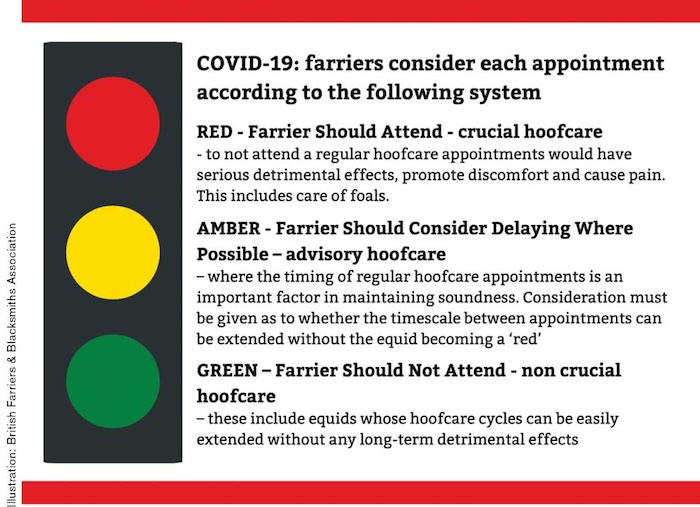
In 2020, the British Farriers & Blacksmiths Association divised the stoplight system to help farriers determine which hoof-care cases are most critical.
For the well-being of a farrier’s clients and business, it may also be necessary to set boundaries with an owner. If the farrier is aware that a horse is sick before a visit, depending on the farrier’s and owner’s biosecurity measures and the farrier’s comfort level, postponing a visit or saving it for the end of the day can be the best course of action. If the farrier suspects the horse is sick on arrival, notify the owner and assess the risk. If adequate biosecurity measures aren’t available and the farrier can’t reasonably ensure the safety of the rest of the day’s clients, consider returning at a later date.
Whether there is an infectious disease outbreak or a single horse is sick, having biosecurity measures ready to implement when needed can protect an entire community’s horses and livelihoods.