 Premium content is for our Digital-only and Premium subscribers. A Print-only subscription doesn't qualify. Please
American Farriers Journal
American Farriers Journal is the “hands-on” magazine for professional farriers, equine veterinarians and horse care product and service buyers.

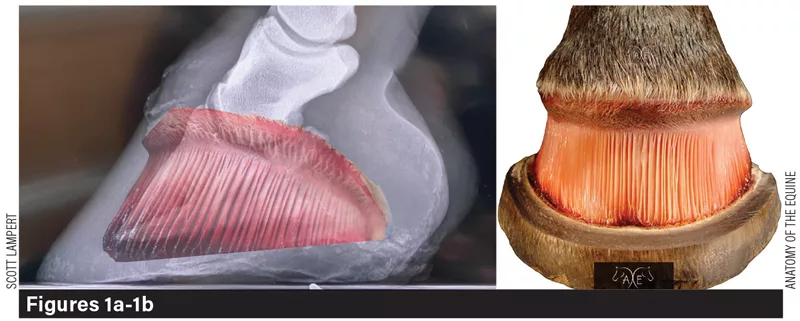
The horse’s laminae is the highly vascularized and innervated soft tissue structures that suspend and support the coffin bone within the hoof capsule. The tissues act like biological Velcro, securing the inner surface of the hoof wall to the coffin bone.
Laminitis is a term that can send shivers down the spine of any horse owner or equine professional. Historically associated with catastrophic hoof failure, career-ending lameness or even life-threatening consequences, the word alone carries weight.
Beyond the high-drama cases is a more insidious, often-overlooked form of the condition — one that quietly undermines the performance and well-being of sport horses around the world. I refer to it as performance laminitis. It’s real. It’s common. And it’s too often blindly disregarded until the damage is already done.
Let’s start with clarity. For the purpose of this article, laminitis refers simply to inflammation of the laminae — the highly vascularized and innervated soft tissue structures that suspend and support the coffin bone within the hoof capsule (Figures 1a & 1b). These tissues act like biological Velcro, securing the inner surface of the hoof wall to the coffin bone.
When defined in its literal sense as inflammation of the laminae, laminitis is extremely common among sport horses. In fact, I argue that upwards of 90% of all sport horses experience some degree of…
American Farriers Journal is the “hands-on” magazine for professional farriers, equine veterinarians and horse care product and service buyers.

American Farriers Journal is the “hands-on” magazine for professional farriers, equine veterinarians and horse care product and service buyers.
Download these helpful knowledge building tools


We are here to support you.
We stock a wide range of high-quality products from trusted brands to ensure durability, performance, and reliability in every job you undertake. Our extensive inventory of horseshoe products and farrier tools means you can find everything you need in one place, saving you time and effort. Your satisfaction is our top priority. We are committed to providing excellent customer service, prompt shipping, and hassle-free returns.
