After graduating from horseshoeing school, it’s tempting to believe that your education is complete. You have the foundations down. You’ve committed to the tools and equipment. You may apprentice and start building a client base. You’re eager to start your career.
Still, the first year or 2 or 3 can be daunting. You’ll encounter situations with horses, clients, vets and peers you won’t know how to navigate. Or you’ll wonder how other farriers deal with back pain or retirement planning. These street smarts come with time, the willingness to accept community support and continuing education.
Here, American Farriers Journal gathered advice from your peers to share with you in your first year after horseshoeing school.
Assess & Build Your Value
Don’t undervalue yourself. Keep apprenticing under someone. Develop mentors at local farrier associations. Going through the certification process usually puts you in a group of people that have a lot to share with one another. I believe certification is for yourself more than it is for the horse owners.
– Jimmy Petty, Concord, N.C.
Do your best and always give your best for the horses. Choose your mentor wisely and stay away from the ones who’ll ruin it for you. They may be more experienced but even they make mistakes. We are all human, after all.
– Adam Snyman, Gordon’s Bay, South Africa
The less you know, the more you think you know. A small amount of knowledge brings elevated confidence in your own skill and ability. (Nobel prize winning published psychology research — The Dunning Kruger Effect.)
– Shane Westman, Davis, Calif.
Find the best person who has the kind of shoeing business you want and is very successful, and see if they will mentor you. Do everything you can to keep learning all aspects of running a shoeing business on top of being a good horseshoer.
– Max Yasukawa, Honolulu, Hawaii
Work as an apprentice. Don’t worry about being the best. Absorb as many trim clients as you can. Go into debt buying the proper tools first. A good forge and a real anvil without a flat horn and turning cams will pay for itself 100 times over. Use your down time to study and compete.
– Chris Diehl, Spring Grove, Pa.
Be diligent with spending time in the fire. Attend every clinic and certification possible. Be patient for the first few years, and only take on good horses.
– Cody Harris, Pocatello, Idaho
Watch and listen to everything the experienced farriers do, and learn anything you can from them. The older guys can teach you a lot more than just shoeing a horse.
– Brett Lewis, Humboldt, Tenn.
Work harder toward certification and competition.
– Jared Brown, Hansonville, Va.
Running a Business
Take a business management class. Make sure the math works. You have to make a profit and not just survive on cash flow. Walk away from bad horses.
– Bradin Scott Schrader, Douds, Iowa
Pay yourself an hourly wage and put the rest in the bank.
– John Boston, Ravenna, Ohio
Don’t fight with bad horses and don’t start out pricing yourself too cheaply. Talk to the established farriers in the area you’ll be working in. See what they charge for the services they offer and stay close. You don’t want to look like you’re undercutting anyone. If you’re too cheap, I’ve found that will scare potential clients away as well because they assume you must not be very good.
– Johnny Carter, Caldwell, Idaho
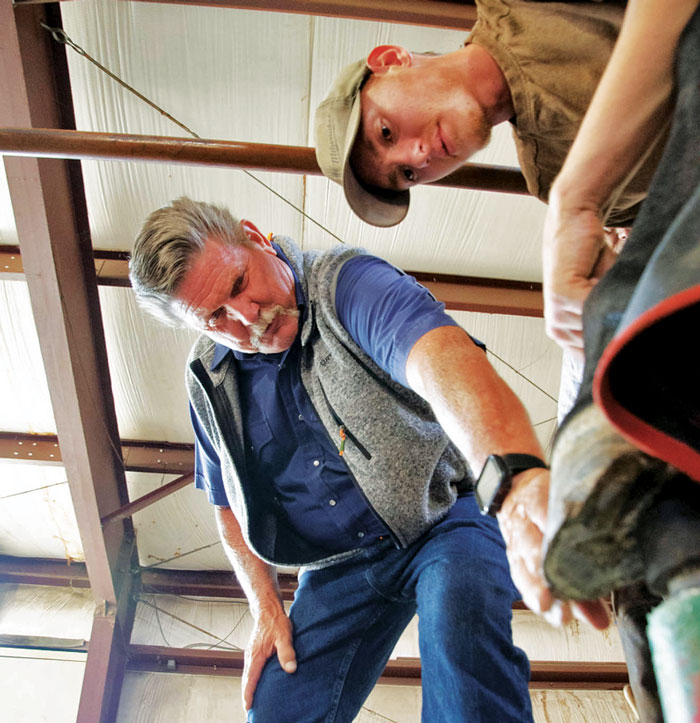
Find out what established farriers in your area are charging, and stay close with those prices. Jeff Cota
Set up some kind of retirement from day 1.
– Billy Walther, Oakley, Ill.
Try to not go in debt for your business. If you do, it’s just for tools. Shoe out of what you have until you can get a decent used vehicle. It’s crazy to shoe out of $50,000-$60,000 trucks.
– Wes Fleisher, Franklin, W.Va.
Even though you have to be “hungry” for work to allow your business to grow, there are still horses and clients you should just say no to.
– Dalton France, Pikeville, Ky.
Raise your prices for all your clients every year or two.
– Matthew Koch, Mills River, N.C.
Charge your worth. Don’t undersell yourself because you’re new. Charge to make a living. Know your ideal client and what you’re absolutely not going to deal with and hold to it as much as possible. It’s OK to walk away from a client and say no.
– Augusta Mae Wott, Fremont, Ohio
Choosing Your Clients
Refuse to work on badly behaved horses and clients who don’t stay on a schedule. Their horse’s feet are a billboard for your standard of care.
– Carrie Rule, Champaign, Ill.
Don’t ever say no. Charge until you like them and don’t be too accommodating for unaccommodating people.
– Georgette Roseke, Vinton, Iowa
Shoeing Advice
When I want to see if a foot is level, I fold a grain bag on the ground for a bright background to view against. It’s amazing what it can reveal.
– Brent Hrymak, Erickson, Manitoba
Some farriers will do anything to tarnish your name. Choose your colleagues wisely. Even the most experienced farriers make mistakes.
– Adam Snyman, Cape Town, South Africa
“No matter how much you think you are doing the right thing, if it’s not working, stop doing it.” – KC Barteld
– Billy Blackman, Havana, Fla.