Takeaways
- Establish personal and career goals and communicate them clearly to your mentor so they can help you achieve them. Build trust with your mentor by meeting their expectations and pushing yourself out of your comfort zone.
- Set yourself up for success by staying organized and being on time, which garners client respect.
- Build positive relationships with your peers and clients so that you can expand your business and customize it to fit your needs.
Becoming a farrier does not happen overnight, nor in a vacuum. Developing the shoeing and interpersonal skills, confidence and business know-how necessary to achieve your version of success often means learning from peers on the job. This takes time and guidance, which is why many farriers choose to become or take on apprentices.
“I came to this career late in life; I was 28 when I shod my first horse,” says Beck Ratte Randall, the U.S. Eventing Team farrier. “It was practically my second career, so I’d already built up a lot of life lessons that gave me a head start on a successful trajectory.”
Leaning on her mentor, retired U.S. Eventing Team farrier and Hall of Famer Steve Teichman, Ratte Randall says he helped set her up for success. This is partially thanks to open communication, including Teichman establishing clear expectations of Ratte Randall and her defining career goals so Teichman could help her reach them.
For any young person, it can be difficult to articulate long-term goals. They may not exist yet. However, giving yourself direction can help gain relevant experience while learning more about yourself and your ambitions along the way.
Ratte Randall started her adult life with a passion for horses and an art degree. After working for several sport horse training operations, she dipped her toe into farriery.
“I was shoeing, but I was a little dissatisfied,” she says. “I wanted an opportunity to travel, and lo and behold, I met a circus performer. They say, ‘We need a dressage rider who can join our tour, and we’re leaving for Australia in 2 months. Are you interested?’ Immediately, no holds barred, I dropped everything and ran away with the circus.”
The challenging and transitory nature of the circus helped Ratte Randall define her career goals more clearly and helped drive her back to farriery. She wanted to keep pushing herself, maintain her independence and travel. So, Teichman, who traveled frequently to shoe high-end horses, was a good match as a mentor.
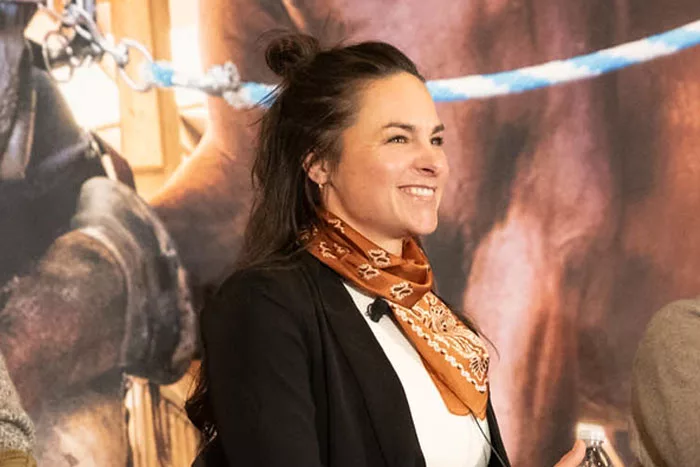
At the 2025 International Hoof-Care Summit, Ratte Randall spoke to a group of young professionals about how to set themselves up for success. For her, finding a mentor who complemented her goals was important. Now with her own assistants and operating a multi-state business, she emphasizes what worked for her might work for others.
Setting Goals
For Ratte Randall, success includes clearly articulated financial and personal goals, and she sets her business up to achieve them. Since she shoes farther away from home, one of her priorities is to keep her weekends work-free.
“I worked really hard for a long time to build trust and relationships with my peers and clientele so that I could put other people in place to do things like fix a lost shoe for me,” she says. “I decided that I was going to live in one location, and all of my clients were going to be in another. If you work hard enough, stay at it long enough and define what your ultimate goal is, you can make this career fit your needs.”
When she envisions success, it’s not just keeping her weekends to herself. It’s prioritizing vacations, activities and passions outside of work, such as the Aachen Horse Show in Germany, where some of her clients compete. Or, it’s making the time to pursue artistic endeavors.
Financial success for Ratte Randall is not simply about making a certain amount of money. It’s about investing that money into something that makes her happy, such as her horses.
“We all have bills to pay,” she says. “And I know they say money can’t buy happiness, but I’ve got a bunch of colts in my back field. I’ll tell you what, they make me happy watching them go. And if I can bring home money so I can buy another colt or rescue another horse and stick it out in my back field — much to my husband’s chagrin — I’m going to do it.”
“Show the clients and your mentor that you are someone who takes this seriously…”
If well-defined goals are intimidating, direction was enough of a starting point for Ratte Randall. A self-proclaimed daydreamer, she needed to continue to learn, explore and drive herself and her career forward. To prepare for these ambitions, she made sure to open the door whenever opportunity knocked.
“That might mean educating yourself, attending the International Hoof-Care Summit or just allowing yourself to have an open mind,” she says. “Opportunities will not always come in the way you think they should. Sometimes they come in odd packages, but you need to be able to see the bigger picture.”
Though not all opportunities directly influence career trajectory, taking the time to explore a passion, narrow down an interest or cross one off the list is not time wasted.
After shadowing the farrier on tour with the circus, Ratte Randall decided to leave and pursue horseshoeing again. Though she was open to whatever came her way, she also created her opportunities by riding along with local farriers on her off days. This allowed her to meet Teichman, whose business and mindset mirrored her ambitions.
Once she began learning from him, it was clear to Ratte Randall that shoeing was her calling. So, she dove in headfirst. Certain career goals had been established, but the details were yet to be realized.
“I’m always thinking about my next goal,” she says. “In working with Steve, I’m wondering if I want to trim and shoe my own horses. Do I want to work for a team? I’m constantly trying to define what it is I want or don’t want.”
Periodically checking in and reshaping your version of success can help you feel in control of your career. It could be affording a family, shoeing a certain discipline or competing on a team. Having direction or specific goals and communicating those to a mentor helps them help you.
Define Expectations
“One of the awesome things about this career is you’re getting paid to learn,” Ratte Randall says. “Know that not only is that mentor paying you to learn that job, they’re also paying for all the product you mess up. We all do. We all waste a pair of pads because we cut them wrong. We all overheat a pack of Equi-Thane. That all comes out of your mentor’s pocket.”
This is a normal part of hands-on education. It won’t be perfect — and it might not even be good — the first, second or 10th time. But it’s important to remember those mistakes, learn from them and appreciate the value of learning in a forgiving environment.
“They’re paying for our education, and they’re covering for us when we might mess up,” she says. “Your knife is the least useful tool in your toolbox. So, I over-pared some horses. I remember pulling off a pair of glue-on shoes, and I nipped the heel on that horse. The horse had a show coming up. Steve didn’t call me out to the client and covered for me. That’s money out of his pocket.”
Ratte Randall carries this mentality forward with her assistants. When one bled a foot, she had her assistant’s back. The subsequent extra driving, treatments, heart bars, hospital plates, time and energy came at no cost to the client.
This is the result of trust building and, as Ratte Randall puts it, becoming a mentor to clients as well. Down the line, this can open doors professionally and personally as a result of the respect earned and skill set demonstrated.
“They can lean on me and count on my education and knowledge,” she says. “As an apprentice, an assistant and a young professional, you’re attempting to build trust with clientele. And not just with them but with riders, grooms, staff, body workers and veterinarians. All those people need to be able to lean on you and believe that you have their back at the end of the day.”
One of the ways young professionals can earn this respect with their mentor and clients is for the mentor to establish expectations within the working relationship. This builds trust between the apprentice and farrier while establishing basic skills and etiquette.
For Ratte Randall, this is the key to success, and it’s important to break out of comfort zones to do it. Asking questions and being proactive in the learning process can feel unnatural when someone is not used to being assertive. However, doing it scared, uncomfortable or unsure is the only way to ensure it’ll be easier the second time. It also demonstrates to the mentor that the apprentice is enthusiastic and attentive.
“I knew what was expected of me for whatever pay I was getting, and I worked really hard to meet that expectation,” she says. “He knew that I wanted to be a professional in the future, so he devoted himself to making sure I had all the tools to do that. Working relationships go two ways. Not only do you know what their expectations of you are — how you’re supposed to work, show up and present yourself — but make sure they know yours too.”
With her own assistants, Ratte Randall’s expectation is to keep moving and stay off the phone. There’s always something more to be done, whether it’s sweeping, organizing the truck or retrieving a horse.
Keeping her workweek at 3-4 days instead of the traditional 5, she understands assistants may need additional sources of income to support themselves. Her assistant works with other farriers when Ratte Randall isn’t around, a relationship she says only works because of open communication.
“Make sure your mentor knows what it is you’re hoping to achieve,” she says. “They cannot help you if they don’t know. And this is on you to define for yourself as clearly as you can at any moment in time, while keeping an open mind that that might change.”
An apprenticeship is a long-term partnership. Ratte Randall emphasizes no one is a ready-made farrier right out of horseshoeing school, just like no one is an expert in their field after graduating with a 4-year degree.
“It’s too difficult of a job for you to not know what it is that you’re attempting to achieve,” she says. “Don’t short-change yourself by not knowing what those expectations are and having an unsuccessful relationship with your mentor.”
Set Yourself Up for Success
One of the easiest things Ratte Randall recommends to be successful is to dress professionally. For her, this means well-fitting clothes without rips or stains, a tucked shirt and hair out of the way.
“I attempt to be a chameleon. Where am I going? What do they expect? How can I present myself in a way that I immediately fit in? Is this faking it? Maybe a little bit, but we judge books by their cover. It’s a fact of life, and it’s something that you can use to your advantage,” she says.
She also hands out logos to her clients. It’s free advertising, and it builds brand trustworthiness. However, what truly builds a brand is consistent and reliable action. Organization is key in any business, and there are ways to make it less daunting if it’s a struggle.
“Opportunities will not always come in the way you think they should…”
Ratte Randall writes everything down in multiple places to ensure nothing is accidentally forgotten or overlooked, even including a whiteboard in every vehicle she drives. She keeps a daily list of the horses she’s working on and frequently utilizes Google Calendar to keep her weeks and months organized. The color coding, time blocking and repeatable events features help, she says, especially at the Olympics.
She also keeps ongoing notes on each horse, so she can go back 6 months and review a shoeing package, revisit an old prescription or look for cause and effect. Organization is a skill she had to cultivate and is the only way to do the best work possible without distraction.
Being on time is another key factor to gaining respect from clients and mentors. Whether this means blocking off time in a calendar, setting alarms, restructuring your day or even leaving yourself notes, showing up on time, organized and in professional attire goes a long way.
“All of this is going to show the clients, your mentor and those around you that you are someone who takes this seriously,” she says.
Build Positive Relationships
Having a career vision and executing it with the help of a mentor, defining personal and professional expectations and staying organized are necessary and important factors to a successful career. Though none of it is possible without building positive relationships with mentors, other farriers and clients.
Much of Ratte Randall’s success has been because she built relationships with her peers. As part of a team, the attending farrier has to believe that she’s going to do what she says she’ll do when shoeing, and she’s worked hard to build that trust. Forging positive relationships also extends to other local farriers. She keeps several people whom she trusts to step in when a horse loses a shoe if she can’t.
Trust is built through repeated, reliable actions, and one area farrier has demonstrated just that.
“He’s young and up and coming, and he gets into some really good barns. Why? Because he shows up and does what he says he’s going to do. He’s always very kind and open to criticism. He asks me if everything was OK, and he presents himself professionally. He isn’t trying to change my shoeing package or prove anything. He’s doing a great job of building a peer relationship,” she says.
Ratte Randall has set up her business so she’s always shoeing with another farrier to cover the excess work. Without people like him to count on, she couldn’t maintain her current caliber of work, take weekends off or travel as much as she does.
Along with positive relationships with peers, it’s important to do the same with clients.
“It is in your best interest long-term to give the client an explanation as to why you might do something different without bashing the farrier who was there before,” she says. “You don’t know what they were dealing with personally or professionally. Everybody’s at a different point in their learning.”
Young professionals may not be in a position to turn down a job. In those situations, taking a graceful approach can help diffuse any frustration with the client or the previous farrier.
“Maybe they were approaching the situation without all the education they needed,” she says. “Maybe they didn’t have a mentor to call and ask for information. If you have to take that client, just keep it in the back of your mind that if they talk badly about the previous farrier, they might talk badly about you in the future.”
However, as farriers build respect with their clients and peers, gain experience, knowledge and define career goals, it gets easier to customize your business to fit your needs. It’s natural to want this freedom right away, but putting in the time and hard work to make it happen can make it even more rewarding down the road.